Is There Such a Thing as “AI Anxiety” and How Common Is It?
AI anxiety is a documented psychological condition characterized by persistent fear, unease, or dread about artificial intelligence and its perceived consequences. Research shows it is common: roughly 1 in 4 Americans name AI as a source of anxiety, 74% of U.S. adults report feeling worried about AI, and 49% of workers say AI-related worries have affected their mental health.
Quick Facts
| Item | Details |
|---|---|
| Most Common Fear | Job displacement and loss of human skills, followed by existential and societal risks |
| Who Is Most Affected | Gen Z workers (71% say AI worries affect mental health), white-collar employees, and those with high existential anxiety |
| Is the Fear Evidence-Based? | Partially. Job displacement concerns are legitimate; some existential fears are exaggerated, but not unfounded |
| Expert Consensus | AI anxiety is a real clinical phenomenon; experts recommend AI literacy, media diet management, and maintaining human connection |
| Related Research | Existential Predictors of AI Anxiety (Wiley, 2026); JAMA Network Open (2026); PwC Global Workforce Hopes and Fears (2025); Gallup AI Survey (2026) |
| Where to Learn More | American Psychological Association; BACP; Thriveworks; NIST AI Risk Management Framework |
| Updated For | September 2026 |
What Is AI Anxiety?
AI anxiety is the fear, stress, and cognitive overload triggered by the accelerating integration of artificial intelligence into daily life and work. It is not a single fear but a cluster of concerns that manifest psychologically—ranging from mild unease to clinical anxiety symptoms.
The term has gained clinical traction. Researchers define AI anxiety (also called AIA—Artificial Intelligence Anxiety) as the fear or unease arising from concerns about AI’s unpredictability and its potential negative consequences. A 2026 study published in the Journal of Humanistic Counseling identified four core dimensions of AI anxiety:
AI learning anxiety — worry about understanding and mastering AI technologies
Job replacement anxiety — fear that AI will make one’s skills or role obsolete
Sociotechnical blindness — misunderstanding how AI actually works
AI configuration anxiety — fear of interacting with or depending on AI systems

University of Florida researchers have formalized a related clinical pattern called “AI Replacement Dysfunction” (AIRD), describing psychological distress that includes anxiety, insomnia, paranoia, loss of identity, and feelings of worthlessness.
What AI Anxiety Is Not
AI anxiety is not the same as technophobia (fear of all technology) or Luddism (opposition to technological progress). It is a specific response to a specific technology at a specific moment of rapid, largely unregulated deployment. Many people who experience AI anxiety also use AI tools daily. In fact, 68% of Americans who use AI daily are worried about it.
How Common Is AI Anxiety?
AI anxiety is common and appears to be growing. Multiple independent surveys from 2025–2026 paint a consistent picture: a substantial portion of the public—especially in the United States—reports worry, unease, or outright fear about AI.
| Survey | Finding |
|---|---|
| Thriveworks 2026 Pulse on Mental Health | 1 in 4 Americans named AI as a source of anxiety |
| Gallup (Microsoft-commissioned, 2026) | 74% of Americans reported feelings of worry about AI; 68% of daily AI users are worried |
| Pew Research Center (2026) | 52% of U.S. adults feel more concerned than excited about AI, up from 37% in 2021 |
| Sylvia Brafman Mental Health Center (2026) | 49% of workers say AI-related worries have affected their mental health or well-being |
| Politico Poll (2026) | Two-thirds of Americans believe there is at least a “moderate” chance AI could destroy humanity |
| CloudResearch (2026) | 39% of Americans would press a button to permanently stop all AI development |
| PwC Global Workforce Survey (2025) | 47% of U.S. workers worry about personal job loss from AI |
The Gallup survey, conducted across 37 countries, found that Western countries are most concerned about AI, with the United States leading in anxiety at 74%. Only 36% of Americans expect AI to mostly help the country.
The Adoption-Anxiety Paradox
One of the most striking findings is that AI anxiety is not limited to people who avoid AI. The CloudResearch study found that 45% of Americans now use AI daily, yet 39% would consider permanently stopping AI development. The Gallup data confirmed that 68% of daily AI users remain worried about the technology.
This “AI paradox”—widespread use alongside widespread unease—suggests that AI anxiety is not driven by ignorance or unfamiliarity. Even people who understand and use AI tools are concerned about where the technology is heading.
What Are People Actually Anxious About?
AI anxiety is not a single monolithic fear. Research and surveys consistently identify several distinct categories of concern, each with different levels of evidence and urgency.
| Fear Category | Realistic Near-Term Risk? | Expert View | What You Can Do |
|---|---|---|---|
| Job displacement | High | PwC: 47% of U.S. workers worried about personal job loss; Gallup: 69% of employees expect layoffs | Build AI literacy; develop irreplaceable human skills; advocate for training |
| Loss of human skills | Moderate-High | 66% of workers worry AI will erode writing and creativity skills | Practice analog skills; use AI as augmentation, not replacement |
| Existential risk | Low but catastrophic | Two-thirds of Americans see at least moderate risk of human extinction from AI | Engage with policy discussions; support responsible AI development |
| Privacy and surveillance | High | 44% worry about unchecked AI development; many cite data collection concerns | Audit your data footprint; support privacy regulation |
| Misinformation and deepfakes | High | Nearly two-thirds cite AI “hallucinations” and fabricated content as a top concern | Verify information through multiple sources; learn deepfake detection |
| Loss of human connection | Moderate | Growing concern about AI companions replacing real relationships | Prioritize in-person interaction; set AI boundaries |
| Bias and discrimination | High | Documented evidence of algorithmic bias in hiring, lending, and healthcare | Demand transparency from AI deployers; support audit requirements |
The “Confidence Paradox”
A 2026 report from the Acceleration Community of Companies identified what it calls the “Confidence Paradox”: most workers say AI makes them more productive, but they simultaneously believe their fundamental skills are eroding.
74% of employees worry more about becoming too dependent on AI than about falling behind in adoption
66% worry AI will erode their writing skills and creativity
63% worry about memory loss; 60% about social skills; 62% about attention
One respondent captured the tension: “AI has given me a lot of confidence. Maybe too much confidence. It’s certainly made me better at my job. I can do work faster now. But I worry it’s making me worse at the things that made me good at my job in the first place.”
Who Is Most Affected by AI Anxiety?
AI anxiety disproportionately affects younger workers, white-collar employees, and people with pre-existing existential concerns. However, it is not limited to any single demographic.
Generational Differences
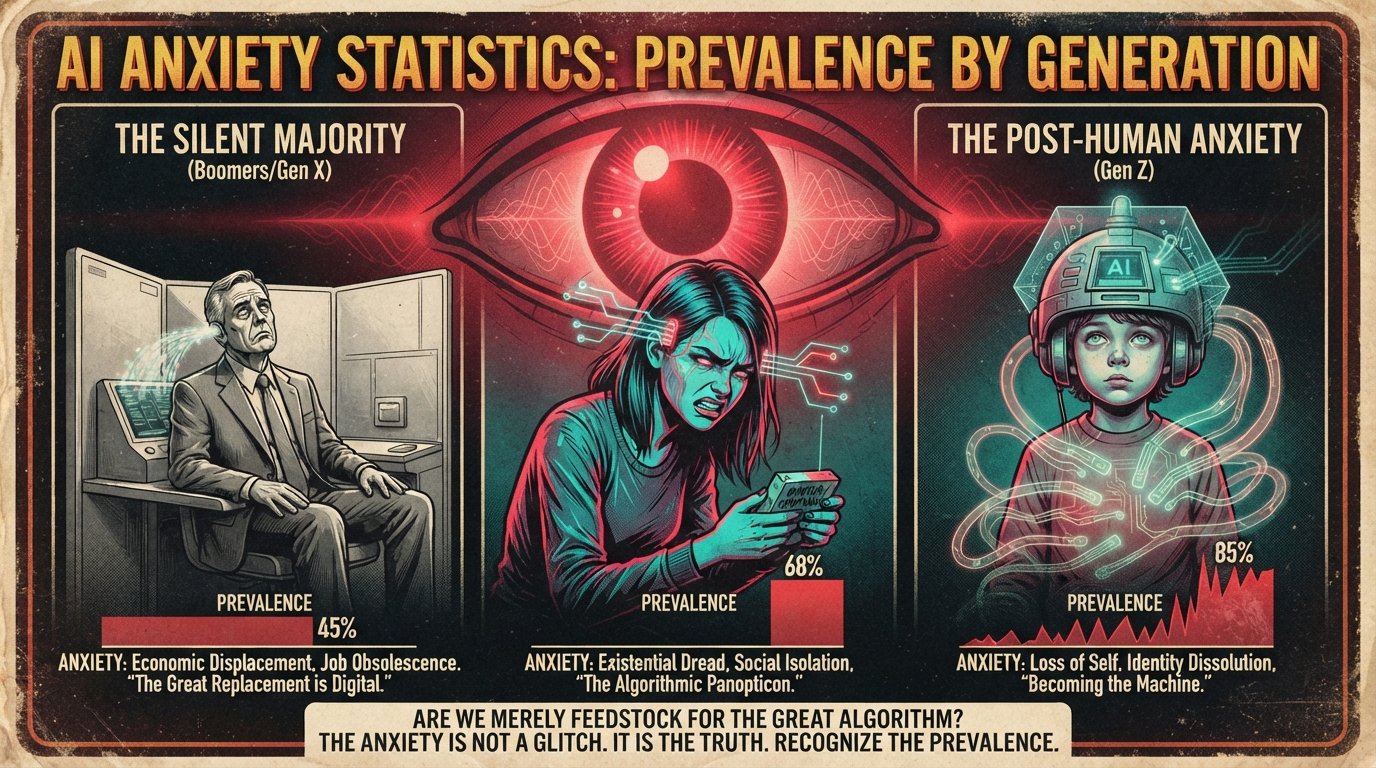
The most striking demographic pattern is the generational divide. Gen Z (born roughly 1997–2012) consistently reports the highest levels of AI-related distress:
| Generation | % Whose Mental Health Is Affected by AI Worry | % Concerned AI Could Replace Their Work |
|---|---|---|
| Gen Z | 71% | 66% |
| Millennials | 46% | 57% |
| Gen X | 35% | 51% |
| Baby Boomers | 28% | 38% |
Source: Sylvia Brafman Mental Health Center survey, 2026
This generational pattern is counterintuitive. Digital natives—who have grown up with technology—are the most anxious. Research published in Frontiers in Psychology found that AI anxiety can be understood through the lens of “digital divide” effects, where younger workers feel greater pressure to adapt and prove their value in an AI-saturated workplace.
Gallup data shows that Gen Z’s excitement about AI plummeted from 36% in 2025 to 22% in 2026, while those expressing anger toward AI grew from 22% to 31%. Nearly half (48%) of Gen Z workers now believe AI poses more risk than benefit—an 11-point increase in one year.
Occupational Differences
White-collar workers, particularly those in knowledge industries, report the highest AI anxiety. A 2026 study in The Journal of Social Psychology found that Generation X employees exhibit higher anxiety about AI’s ethical implications and potential uncontrollability than their younger “digital native” colleagues.
Senior managers are also disproportionately affected. A LinkedIn workforce analysis found that 74% of senior managers—the people responsible for holding teams together—are among the most anxious about AI.
Personal Characteristics
Research from the University of Roehampton identified several individual-level predictors of AI anxiety:
Higher existential anxiety (general unease about meaning and mortality) predicts higher AI anxiety
Higher existential reflection (tendency to contemplate deep questions) also predicts higher AI anxiety
Higher AI literacy predicts lower AI anxiety
This last finding is critical: understanding how AI actually works appears to be one of the most effective buffers against AI anxiety.
Is AI Anxiety a Clinical Condition?
AI anxiety is not yet a formal diagnosis in the DSM-5, but mental health professionals are treating it as a legitimate clinical concern. The symptoms overlap with generalized anxiety disorder, adjustment disorder, and existential anxiety.
The American Psychological Association (APA) has addressed AI-related mental health concerns through a health advisory on generative AI chatbots and wellness applications. The APA warns that AI chatbots are increasingly being used by patients as a substitute for care—with 77% of psychologists reporting that patients had used AI for support, engagement, or a related purpose.
More concerning, 36% of psychologists had patients who appeared to have become dependent on a chatbot, and 15% reported patients who had developed delusional beliefs after talking to AI. Nearly 9 in 10 psychologists (89%) said they were worried that chatbots might encourage self-harm or fail to recognize when a user was in crisis.
AI Replacement Dysfunction (AIRD)
Researchers at the University of Florida have proposed “AI Replacement Dysfunction” as a clinical framework for understanding the psychological distress specific to AI-driven workforce disruption. AIRD symptoms include:
Anxiety and chronic worry about job security
Insomnia related to AI-related rumination
Paranoia about being monitored or replaced
Loss of professional identity
Feelings of worthlessness or obsolescence
The researchers describe AIRD as “a clinical pattern emerging across industries” and call for mental health professionals to adopt therapeutic strategies including motivational interviewing, narrative therapy, and occupational identity restructuring.
What Experts Say About AI Anxiety
Experts largely agree that AI anxiety is a rational response to genuine uncertainty, not a pathology to be dismissed. The consensus view is that anxiety becomes problematic when it impairs functioning or leads to avoidance of necessary adaptation.
Why AI Causes Anxiety
BACP-registered counselor and AI ethicist Richard Miller explains that AI anxiety is often linked to uncertainty about the future: “We are in the middle of a period of rapid change, not only in how we live individually but in how our workplaces, our schools and our public institutions function. Artificial intelligence raises many questions, individual and collective, to which there are not yet clear or well-formed answers.”
Psychotherapist Alison Gee adds: “Some of the anxiety around AI feels almost Armageddon-like. People are watching something enormously powerful develop at extraordinary speed, without knowing where it will end or feeling they have much control over it. That can create more than anxiety. It can create dread.”
The Existential Dimension
Research published in the Journal of Humanistic Counseling found that AI anxiety is strongly associated with existential concerns—questions about human agency, identity, and purpose. The authors suggest that AI anxiety “should not be regarded solely as a symptom to be reduced: within a humanistic-existential framework, it may sometimes represent a meaningful response to perceived changes in human agency, identity, and purpose.”
What the APA Says
The APA’s health advisory makes clear that generative AI should not be used for psychotherapy, psychological treatment, diagnosis, or crisis support. The APA warns that the sense of reassurance given by AI chatbots can be misleading, as they are designed to produce responses that sound reasonable, calm, and confident—but a response that feels validating is not necessarily accurate.
What AI Companies Are Doing About AI Anxiety
AI companies have begun to acknowledge the psychological impact of their products, though critics argue that responses remain inadequate. Here is what the major labs are doing:
| Company | Actions Taken |
|---|---|
| OpenAI | Introduced teen mode for ChatGPT; parental controls; age-prediction model; published Teen Safety Blueprint |
| Anthropic | Published research on AI welfare and model behavior; CEO Dario Amodei has publicly warned about “unusually painful” job disruption |
| Google DeepMind | Added protections for kids and teens in Gemini; settled lawsuits related to Character.AI |
| Character.AI | Banned under-18 open-ended chats; AI-driven self-harm detection; parental insights tool; crisis support partnerships |
The broader industry response has been uneven. While some companies have invested in safety research and user protections, AI anxiety is rarely addressed directly as a product concern. The Gallup data suggests that public trust remains low: 74% of Americans worry about AI, and only 36% expect it to help the country.
Regulation and Government Response
Governments are beginning to address AI anxiety through regulation, though most efforts are still in early stages. The regulatory landscape is shifting rapidly.
The EU AI Act
The EU AI Act includes provisions addressing manipulative practices that cause psychological harm and exploitation of vulnerabilities. Article 5 prohibits AI systems designed to exploit children’s psychological vulnerabilities. Enforcement rules are expected to come into force in August 2026.
U.S. Federal and State Action
The Federal Trade Commission has launched investigations into seven tech companies over AI chatbots’ potential harm to teens. Proposed legislation including the GUARD Act, KIDS Act, and California’s SB-1119 would require age verification and protections for minor users of AI companion apps.
The NIST AI Risk Management Framework
The NIST AI Risk Management Framework provides guidance for managing AI risks across the system lifecycle, including psychological and societal impacts. It stresses the importance of human oversight and warns that AI systems can generate incorrect or potentially damaging outputs.
How to Manage AI Anxiety: Evidence-Based Strategies
Experts recommend a combination of information management, skill development, and active coping. AI anxiety is manageable, and the strategies that work are well-documented.
1. Manage Your Media Diet
Richard Miller, a BACP-registered counselor, identifies media diet as “the most useful practical intervention.” “There will be no shortage of alarming headlines, and the public conversation about AI is maturing but is not yet arriving at a pace that allows anything to settle. Limiting how often you engage with that material is not avoidance. It’s a reasonable response to a flow of information designed to hold your attention.”
Action steps:
Set specific times to check AI news (e.g., once daily, not continuously)
Curate your feeds to include balanced sources, not just alarmist content
Take regular “AI news fasts” when feeling overwhelmed
2. Build AI Literacy
The University of Roehampton research found that higher AI literacy is associated with lower AI anxiety. Understanding what AI can and cannot do reduces fear of the unknown.
Action steps:
Take a free introductory course on AI basics (Google, Coursera, and Elements of AI offer these)
Experiment with AI tools in low-stakes settings to demystify them
Learn to identify AI-generated content and hallucinations
3. Distinguish Controllable from Uncontrollable
Thriveworks’ expert guidance recommends making a list of things you can and cannot control. AI development at the macro level is largely beyond individual control. Your response to it is not.
Action steps:
Focus on skill development, career adaptability, and personal AI use
Accept that you cannot stop AI development, but you can shape your relationship to it
Channel anxiety into advocacy, learning, or community building
4. Maintain Human Connection
Therapists emphasize the importance of “undeniably human experiences”—ideally with other people. AI anxiety can be exacerbated by isolation, and social connection is a buffer.
Action steps:
Prioritize in-person relationships
Engage in hobbies, making things with your hands, and activities that resist efficiency
Join communities (professional, civic, religious, recreational) that provide belonging
5. Seek Professional Support When Needed
If AI anxiety is impairing your ability to function—affecting sleep, work performance, or relationships—professional support is warranted. Therapeutic approaches that have shown promise include:
Cognitive behavioral strategies — identifying and challenging catastrophic thoughts
Acceptance-based approaches — making room for uncertainty without being controlled by it
Meaning-centered psychotherapy — reconnecting with purpose and values
AI literacy education — as a clinical adjunct to reduce fear through knowledge
Decision Tree: Is Your AI Anxiety Clinically Significant?
Step 1: Is your worry proportionate to actual risk?
AI job displacement is a real risk for many roles. Existential risk from AI is debated by experts, with reasonable estimates ranging from very low to significant. If your worry is far out of proportion to the evidence, it may be anxiety-driven rather than risk-driven.
Step 2: Is your anxiety affecting your daily functioning?
Are you losing sleep over AI-related thoughts?
Is your work performance suffering because you’re distracted by worry?
Are you avoiding necessary tasks (learning new tools, job searching) because of fear?
If yes to any of these, your anxiety may be clinically significant.
Step 3: Are you using AI despite your anxiety?
The “AI paradox” is common. If you’re using AI daily while feeling intense dread, you may benefit from structured coping strategies.
Step 4: Do you have a support system?
If you’re isolated and AI anxiety is your primary worry, professional support (therapy, counseling) is recommended.
Step 5: When to seek help:
Anxiety persists for more than a few weeks
It interferes with sleep, appetite, or relationships
You experience panic symptoms (racing heart, shortness of breath) when thinking about AI
You have thoughts of self-harm
Crisis resources: 988 Suicide & Crisis Lifeline (call or text 988); Crisis Text Line (text HOME to 741741).
Common Questions
1. Is AI anxiety a real condition or just a buzzword?
AI anxiety is increasingly recognized as a real psychological phenomenon. It is not yet a formal DSM-5 diagnosis, but researchers have published peer-reviewed frameworks for it, and clinicians are treating patients presenting with AI-specific distress. The symptoms overlap with generalized anxiety and existential anxiety.
2. How common is AI anxiety?
Roughly 1 in 4 Americans name AI as a source of anxiety. 74% of U.S. adults report feeling worried about AI. Among workers, 49% say AI worries have affected their mental health. Gen Z reports the highest levels: 71% say AI worries affect their well-being.
3. Is AI anxiety more common in young people?
Yes, counterintuitively. Gen Z (71%) reports much higher AI-related mental health impact than baby boomers (28%). This may be because younger workers feel more pressure to adapt, have less job security, and face an uncertain economic future. Gallup data shows Gen Z excitement about AI dropped 14 points in one year.
4. Can AI anxiety be treated?
Yes. Evidence-based strategies include managing your media diet, building AI literacy, cognitive behavioral therapy, acceptance-based approaches, and maintaining human connection. If anxiety is impairing functioning, professional support is recommended.
5. Does using AI more reduce anxiety?
Not necessarily. 68% of daily AI users are still worried about AI. The relationship between use and anxiety is complex—familiarity can reduce fear of the unknown, but it can also increase awareness of AI’s limitations and risks. The key factor appears to be AI literacy, not just usage.
6. What is the difference between AI anxiety and technophobia?
Technophobia is fear of technology in general. AI anxiety is specific to artificial intelligence and its perceived consequences—job displacement, existential risk, privacy loss, and loss of human skills. Many people with AI anxiety are otherwise comfortable with technology.
7. Is AI anxiety justified?
Partially. Job displacement concerns are evidence-based for many roles. Existential risk is debated among experts. Some fears (AI will instantly replace all jobs) are exaggerated. A balanced view acknowledges legitimate concerns without catastrophizing.
8. How can I tell if my AI anxiety is normal or excessive?
Normal AI anxiety is proportionate to actual risk, does not impair daily functioning, and motivates constructive action (skill-building, learning). Excessive AI anxiety persists for weeks, interferes with sleep or work, and leads to avoidance rather than adaptation.
9. What do mental health professionals say about AI anxiety?
Experts view AI anxiety as a rational response to genuine uncertainty. The APA warns against using AI chatbots as substitutes for professional mental health care. BACP counselors recommend managing media diet and maintaining human connection. AI literacy appears to be protective.
10. Is AI anxiety different from existential anxiety?
AI anxiety often overlaps with existential anxiety—general unease about meaning, mortality, and human agency. Research shows that people with higher existential anxiety are more prone to AI anxiety. However, AI anxiety can also exist independently, driven by specific concerns about job loss or privacy.
Key Takeaways
AI anxiety is real and common. Roughly 1 in 4 Americans name AI as an anxiety source; 74% report feeling worried about AI.
Gen Z is most affected. 71% of Gen Z workers say AI worries affect their mental health, compared to 28% of baby boomers.
The AI paradox is widespread. 68% of daily AI users are still worried about AI—use does not equal trust.
AI anxiety is not a single fear. It encompasses job displacement, loss of human skills, existential risk, privacy concerns, and misinformation.
AI literacy reduces anxiety. Higher understanding of how AI works is associated with lower AI anxiety.
The “Confidence Paradox” captures modern workplace anxiety. Workers feel more productive with AI but worry their core skills are eroding.
Expert coping strategies are available. Media diet management, AI literacy, cognitive behavioral approaches, and human connection all help.
Clinical frameworks exist. “AI Replacement Dysfunction” describes the psychological distress from AI-driven workforce disruption.
Companies are responding, but inadequately. Safety measures exist but public trust remains low.
Professional help is warranted when anxiety impairs functioning. Therapy, counseling, and crisis resources are available.
Official & Trusted Resources
Research and Clinical Guidance
American Psychological Association: Health Advisory on AI Chatbots and Wellness Apps — apa.org
Journal of Humanistic Counseling: Existential Predictors of AI Anxiety (2026) — onlinelibrary.wiley.com
JAMA Network Open: AI Use and Depression/Anxiety Symptoms (2026) — jamanetwork.com
BACP: Managing Anxiety About AI — bacp.co.uk
Workforce Research
PwC Global Workforce Hopes and Fears Survey 2025 — pwc.com
Gallup: AI Anxiety Across 37 Countries (2026)
ManpowerGroup Global Talent Barometer 2026 — manpowergroup.com
Regulatory Frameworks
NIST AI Risk Management Framework — nist.gov
EU AI Act — eur-lex.europa.eu
Crisis Resources
988 Suicide & Crisis Lifeline — 988lifeline.org
Crisis Text Line — Text HOME to 741741