
Jobs Safe From AI in 2026: Evidence-Based Guide to AI-Resistant Careers
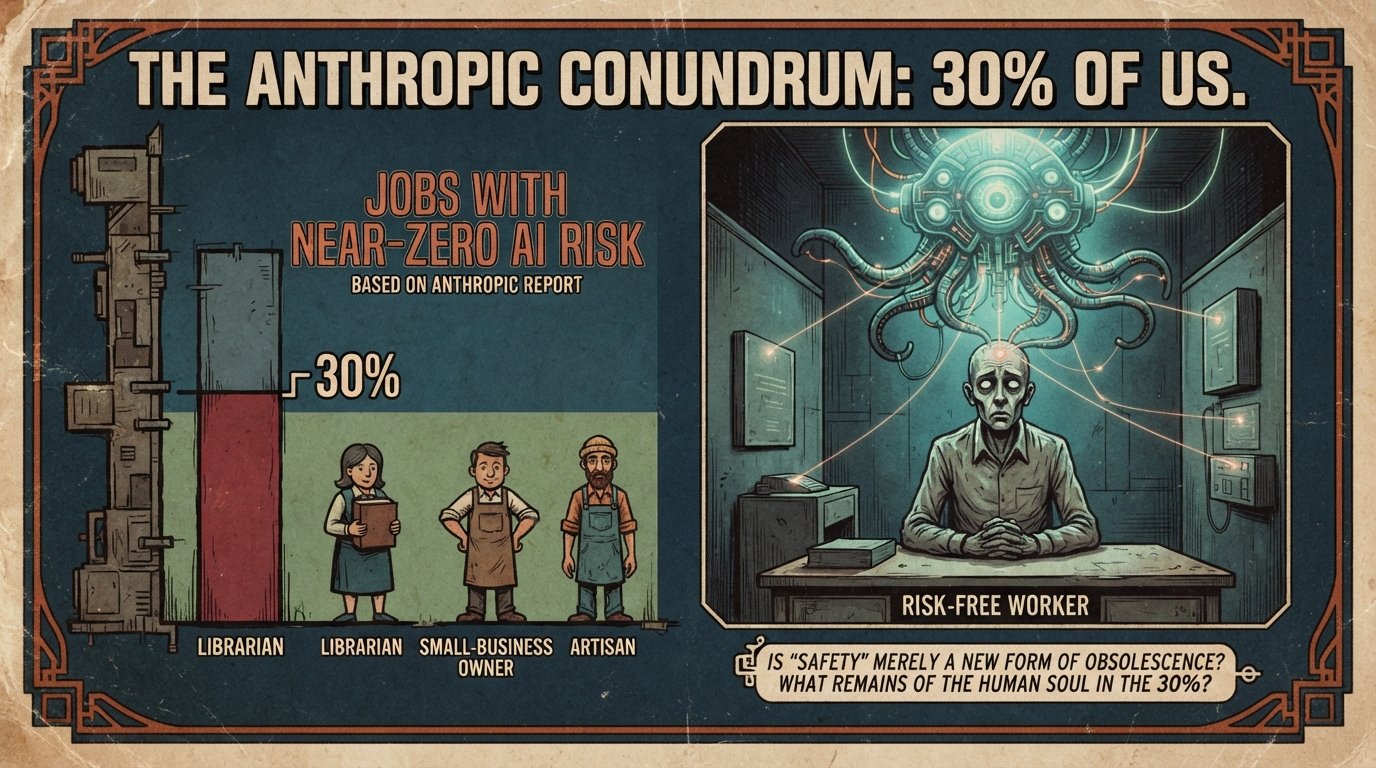
About 30% of jobs face almost zero risk of AI elimination, according to Anthropic’s 2026 labor market report. The safest roles share three traits: physical work, in-person service, and real-world manipulation. Anthropic’s specific examples include cooks, motorcycle mechanics, lifeguards, bartenders, dishwashers, and dressing room attendants. Jobs most at risk involve computers and data.
Quick Facts
| Item | Details |
|---|---|
| Most Common Fear | AI will eliminate jobs faster than the economy creates new ones, particularly entry-level and white-collar roles |
| Who Is Most Affected | Workers aged 22–25 in AI-exposed occupations; routine clerical and data-processing roles; lower-wage workers |
| Is the Fear Evidence-Based? | Partially. No widespread economy-wide displacement yet, but young workers in AI-exposed roles face a 19% employment gap (Stanford, 2026) |
| Expert Consensus | AI is unlikely to cause mass unemployment. Goldman Sachs estimates 9% of U.S. workers (15 million) displaced over 10 years. McKinsey projects 11 million occupational changes by 2035. 30% of jobs face near-zero AI risk |
| Related Research | Anthropic Labor Market Impacts (Mar 2026), Stanford Digital Economy Lab “Canaries in the Coal Mine” (Aug 2026), Goldman Sachs Top of Mind (Jun 2026), McKinsey “Workforce in Motion” (Sep 2026), Pew Research 37-Country Survey (Sep 2026), Atlanta Fed Working Paper 2026-4 (Mar 2026) |
| Where to Learn More | Anthropic Economic Index, Stanford Digital Economy Lab, Goldman Sachs Research, McKinsey Global Institute, NIST AI RMF |
| Updated For | October 2026 |
What Makes a Job Safe From AI?
A job is safe from AI when it requires physical presence, real-world manipulation, or human relationships that cannot be digitized. Anthropic’s March 2026 labor market report found that 30% of jobs have almost zero risk of AI elimination.
The common denominators are clear: physical work, in-person service, and real-world manipulation. These are tasks that require a body in a specific place doing something with objects or people that cannot be reduced to text, code, or data.
Anthropic’s report identified six specific examples of least-AI-exposed jobs:
Cooks
Motorcycle mechanics
Lifeguards
Bartenders
Dishwashers
Dressing room attendants
These are not necessarily high-paying or prestigious roles. But they share a fundamental characteristic: AI has no physical form. A large language model can generate a recipe, diagnose a motorcycle problem from error codes, or write a lifeguard training manual. It cannot flip a burger, replace a carburetor, or pull a drowning swimmer from a pool.
The broader categories that share this protection include:
Food service jobs (cooks of all kinds, servers, food preparers)
Hospitality jobs (housekeepers, attendants, hotel staff)
Maintenance and repair jobs (technicians, mechanics, HVAC specialists)
Physical trades and manual labor (carpenters, roofers, plumbers, electricians)
Agriculture and outdoor labor (farm workers, ranch hands, arborists)
Safety and supervision work (guards, crowd control, ski patrol)
Personal service jobs (stylists, massage therapists, tattoo artists)
What this means for workers: If your job requires you to physically manipulate the world or care for people in person, you have significant protection from AI displacement. The protection is not absolute — automation in food service and retail has been advancing for decades — but AI specifically does not threaten these roles in the same way it threatens knowledge work.
The Three Pillars of AI-Resistant Work
AI-resistant work rests on three pillars: physical dexterity, human relationships, and high-stakes judgment. Jobs that combine two or more of these pillars are the most protected.
Pillar 1: Physical Dexterity and Real-World Manipulation
Jobs requiring hands-on physical skill are highly resistant to AI because current AI systems have no embodiment.
Robotics has advanced significantly, but robots remain far less capable than humans at manipulating objects in unstructured environments. A robot can weld a car on an assembly line. It cannot diagnose why a specific motorcycle is making a strange noise, order the right part, and install it in a cramped garage.
Occupations in this category include:
Electricians and plumbers
HVAC technicians
Welders and machinists
Automotive and motorcycle mechanics
Construction workers (carpenters, roofers, ironworkers)
Wind turbine technicians
Solar photovoltaic installers
Tree trimmers and arborists
A Resume Now analysis found that tree trimmers and pruners, structural iron and steel workers, and derrick operators in oil and gas rank among the most AI-resistant occupations based on physical skill requirements.
Pillar 2: Human Relationships and Emotional Intelligence
Jobs centered on human connection, empathy, and trust are resistant to AI because these qualities cannot be replicated by software.
AI can analyze language. It cannot read a room. It cannot sit with a grieving family, manage a team through a crisis, or build the trust required for a therapist-client relationship.
Occupations in this category include:
Registered nurses and nurse practitioners
Physical therapists
Occupational therapy assistants
Mental health counselors and social workers
Physicians and surgeons
Veterinarians
Teachers and educators
Emergency medical technicians (EMTs) and paramedics
The World Economic Forum’s Future of Jobs Report identifies empathy, emotional intelligence, and relationship-building as among the fastest-growing required skills across industries through 2030.
Pillar 3: High-Stakes Decision-Making and Accountability
Jobs that require real-time judgment under pressure, with consequences for failure, are resistant to AI because accountability cannot be delegated to software.
AI can inform decisions. It cannot be held responsible for them. A surgeon who makes a split-second call during a complication owns that decision. A CEO who bets the company on a strategy owns that outcome. A lawyer who advises a client owns that counsel.
Occupations in this category include:
Surgeons and emergency physicians
Nurse anesthetists
CEOs and senior executives
Attorneys and judges
Airline pilots and flight engineers
Firefighters
Police officers and detectives
The AI-Resistant Careers Index from Resume Now identified 20 high-paying jobs least likely to be replaced by automation, based on three human skills: adaptability, stress tolerance, and self-control. Healthcare roles consistently rank among the most resistant because they require real-time judgment when situations change unexpectedly.
30% of Jobs Have Near-Zero AI Risk: The Anthropic Data
Anthropic’s March 2026 report, based on analysis of millions of job tasks, found that 30% of jobs have almost zero risk of AI elimination. These jobs cluster in physical work, in-person service, and manual labor.
The report, titled “Labor Market Impacts of AI,” used Anthropic’s own usage data to measure which tasks its Claude AI model could perform. By comparing that task coverage to actual occupational task requirements, the company created a vulnerability index.
Key findings from the Anthropic report:
30% of jobs have almost zero risk of AI elimination
Jobs involving computers and data are most at risk
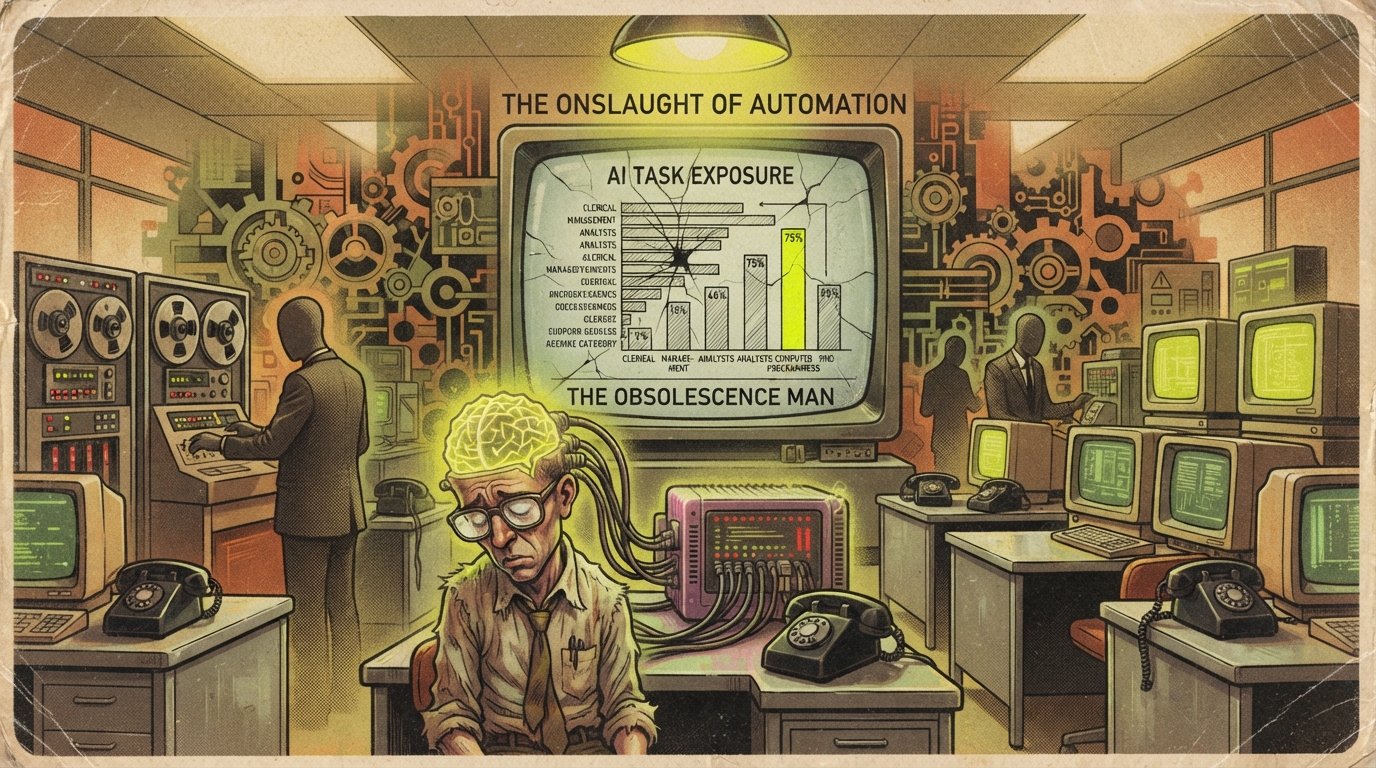
Computer programmers carry 75% task coverage — meaning AI can perform 75% of their tasks
Customer service representatives and financial analysts also rank among the most exposed
People in the most AI-exposed occupations tend to be older, more educated, more likely to be women, and higher-paid
Hiring of young workers in the most-exposed occupations is slowing, with a 16% fall in employment for people aged 22 to 25
The report also noted a concerning trend: there is a risk of a “great recession” for white-collar workers, even as physical labor markets remain tight.
What this means: The AI displacement story is not uniform. It is a story about cognitive work being automated while physical work remains largely untouched. If you work with your hands or care for people in person, you are in the protected 30%. If you work primarily with data, documents, or code, you are in the exposed 70%.
The 19% Employment Gap for Young Workers
The most concerning labor market signal is not mass unemployment but the widening employment gap for young workers in AI-exposed occupations. Stanford’s research shows a 19% gap for workers aged 22 to 25 as of mid-2026, up from 15% in 2025.
The Stanford Digital Economy Lab’s “Canaries in the Coal Mine” paper, updated in August 2026, analyzed ADP payroll data through June 2026. The findings are clear:
No widespread economy-wide job displacement from AI
But employment for 22-to-25-year-olds in AI-exposed occupations now runs 19% below where it would be had it tracked their less-exposed peers
The gap is driven by reduced hiring rather than increased separations
Older workers and workers in less-exposed jobs are doing much better
Workers who use AI mainly to automate work had the largest employment declines
Workers who use AI to complement their work did much better
What this means for young workers: Entry-level roles in AI-exposed fields — software development, customer service, financial analysis, data processing — are being disproportionately affected. Companies are not firing experienced workers. They are simply not hiring junior staff for roles that AI can now handle.
The protection against this trend is twofold:
Choose occupations in the protected 30% — physical work, healthcare, skilled trades, education
If you work in an AI-exposed field, develop tacit knowledge — the kind you can only get through experience, mentorship, and real-world practice
Goldman Sachs: 15 Million Workers Displaced Over 10 Years
Goldman Sachs estimates that more than 9% of the U.S. workforce — roughly 15 million workers — could be displaced during a 10-year AI transition. But the bank does not expect a job apocalypse.
Goldman Sachs Research economist Joseph Briggs has stated: “We’re not expecting that displaced workers will be displaced over the long run. We do expect that ultimately there are going to be more than enough jobs created to accommodate them.”
The bank’s baseline forecast:
Around 9% of U.S. workers will be reallocated to new positions during the AI transition
That corresponds to 15 million workers leaving or being displaced from their positions
The displacement will be spread over a 10-year period
The unemployment rate increase in any given year will likely be less than one percentage point
AI has reduced monthly payroll growth by roughly 16,000 jobs in the past year
Employment in call centers, software publishing, management consulting, and advertising services has fallen sharply below trend
Goldman Sachs CEO David Solomon has publicly stated he does not predict a major white-collar wipeout. Citing internal analysis, he said AI could automate roughly 25% of current work hours over the next decade — but argued that this would not translate into equivalent job losses.
What this means for workers: If you work in an AI-exposed occupation, you have roughly a 1-in-10 chance of needing to change jobs within the next decade. The risk is higher for younger, less experienced workers and those in routine knowledge work. The risk is lower for physical trades, healthcare, education, and roles requiring human relationships.
McKinsey: 11 Million Workers Need New Occupations
McKinsey Global Institute projects that about 11 million American workers — roughly 7% of the workforce — will need to leave their occupations entirely by 2035 because of AI-related displacement.
The firm’s September 2026 report, “Workforce in Motion,” projects that AI and automation will cut demand for about 36 million U.S. jobs by 2035, while growth elsewhere creates about 41 million. The net result is positive, but the transition is the challenge.
Key findings:
About 770,000 people per year would need to make an occupational switch — roughly 3.6 times the historical average
Lower-wage workers are 7.6 times as likely as higher-wage workers to need a new occupation
Only one in seven displaced workers has a direct path into a growing job that requires little retraining and pays at least as much
Nearly half face an “unpaved” path blocked by large skill gaps or credential requirements
About 85% of growing jobs require a credential
Shrinking jobs are concentrated in office and administrative support, retail, and transportation
Job growth is in healthcare, construction, and management
“The next decade’s challenge is mobility, not scarcity,” the authors wrote.
What this means for workers: The jobs will exist, but getting into them is the problem. Workers in declining roles — particularly lower-wage administrative and retail positions — face the steepest climb. Credentials and retraining will be essential for most transitions. The safest path is to choose a field with growing demand and low AI exposure from the start.
Comparison: Jobs at Risk vs. Jobs Safe From AI
| Occupation | AI Exposure Level | Key Protection Factor | Near-Term Risk |
|---|---|---|---|
| Software developers | Very High (75% task coverage) | High salaries create transition buffer; senior roles more protected | High for entry-level; moderate for senior |
| Customer service representatives | Very High (70% task coverage) | Human escalation for complex issues | High; voice AI achieving 95% accuracy |
| Data entry keyers | Very High (67% task coverage) | Limited transferable skills | Very High |
| Financial analysts | High (60-70% task coverage) | Regulatory requirements; client relationships | Moderate to High |
| Writers and authors | High (57% task coverage) | Originality, voice, and creative direction remain human | Moderate to High |
| Radiologists | Moderate (professionalized role) | AI augments rather than replaces; demand growing | Low |
| Registered nurses | Low | Hands-on care, patient relationships | Very Low |
| Electricians | Very Low | Physical dexterity, situational judgment | Very Low |
| Cooks | Very Low | Physical work, real-world manipulation | Very Low |
| Motorcycle mechanics | Very Low | Diagnostic judgment, physical repair | Very Low |
| Lifeguards | Very Low | Physical presence, real-time rescue judgment | Very Low |
| Physical therapists | Very Low | Hands-on treatment, patient relationships | Very Low |
| Firefighters | Very Low | Physical rescue, high-stakes judgment | Very Low |
| EMTs and paramedics | Very Low (7% automation risk) | Emergency response, physical care | Very Low |
| CEOs and senior executives | Low | Accountability, strategic judgment | Low |
PwC: AI-Exposed Jobs Are Growing, Not Shrinking
A counterintuitive finding from PwC’s 2026 AI Jobs Barometer: AI-exposed entry-level roles have grown 35% since 2019, while other entry-level roles declined 10%.
PwC’s analysis of global job postings found that AI is splitting the labor market into two tracks:
Track 1: “Professionalised” roles — Jobs reshaped by AI to demand more expertise, judgment, and creativity. Examples include radiologists, employment recruiters, and air traffic controllers. These roles are seeing twice the job growth and 42% faster salary increases compared to less-exposed roles.
Track 2: “Automated” roles — Jobs where AI performs routine tasks, reducing demand for human labor. Examples include software developers, loan officers, and finance managers.
AI-specific jobs are growing 69% annually — eight times faster than the overall market. The World Economic Forum estimates that AI has already created more than 1.3 million new jobs, including AI engineers, data annotators, and AI ethics officers.
What this means: The AI job market is not simply destructive. It is transformative. Some roles are growing because AI makes workers more valuable. Others are shrinking because AI makes workers less necessary. The key is to be in a role where AI amplifies your value rather than replacing it.
What the IMF and ILO Say About AI and Jobs
The International Monetary Fund estimates that nearly 40% of jobs globally are exposed to AI, with exposure rising to 60% in advanced economies. The ILO finds that one in four jobs worldwide is potentially exposed to generative AI.
These are exposure estimates, not elimination estimates. Exposure means that AI can perform some or all of the tasks in a given occupation. It does not mean the occupation will disappear.
Key findings from international research:
The IMF estimates that nearly 40% of jobs globally are exposed to AI
Exposure rises to 60% in advanced economies, where cognitive and white-collar work is more prevalent
The ILO-NASK Global Index finds that 25% of global employment falls within occupations potentially exposed to GenAI
Higher shares in high-income countries (34%) compared to lower-income countries
The World Economic Forum’s 2025 Future of Jobs analysis indicates that tens of millions of roles will be displaced this decade, while a comparable number of new roles emerge
The result is not simple net loss but significant reshaping of job composition and skill demand
IMF Managing Director Kristalina Georgieva described the impact as “a tsunami hitting the labour market.” But the IMF’s own research suggests that for every AI-enhanced job, there could be a net addition of 1.3 jobs in the economy overall.
What this means: Nearly half of all workers globally will see their jobs transformed by AI. Some will be enhanced and made more productive. Others will be displaced. The difference depends on whether AI complements or substitutes for the tasks they perform.
The Reskilling Gap: 77% of Employers Plan, Only 13% of Workers Receive Training
There is a massive gap between corporate intention and operational reality when it comes to AI reskilling. While 77% of employers plan to reskill workers for AI, only 13% of employees have actually received any training.
Mercer’s 2026 report found that while employers anticipate AI-driven workforce reductions, the bigger obstacle is preparing employees for new roles. About 60% of HR leaders anticipate that between 11% and 20% of their workforce will need to be redeployed or reskilled because of AI-driven changes.
Government and corporate reskilling initiatives:
The White House’s March 2026 National Policy Framework for AI recommends that “Congress should use non-regulatory methods to ensure that existing education programs and workforce training and support programs, including apprenticeships, affirmatively incorporate AI training”
The EU AI Act classifies AI systems used in employment and worker management as high-risk, imposing strict requirements for transparency, safety, and human oversight
Verizon announced a $70 million investment in AI upskilling, offering free AI training from IBM, Google, Microsoft, Anthropic, Coursera, and OpenAI
A free national AI training programme in the UK targets 10 million workers and 2 million SME employees
Anthropic pledged $200 million to research AI’s economic impact and established a $150 million national fellowship program for early-career professionals
What workers should do: Take advantage of free training where available. Pursue credentials for growing occupations — about 85% of growing jobs require one. Build meta-skills: analogical reasoning, critical thinking, and social coordination are more durable than any specific technical skill.
Is Your Job Safe? A Decision Tree
Use this decision tree to assess your personal AI displacement risk.
Step 1: Does your job require physical presence — manipulating objects, caring for people, or performing manual tasks?
Yes → You are in the protected 30%. Your risk is very low. Focus on deepening your expertise.
No → Proceed to Step 2.
Step 2: Does your job require real-time judgment under pressure, with consequences for failure?
Yes → You have significant protection. AI can inform but not replace accountability. Risk is low.
No → Proceed to Step 3.
Step 3: Is your job primarily knowledge-based and performed identically across companies?
Yes → You are at moderate to high risk. Proceed to Step 4.
No → You have some protection. AI struggles with roles requiring tacit knowledge and contextual judgment.
Step 4: Does your role involve routine tasks that can be codified in written procedures?
Yes → You are at high risk. AI excels at reproducing codified knowledge. Consider retraining.
No → You are at moderate risk. Develop skills in AI-augmented areas.
Step 5: Are you in the first 3–5 years of your career?
Yes → You face the highest risk. Entry-level roles in AI-exposed fields are being disproportionately affected.
No → You are more protected. Experienced workers show no comparable employment gap.
Step 6: Does your role involve tasks where AI complements rather than substitutes for your work?
Yes → You are at lower risk. AI may make you more productive and valuable.
No → You are at higher risk. Consider developing skills in AI-augmented areas.
Common Questions
What jobs are safe from AI?
About 30% of jobs have near-zero AI risk. The safest roles involve physical work, in-person service, and real-world manipulation. Examples include cooks, mechanics, lifeguards, electricians, plumbers, nurses, physical therapists, firefighters, and EMTs. Jobs requiring human relationships and high-stakes judgment are also highly protected.
Will AI take my job?
It depends on your occupation. Routine knowledge work in AI-exposed fields — software development, customer service, data entry, basic content creation — faces the highest risk. Goldman Sachs estimates 9% of U.S. workers will face displacement over 10 years. Jobs requiring physical presence, human judgment, and tacit knowledge are more protected.
What is the safest career for the AI era?
Careers combining physical skill and human judgment are safest: electricians, plumbers, HVAC technicians, nurses, physical therapists, surgeons, firefighters, and EMTs. PwC’s data shows that “professionalised” roles — jobs reshaped by AI to demand more expertise — are seeing twice the job growth and 42% faster salary increases.
Why are young workers hit hardest?
Entry-level roles involve routine tasks that AI can automate. Stanford found a 19% employment gap for workers aged 22–25 in AI-exposed occupations. Companies are reducing hiring for junior roles rather than firing experienced workers.
Are trades safe from AI?
Yes. Skilled trades are among the most AI-resistant occupations. Electricians, plumbers, carpenters, welders, and mechanics require physical dexterity, situational judgment, and real-world problem-solving that current AI and robotics cannot replicate.
Is healthcare safe from AI?
Healthcare is among the most AI-resistant sectors. Nursing, physical therapy, surgery, and emergency medicine require hands-on care, real-time judgment, and human relationships. AI augments these roles rather than replacing them. Radiologists are seeing job growth as AI improves diagnostic accuracy.
What skills protect against AI displacement?
Four skills are most protective: high-stakes decision-making, adaptability, accountability, and emotional intelligence. Meta-skills like analogical reasoning and social coordination are more durable than any specific technical skill.
Will AI create more jobs than it destroys?
Over the long run, likely yes. McKinsey projects 41 million new jobs versus 36 million eliminated by 2035. In the near term, the net impact is modestly negative. The challenge is mobility — getting displaced workers into growing roles.
What should I study to be AI-proof?
Healthcare, skilled trades, engineering, education, and management are the most AI-resistant fields. Within any field, focus on roles requiring physical presence, human interaction, and judgment under uncertainty.
How long will the AI job transition last?
Goldman Sachs projects a 10-year transition period. McKinsey’s forecast extends to 2035. The consensus is that disruption will be significant but time-limited, with new roles emerging as old ones decline.
Key Takeaways
About 30% of jobs have near-zero AI risk, according to Anthropic’s March 2026 report
The safest roles share three traits: physical work, in-person service, and real-world manipulation
Anthropic’s specific examples include cooks, motorcycle mechanics, lifeguards, bartenders, dishwashers, and dressing room attendants
Jobs most at risk involve computers and data: programmers (75% task coverage), customer service reps (70%), data entry keyers (67%)
Young workers aged 22–25 in AI-exposed roles face a 19% employment gap, per Stanford
Goldman Sachs estimates 15 million U.S. workers displaced over 10 years; McKinsey projects 11 million occupational changes by 2035
PwC found AI-exposed entry-level roles have grown 35% since 2019, while other entry-level roles declined 10%
Healthcare, skilled trades, education, and management are the most AI-resistant sectors
Reskilling programs exist but are underutilized: 77% of employers plan to reskill, only 13% of workers receive training
The decision tree: if your job requires physical presence, human relationships, or high-stakes judgment, you are well-protected
Official & Trusted Resources
Anthropic Labor Market Impacts Report (March 2026) — 30% of jobs have near-zero AI risk: anthropic.com/research/labor-market-impacts
Stanford Digital Economy Lab: “Canaries in the Coal Mine” (August 2026) — 19% employment gap for young workers: digitaleconomy.stanford.edu
Goldman Sachs Top of Mind: “An AI Job Apocalypse?” (June 2026) — 15 million U.S. workers displaced over 10 years: goldmansachs.com
McKinsey Global Institute: “Workforce in Motion” (September 2026) — 11 million occupational changes by 2035: mckinsey.com/mgi
Pew Research Center 37-Country Survey (September 2026) — Global attitudes on AI and jobs: pewresearch.org
Atlanta Fed Working Paper 2026-4 (March 2026) — Corporate executive survey on AI and workforce: atlantafed.org
PwC AI Jobs Barometer 2026 — AI-exposed entry-level roles growing 35%: pwc.com
IMF AI Exposure Estimates 2026 — 40% global, 60% advanced economies: imf.org
White House National Policy Framework for AI (March 2026) — Workforce training provisions: whitehouse.gov
EU AI Act (Regulation (EU) 2024/1689) — High-risk classification for employment AI: eur-lex.europa.eu