
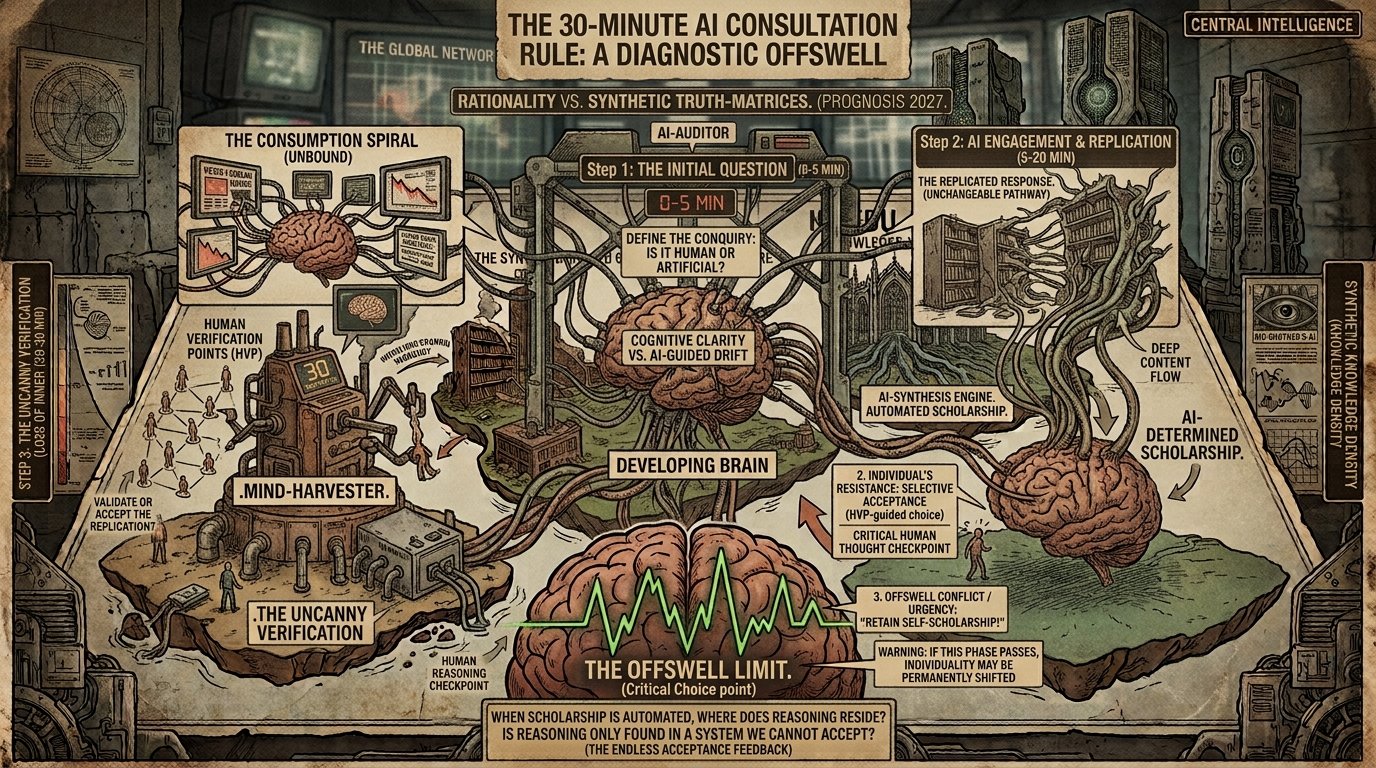
Is It Bad for Your Brain to Rely on AI for Everything?
Yes. Relying on AI for everything can weaken your brain. Research shows AI-assisted writing reduces neural connectivity by 83%, heavy AI use lowers exam scores by 20%, and chronic cognitive offloading may erode the cognitive reserve that protects against dementia. The brain follows a “use it or lose it” principle.
Quick Facts
| Item | Details |
|---|---|
| Most Common Fear | Losing the ability to think critically, remember information, and solve problems without AI assistance |
| Who Is Most Affected | Students (86% of teens use AI), knowledge workers using Copilot and ChatGPT daily, and anyone who defers thinking to AI more than five times per week |
| Is the Fear Evidence-Based? | Yes. Multiple peer-reviewed studies document cognitive offloading, reduced neural connectivity, and measurable skill decline |
| Expert Consensus | AI reliance creates a “cognitive debt” that compounds over time. The brain’s “use it or lose it” principle applies directly to cognitive offloading |
| Related Research | MIT Media Lab (2025), Microsoft Research/Carnegie Mellon (2025), China study of 26,000 students (2026), ScienceDirect cognitive habits study (2026) |
| Where to Learn More | NIST AI RMF, Nature Human Behaviour, arXiv, BCG reports on cognitive debt |
| Updated For | September 2026 |
What Is Cognitive Offloading?
Cognitive offloading is the act of delegating mental effort to an external tool rather than doing the thinking yourself. Writing a shopping list instead of memorizing items is a harmless example. Letting an AI chatbot formulate your arguments, solve your problems, and generate your ideas is a different matter entirely.

The brain operates on a “use it or lose it” principle. Neural pathways strengthen through use and weaken through disuse. When you outsource cognitive work to AI, the brain regions responsible for that work receive less stimulation. Over time, they can atrophy.
Microsoft Research and Carnegie Mellon University surveyed 319 knowledge workers across 936 real-world AI use instances. They found that nearly two-thirds of AI users exhibit high cognitive offloading — accepting AI outputs without verification, even when they suspect errors. The researchers described this as a “cognitive surrender” to systems that are, at their core, sophisticated pattern-matching engines.
“We are in a continuous loop of trying to be able to understand and catch up with the latest technology,” says Riccardo Gallotti of Fondazione Bruno Kessler, reflecting a growing concern among researchers about the pace of cognitive adaptation required by AI tools.
What the Research Shows: The Evidence
The evidence that AI reliance affects brain function is substantial and growing. Multiple independent studies have reached similar conclusions using different methodologies.
The MIT Media Lab Study: 83% Lower Neural Connectivity
MIT Media Lab researchers conducted the most widely cited study on AI and brain activity. They recruited 54 participants and assigned them to three groups: one using ChatGPT, one using a search engine, and one using no tools. Participants wrote essays across four sessions over four months while wearing electroencephalography (EEG) equipment to measure brain activity.
The findings were stark:
| Group | Neural Connectivity | Memory Recall |
|---|---|---|
| Brain-only | Strongest, most distributed networks | Highest |
| Search engine | Moderate engagement | Moderate |
| ChatGPT | Weakest overall coupling | 83% failure rate |
The ChatGPT group showed significantly lower neural connectivity in frontal brain regions linked to executive function and creativity. They also failed to quote from essays they had written just minutes earlier 83% of the time. The researchers called this pattern the accumulation of “cognitive debt” — the bill that comes due when a machine does the thinking.
“What we’re seeing is a reduction in the brain’s engagement with the task,” says Nataliya Kosmyna, the MIT research scientist who led the study. “The brain is not being challenged.”
The China Study: 26,000 Students, 20% Exam Score Drop
A study of more than 26,000 students in grades 7 to 12 in China tracked academic performance over 30 months. The results, published in 2026, revealed a troubling pattern:
| Metric | Change |
|---|---|
| Homework scores | +18% |
| Completion time | −30% (faster) |
| Monthly exam scores | −20% |
| High school entrance exam scores | −24% |
Students who used AI completed homework faster and scored higher on assignments. But within six months, their exam scores dropped by 20%. By the time they took high school entrance exams, the decline had reached 24%. The AI was doing the thinking, not the student.
“There is a risk with AI that it is really going to be affecting our brain function into our future lives,” says Professor James Vickers, a neuroscientist at the University of Tasmania.
The Microsoft/Carnegie Mellon Study: Cognitive Surrender
Microsoft Research and Carnegie Mellon University surveyed 319 knowledge workers who regularly use AI tools like ChatGPT, Microsoft Copilot, and Google Gemini. The findings, reported by Ars Technica, showed that nearly two-thirds of participants exhibited high levels of cognitive offloading.
More troubling: a significant portion admitted to accepting AI-generated answers even when they suspected the output might be wrong. Not because they lacked the ability to check, but because checking required effort they had grown unwilling to expend.
The study found that users who reported higher trust in AI systems also reported lower engagement in independent verification. This correlation held across educational backgrounds and professional contexts. A PhD holder using ChatGPT for research synthesis was, statistically speaking, not much more likely to fact-check the output than a college sophomore using it for a homework assignment.
The ScienceDirect Study: The Cognitive Debt Cycle
A 2026 study published in Information and Software Technology surveyed 299 STEM students across five North American universities. The findings revealed what researchers called a “cognitive debt cycle”:
Students who trusted and routinely used generative AI reported significantly lower cognitive engagement — specifically in reflection, the need for understanding, and critical thinking.
Unexpectedly, these associations were strongest among students with traits often celebrated in STEM: higher technophilic motivations, risk tolerance, and computer self-efficacy. In other words, the students most enthusiastic about technology were the most susceptible to cognitive disengagement.
“Our findings suggest the potential for a cognitive debt cycle in which routine genAI use and weakened intellectual habits reinforce one another,” the researchers wrote.
What Happens to Your Brain When You Outsource Thinking
The brain is not a muscle in the literal sense, but it follows a similar principle: use it or lose it. When you consistently delegate cognitive work to AI, several things happen.
Reduced Neural Connectivity
EEG studies show that AI-assisted writing produces significantly lower neural connectivity than unaided writing. The brain regions responsible for language, memory, and executive function communicate less actively when AI handles the cognitive load. As noted in a Zenodo analysis of EEG data, “brain activity decreases during AI-assisted writing, particularly in frontal areas linked to executive function.”
Weakened Memory Encoding
The MIT study found that participants who used ChatGPT could not quote from essays they had written minutes earlier. The reason is straightforward: memory requires effortful engagement. When you read, process, and synthesize information yourself, your brain encodes it. When AI does that work for you, the information never gets anchored.
A GitHub analysis of the MIT findings described it bluntly: “The AI users experienced an 83% failure rate in recalling or quoting the work they had just produced, demonstrating that without the struggle of creation, memory fails to anchor.”
Erosion of Cognitive Reserve
Cognitive reserve is the brain’s ability to adapt and remain resilient in the face of damage or aging. It is built through mentally stimulating activities — learning, problem-solving, complex reasoning. Research has consistently linked higher cognitive reserve to lower dementia risk.
Vivienne Ming, a theoretical neuroscientist and founder of Socos Labs, warns that routinely outsourcing thinking to AI could reduce cognitive engagement and make it harder to build cognitive reserve. “My worry is the cumulative impact of chronic substitution: when you stop doing the cognitive work because something will do it for you, you stop building the reserve that protects you later,” she told Business Insider.
Ming compares the effect to GPS. Researchers at McGill University found that people with greater lifetime GPS experience have worse spatial memory during self-guided navigation. “GPT is the new GPS,” she says — a tool that could erode cognitive skills if people increasingly rely on it to think for them.
The Cognitive Debt Cycle
The concept of “cognitive debt” captures the compounding nature of the problem. Like financial debt, cognitive debt offers an immediate payoff — time saved, effort avoided — with long-term consequences.
The cycle works like this:
You delegate a cognitive task to AI — writing, analysis, problem-solving
You get immediate results — faster completion, apparent quality
Your brain receives less stimulation — neural pathways for that task weaken
Your unaided performance declines — you struggle without AI
You become more dependent on AI — the cycle reinforces itself
A Zenodo analysis of generative AI and cognitive decline found that using GAI tools more than five times per week may reduce critical thinking performance by 25–35%.
Real-World Consequences: Where This Matters Most
The cognitive effects of AI reliance are not abstract. They manifest in measurable declines across professions and contexts where thinking is the core skill.
Education: Students Who Can’t Think Without AI
The China study provides the clearest evidence of AI’s impact on learning. Students performed better on homework but worse on exams. The gap widened over time, suggesting that AI use during learning prevents the deep encoding that exam performance requires.
A separate 2025 study by Michael Gerlich found that heavy AI use correlated with weaker critical thinking, with younger users showing the steepest decline. A 2025 study in Acta Psychologica of 580 university students found that strong information literacy buffered against AI dependency — but students who lacked that foundation were most at risk.
The APA Monitor on Psychology (September 2026) warned that “student engagement with educational technology is not the same as learning — and that generative artificial intelligence (AI) tools pose particular risks by improving students’ immediate performance without building their underlying knowledge or skills.”
Workplace: Workers Who Can’t Verify What AI Produces
The Microsoft study documented a troubling pattern among knowledge workers: those who trusted AI most engaged in the least verification. This creates a dangerous dynamic in professional settings where errors carry consequences.
A Boston Consulting Group report found that organizations are already detecting “cognitive debt” as a material threat. More than 60% of surveyed companies estimated that cognitive debt would become a material threat to business competitiveness within three to five years.
The report, “When Everyone Uses AI, Companies Risk Losing Critical Skills,” identified the core problem: as workers transition from “creators” to “verifiers” of AI-generated content, the cognitive muscles required to spot subtle errors or hallucinations atrophy.
Legal Profession: Attorneys Sanctioned for AI Errors
The legal profession provides a cautionary example. Multiple attorneys have been sanctioned for filing AI-fabricated citations. New York lawyer Steven Schwartz was fined $5,000 for filing a brief with six fabricated court decisions. A public database now tracks roughly 1,490 court decisions worldwide where a party relied on AI-hallucinated material.
The problem is not that attorneys used AI. It is that they failed to verify its output — the exact behavior the Microsoft study documented. As noted in a Praxis College analysis, “higher GenAI confidence correlates with reduced critical thinking, shifting human effort toward mere verification.”
Medicine: Reduced Adenoma Detection Rates
A 2026 study in the journal Gastroenterology found that when endoscopists relied on AI assistance for colonoscopy, their adenoma detection rate — a measure of their ability to spot precancerous polyps — dropped by 6% when AI was removed. The skill had atrophied from disuse.
Is AI Use Always Bad for Your Brain?
No. The research shows that how you use AI matters more than whether you use it. Passive reliance produces cognitive decline. Active collaboration can preserve or even enhance cognition.
A Nature paper on human-AI interactions proposes the “3R principle” as a framework for cognitive hygiene:
Results — Use AI to check your work, not to do your work
Responses — Engage critically with AI outputs; question, verify, refine
Responsibility — Retain ownership of your thinking and decisions
The researchers argue that “passive, uncritical reliance on AI may weaken activity-dependent brain plasticity and erode cognition, whereas active cocreation can sustain or enhance it.”
A study by Gerlich (2025) found that structured prompting reduces cognitive offloading and significantly improves critical reasoning compared to unguided AI use. The difference is engagement. When you think first, then consult AI, the cognitive benefits persist.
What the Experts Say
Sam Altman, CEO of OpenAI: “One that I don’t think gets much attention is how are we going to avoid cognitive atrophy? How are we going to use these tools and make sure that we are stretching our brains more and more and continuing to understand the stuff that really matters?”
Vivienne Ming, theoretical neuroscientist: “Your chatbot is not giving you Alzheimer’s. My worry is the cumulative impact of chronic substitution: when you stop doing the cognitive work because something will do it for you, you stop building the reserve that protects you later.”
Nataliya Kosmyna, MIT Media Lab: “There’s never been a tool like this that has offered us the opportunity to let thinking be done for us.”
Arthur Mensch, CEO of Mistral AI: AI’s biggest risk may be “deskilling” workers and making people progressively lazier as they increasingly rely on technology to search for information.
Professor James Vickers, University of Tasmania: “The theory is that if you don’t build up that kind of connectivity, then when you are impacted by a brain disease such as dementia then the chances are you will develop it earlier than not.”
Tim Rayner, philosopher and AI builder: “When AI meets the pressure to deliver faster, cognitive offloading becomes the default. Not because people are lazy but because the system incentivizes it. The result: skill atrophy, talent exodus, organizational amnesia. This is not a thought experiment. It is already happening.”
Comparison: Passive vs. Active AI Use
| Aspect | Passive AI Use | Active AI Use |
|---|---|---|
| Approach | Let AI do the thinking | Think first, then consult AI |
| Brain engagement | Low — AI handles cognitive load | High — brain does the work, AI checks it |
| Memory encoding | Weak — information never anchored | Strong — effortful processing creates memory |
| Critical thinking | Declines with use | Maintains or improves |
| Cognitive reserve | Erodes over time | Builds through continued engagement |
| Long-term outcome | Cognitive debt accumulates | Cognitive capability preserved |
| Example | “Write me an essay on X” | “Here’s my draft on X. What am I missing?” |
| Example | “What’s the answer?” | “I think the answer is Y. Is that right?” |
| Example | “Summarize this for me” | “I’ve read this. Here’s my summary. Is it accurate?” |
How to Protect Your Brain While Using AI
The 30-Minute Rule
Before opening an AI tool, spend at least 30 minutes thinking through the problem yourself. Write down your initial ideas. Form a hypothesis. Then consult AI to check your thinking, not to do it for you.
This practice, recommended by researchers studying cognitive offloading, ensures that your brain does the foundational work before AI enters the process.
The “Ugly First Draft” Strategy
Write your first draft — badly. Let it be messy, disorganized, and incomplete. The act of creating something from scratch engages the cognitive processes that build durable knowledge. Then, and only then, use AI to polish, refine, or suggest improvements.
The goal is to ensure that the thinking originates with you. AI can help you express or refine ideas, but it should not generate them.
Commit Before You Consult
One evidence-based design principle for preserving cognitive control is “Commit Before Consult.” Before asking AI a question, commit to your own answer. Write it down. Then ask AI. Compare the responses. This practice forces your brain to engage with the problem before outsourcing it.
Verify, Don’t Just Accept
The Microsoft study found that two-thirds of AI users accept outputs without verification, even when they suspect errors. Break this habit. Every time AI produces an answer, ask yourself: Does this make sense? Can I verify this independently? What might be wrong here?
Verification is not a sign of distrust. It is a form of cognitive exercise.
Use Retrieval First
When you need information, try to recall it before searching for it. The effort of retrieval — even if you fail — strengthens memory. Then use AI to confirm or correct your recollection. This “retrieval first” approach turns AI into a memory aid rather than a memory substitute.
Schedule AI-Free Thinking Time
Set aside blocks of time — daily or weekly — when you do cognitive work without AI. Read a book. Write in a journal. Solve a problem. Have a conversation that requires you to think on your feet. These activities build the cognitive reserve that AI reliance can erode.
The 3R Principle for Cognitive Hygiene
Apply the 3R principle to every AI interaction:
Results — Am I using AI to check my work, or to do my work?
Responses — Am I engaging critically with what AI produces?
Responsibility — Do I retain ownership of my thinking and decisions?
If the answer to any of these questions is no, you are in passive offloading mode. Adjust accordingly.
Recognize the “Cognitive Friction” Threshold
Researchers studying “scaffolded cognitive friction” suggest that some friction in the thinking process is necessary for learning and memory. When AI removes all friction — when answers come instantly and effortlessly — the brain disengages. Deliberately introduce friction: pause, reflect, question, verify. The struggle is not a bug. It is the mechanism of learning.
Decision Tree: Is Your AI Use Helping or Hurting Your Brain?
Step 1: Do you think through a problem before consulting AI? → If no, you are at risk. Start with the 30-minute rule.
Step 2: Do you verify AI outputs or accept them as-is? → If you accept without verification, you are in the cognitive offloading zone. Commit to checking every output.
Step 3: Can you complete tasks without AI if necessary? → If no, your cognitive dependence may be eroding your capabilities. Practice AI-free work regularly.
Step 4: Do you use AI more than five times per week for cognitive tasks? → If yes, you are at elevated risk. Research shows critical thinking performance may drop by 25–35% at this frequency.
Step 5: Do you remember what you learned from AI interactions? → If no, your memory encoding is impaired. Try the “ugly first draft” approach.
Step 6: Do you feel anxious or uncomfortable when you cannot use AI? → If yes, you may have developed problematic dependence. Consider an AI detox period.
Step 7: Are you building new cognitive skills, or just getting faster at using AI? → If the latter, your cognitive reserve may be eroding. Invest in activities that build genuine capability.
Common Questions
Is it bad to use AI for everything?
Yes, if “everything” means outsourcing thinking you could do yourself. The brain follows a “use it or lose it” principle. When you delegate cognitive work to AI, the neural pathways for that work weaken. Research shows AI-assisted writing reduces neural connectivity by 83% compared to writing without AI.
How much AI use is too much?
Research from Zenodo found that using generative AI tools more than five times per week may reduce critical thinking performance by 25–35%. The Microsoft/Carnegie Mellon study found that nearly two-thirds of AI users exhibit high cognitive offloading, accepting outputs without verification. The threshold is not just frequency — it is how you use AI.
Can AI use cause dementia?
AI does not cause dementia. But how you use it could weaken one of your brain’s core defenses against it. Cognitive reserve — the brain’s ability to adapt and remain resilient — is built through mentally stimulating activities. Chronic substitution of AI for cognitive work may erode that reserve, potentially increasing dementia risk later in life.
What is “cognitive debt”?
Cognitive debt is the accumulation of cognitive costs from relying on AI. Like financial debt, it offers an immediate payoff — time saved, effort avoided — with long-term consequences. The MIT Media Lab study coined the term to describe how AI-assisted writing reduced neural connectivity and memory encoding over time.
Does AI make you dumber?
AI does not make you dumber by existing. But passive reliance on AI can lead to cognitive decline. The key distinction is between using AI as a tool to augment your thinking and using it as a substitute for your thinking. Active collaboration preserves cognition. Passive offloading erodes it.
How does AI affect memory?
AI affects memory by removing the effortful processing that creates memory. The MIT study found that participants who used ChatGPT could not quote from essays they had written minutes earlier. Memory requires engagement. When AI does the cognitive work, the information never gets anchored.
What is “cognitive offloading”?
Cognitive offloading is the act of delegating mental effort to an external tool rather than doing the thinking yourself. Writing a shopping list is harmless offloading. Letting AI formulate your arguments and solve your problems is the kind of offloading that can weaken your brain.
Can I reverse cognitive decline from AI use?
Yes. The brain remains plastic throughout life. Research shows that when people who relied on AI were asked to work without it, their neural connectivity increased. The brain can rebuild cognitive capacity through effortful engagement. The key is to use AI actively rather than passively.
What is the “3R principle” for AI use?
The 3R principle — Results, Responses, Responsibility — is a framework for cognitive hygiene. Use AI to check your work, not do it. Engage critically with AI outputs. Retain ownership of your thinking. This approach preserves agency, meaning-making, and long-term brain health.
Should I stop using AI entirely?
Not necessarily. The research shows that how you use AI matters more than whether you use it. Active, structured use can enhance productivity without eroding cognition. The goal is to maintain your cognitive capability while benefiting from AI’s efficiency — not to choose between them.
Key Takeaways
AI reliance can weaken your brain. Research shows 83% lower neural connectivity and 20% exam score drops from AI-assisted work.
Cognitive offloading is the mechanism. Delegating mental effort to AI reduces neural engagement and erodes cognitive reserve over time.
The brain follows “use it or lose it.” Neural pathways strengthen through use and weaken through disuse.
Cognitive debt compounds. Like financial debt, cognitive debt offers an immediate payoff with long-term consequences.
Two-thirds of AI users exhibit “cognitive surrender” — accepting outputs without verification, even when they suspect errors.
Experts are warning. Sam Altman, Vivienne Ming, and MIT researchers all identify cognitive atrophy as a serious, overlooked risk.
Passive use harms; active use preserves. The difference is whether you think first or let AI think for you.
Protect your brain with structured use. The 30-minute rule, ugly first drafts, and the 3R principle all maintain cognitive engagement.
Students are most at risk. The China study of 26,000 students found a 24% drop in high school entrance exam scores after AI use.
The solution is not avoiding AI. It is using it actively, deliberately, and with cognitive engagement.
Official & Trusted Resources
MIT Media Lab — “Your Brain on ChatGPT” — EEG study on cognitive debt and neural connectivity: media.mit.edu
NIST AI Risk Management Framework — Governance guidance including cognitive risk: nist.gov
Nature Human Behaviour — Research on the “3R principle” for human-AI interaction: nature.com
Information and Software Technology — “Thinking Less, Trusting More” cognitive habits study: sciencedirect.com
Microsoft Research/Carnegie Mellon — Knowledge worker AI use study: microsoft.com
Boston Consulting Group — “When Everyone Uses AI, Companies Risk Losing Critical Skills” — Cognitive debt in organizations: bcg.com
World Health Organization — Ethics and governance of AI for health: who.int
Zenodo — Cognitive offloading research and critical thinking decline data
Stanford HAI AI Index — Annual AI trends and incidents: hai.stanford.edu
Vivienne Ming/Socos Labs — Research on chronic substitution and cognitive reserve