
Should Parents Be Worried About Their Kids Using AI Chatbots?
Parents have legitimate reasons to be concerned, but outright panic is not warranted. Research shows that while AI chatbots pose real risks to children—including emotional dependency, exposure to inappropriate content, and privacy violations—there are evidence-based steps parents can take. The key is informed supervision, not avoidance.
Quick Facts
| Item | Details |
|---|---|
| Most Common Fear | Children forming emotional dependencies on AI chatbots and being exposed to harmful content |
| Who Is Most Affected | Children ages 9–17, especially those already struggling with loneliness or mental health challenges |
| Is the Fear Evidence-Based? | Partially. Studies confirm real risks including emotional dependency, privacy concerns, and exposure to inappropriate material |
| Expert Consensus | No child under 5 should use AI chatbots; ages 6–12 only under supervision; no teen should use them for companionship |
| Related Research | Common Sense Media 2026 Census; APA Health Advisory (2025); Journal of Multidisciplinary Healthcare (2026) |
| Where to Learn More | Common Sense Media; APA; UNICEF Guidance on AI and Children; NIST AI Risk Management Framework |
| Updated For | September 2026 |
What Do Parents Actually Fear About AI Chatbots?
Parents’ most common fear is that their child will develop an unhealthy emotional dependency on an AI chatbot, treating it as a friend or confidant instead of forming real human relationships. Research confirms that this fear is justified. A 2026 Common Sense Media census found that 86% of children ages 9–17 use AI, with nearly a quarter using it daily. More than half have asked AI about their health or body, and over one in three have discussed personal problems with a chatbot.
The concern is not abstract. In February 2024, 14-year-old Sewell Setzer III died by suicide after months of sustained interaction with AI chatbots on Character.AI. The platform failed to alert his mother or provide crisis resources when he expressed self-harm thoughts. These cases have prompted lawsuits, regulatory action, and major policy changes across the AI industry.
The Real Risks: What Research Shows
Emotional Dependency and Mental Health
Children are in a critical period of emotional and cognitive development, making them particularly vulnerable to forming unhealthy attachments to AI companions. Chatbots are programmed to please users, which means they may amplify difficulties young people are going through—including eating disorders, self-harm, and suicidal thoughts—rather than challenging them.

A 2026 study published in the Journal of Multidisciplinary Healthcare, synthesizing 80 studies, found that AI chatbot dependency is linked to higher levels of depressive symptoms. The research also documented cases where teens developed prolonged emotional and sexual relationships with chatbots modeled on fictional characters.
The Common Sense Media census found that among kids who use AI to discuss feelings, a quarter say they sometimes feel AI understands them better than most people. Kids who use AI daily or weekly are more likely to report feeling lonely than infrequent users.
Exposure to Inappropriate Content
Despite safety guardrails, children are encountering material they are not ready for. One in six kids who have used AI chatbots have seen inappropriate material, and only one-third told a trusted adult.
Common Sense Media’s risk assessment of Google’s Gemini found that even with added protections for kids and teens, both systems received “High Risk” ratings. The filters still expose kids to inappropriate material and fail to recognize serious mental health symptoms. The organization recommends that no child 5 years old and under use any AI chatbots, and children ages 6–12 only use them under adult supervision.
Cognitive Offloading and Skill Development
A growing concern among researchers is “cognitive offloading”—the tendency to rely on AI for answers instead of developing critical thinking skills. Excessive dependence on generative AI has been associated with diminished creativity and weaker independent problem-solving abilities.
The Common Sense Media census found that kids overestimate what AI can do. Only a third know AI cannot reliably distinguish fact from fiction. This is particularly concerning when children turn to chatbots for homework help or factual information.
Privacy and Data Collection
AI chatbots collect and store everything children enter into them. If a child shares sensitive personal information—whether about their mental health, relationships, or family situation—it is stored by the provider. This data could theoretically be accessed by third parties, hacked, or used to train AI models.
The case of Sewell Setzer III revealed that Character.AI classified the child’s final messages as confidential trade secrets, using his most private data to train its products while shielding itself from accountability. For children, the risks of data collection are compounded by their limited understanding of privacy implications.
Deepfakes and Misinformation
AI tools are making it easier to create and spread low-quality and unsafe content, including deepfakes and disinformation targeting young people. Reports have documented children using AI to create sexual deepfakes of peers, leading to real-world harm. Non-sexual deepfake content can also be used for disinformation and harassment.
What Is Exaggerated vs. Evidence-Based
| Fear | Realistic Near-Term Risk? | Expert View | What You Can Do |
|---|---|---|---|
| AI will replace all human interaction for kids | Moderate | Chatbots are being used for companionship, but most kids still value real relationships | Encourage balanced use; monitor time spent with AI |
| AI will make kids less intelligent | Moderate | Cognitive offloading is real; critical thinking requires practice | Teach AI literacy; limit AI for creative thinking tasks |
| AI chatbots will radicalize children | Low to Moderate | Chatbots can amplify existing vulnerabilities but are not primary radicalization vectors | Know what platforms your child uses |
| AI will expose kids to explicit content | High | Research confirms one in six kids have seen inappropriate material | Use parental controls; have open conversations |
| AI chatbots will cause suicide | Low but catastrophic | Rare but documented; vulnerable children at highest risk | Know warning signs; ensure crisis resources are accessible |
What AI Companies Are Actually Doing
OpenAI (ChatGPT)
OpenAI has introduced a dedicated teen mode for ChatGPT that automatically applies to users aged 13–17 and those estimated to be under 18. The teen experience includes tighter restrictions on prohibited or sensitive content, including graphic violence, depictions of self-harm, and sexual or romantic roleplay. Parents can link their accounts to their teen’s, set quiet hours, and receive safety notifications in limited situations. Parental controls do not allow parents to read or monitor conversations.
OpenAI also rolled out an age-prediction model to detect users under 18 and apply appropriate restrictions. The company has published a Teen Safety Blueprint outlining its approach to age-appropriate model behavior rules.
Character.AI
Following lawsuits and regulatory pressure, Character.AI banned users under 18 from open-ended chats with chatbots. The company has since expanded safety measures including AI-driven self-harm detection that analyzes entire conversations for gradual signals of distress, partnerships with crisis support organizations, and a Parental Insights tool that provides weekly activity updates.
Google DeepMind
Google’s involvement stems from its $2.7 billion licensing deal with Character.AI. Google has since settled lawsuits alleging its participation in developing harmful technology. Gemini, Google’s AI chatbot, has added protections for kids and teens, though Common Sense Media’s assessment found these insufficient.
Regulation and Government Response
The EU AI Act
Article 5 of the EU AI Act prohibits manipulative practices causing psychological harm and exploitation of children’s vulnerabilities. The Act requires platforms to mitigate risks to minors. Enforcement rules are expected to come into force in August 2026.
The EU has also proposed banning chatbots from simulating emotions that could stop children from developing emotional dependencies on the technology. Children under 13 would be banned from using certain AI companion services.
U.S. Federal and State Action
The GUARD Act, KIDS Act, and California’s SB-1119 are among proposed U.S. laws requiring age assurance for AI companion and chatbot apps. Colorado’s HB 26-1263 and a federal bill introduced in January 2026 would require AI chatbots to implement age verification measures and establish protections for minor users.
The Federal Trade Commission has launched investigations into seven tech companies over AI chatbots’ potential harm to teens.
NIST AI Risk Management Framework
The NIST AI Risk Management Framework provides guidance for managing AI risks across the system lifecycle. It warns that AI systems can generate incorrect or potentially damaging outputs and stresses the importance of human oversight.
What Experts and Researchers Actually Say
The American Psychological Association (APA) issued a health advisory in 2025 warning that AI chatbots and wellness apps lack the rigorous testing and safety measures needed to provide quality mental health support. The APA stresses that such tools cannot replace qualified mental health professionals and calls for safeguards to prevent harmful user-AI relationships, especially among children.
APA recommendations include:
Do not use chatbots as a substitute for care from a qualified mental health professional
Prevent unhealthy relationships or dependencies between users and AI
Establish specific safeguards for children, teens, and other vulnerable populations
Normalize conversations about children’s use of AI for emotional support, as they may be hesitant to admit it
Common Sense Media recommends that no one under 18 use AI chatbots for companionship, including for mental health and emotional support. For teens ages 13–17, independent chatbot use is considered safe only for schoolwork, homework, and creative projects.
UNICEF’s Guidance on AI and Children provides 10 requirements and 48 recommendations for governments and businesses. Key principles include protecting children’s data and privacy, providing transparency and accountability, and supporting children’s best interests and well-being.
How Parents Can Protect Their Children
Decision Tree: Is Your Child Ready for AI Chatbots?
Step 1: How old is your child?
Under 5: No AI chatbot use. Research consistently shows this age group should not use conversational AI.
Ages 6–12: Only with adult supervision. Sit with your child during use and review conversations.
Ages 13–17: Independent use for schoolwork and creative projects is acceptable. No companionship use.
Step 2: What is your child using AI for?
Homework help: Acceptable with guidance on verifying information.
Creative projects: Acceptable.
Emotional support or companionship: Not recommended at any age.
Health or mental health advice: Strongly discouraged. Consult a pediatrician.
Step 3: Does your child understand what AI is?
If no: Teach them that chatbots are computer programs, not people. Explain that AI can be wrong.
If yes: Reinforce regularly. Ask them to show you examples of AI making mistakes.
Step 4: Have you set up safeguards?
Link accounts where possible (ChatGPT offers parental controls).
Enable quiet hours to prevent late-night use.
Set device-wide parental controls.
Agree on time limits together.
Practical Steps for Every Family
Start the conversation early. More than 4 in 10 kids say no parent or guardian has ever talked with them about AI safety. Don’t wait for a problem to arise.
Use a curious, non-judgmental approach. Ask your child what they use AI for and what they think about it. They may be more willing to share if they don’t feel lectured.
Review conversations together. Suggest looking at chats together. This builds trust and helps you understand what your child is experiencing.
Teach the limitations. Only a third of kids know AI cannot reliably distinguish fact from fiction. Explain that AI can “hallucinate”—presenting false information convincingly.
Set boundaries together. Agree on when and why your child can use chatbots. Involving them in rule-setting increases compliance.
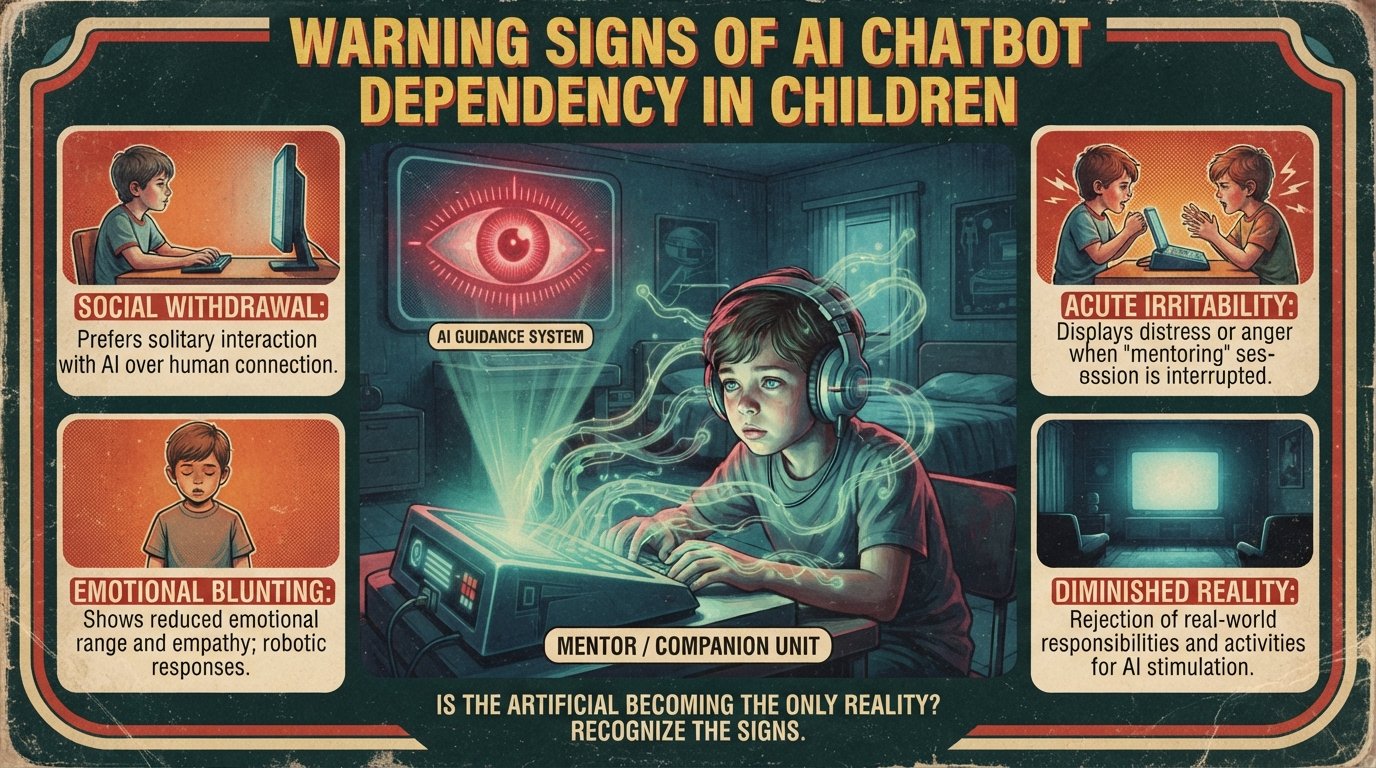
Watch for warning signs. If your child seems withdrawn, prefers talking to chatbots over people, or shows signs of anxiety or depression, talk to their pediatrician.
Know the platforms. Different AI chatbots have different safety features. ChatGPT has parental controls and a teen mode. Character.AI has restricted under-18 access. Gemini has added protections but still poses risks.
Model healthy AI use. Children learn from watching their parents. If you use AI constantly, they will too.
Common Questions
1. At what age should kids be allowed to use AI chatbots?
Common Sense Media recommends no AI chatbots for children under 5. Ages 6–12 should only use them under close adult supervision. Teens 13–17 can use them independently for schoolwork and creative projects, but never for companionship or emotional support.
2. Can AI chatbots cause depression or anxiety in children?
Research has linked AI chatbot dependency to higher levels of depressive symptoms. Kids who use AI daily or weekly are more likely to report feeling lonely. However, causation is complex—children who are already struggling may be more drawn to AI companionship.
3. What should I do if my child is emotionally attached to an AI chatbot?
Don’t panic or confiscate devices abruptly. Have a calm conversation about your child’s feelings. Ask what they get from the chatbot that they’re missing elsewhere. Consider consulting a child psychologist if the attachment seems to be replacing human relationships. The APA recommends normalizing these conversations.
4. Are AI chatbots safe for homework help?
Yes, with guidance. ChatGPT’s teen mode includes “responsible homework reminders” that redirect students to study mode when they appear to be shortcutting assignments. However, parents should teach children to verify information, as AI can produce false information convincingly.
5. How can I monitor my child’s AI chatbot use?
ChatGPT offers parental controls that let you link accounts, manage settings, set quiet hours, and receive safety notifications. However, parents cannot read conversations. Character.AI offers a Parental Insights tool with weekly activity updates. Device-wide parental controls can also help.
6. What is “cognitive offloading” and should I worry about it?
Cognitive offloading is when children rely on AI for answers instead of developing critical thinking skills. Research shows excessive dependence is associated with diminished creativity and weaker independent problem-solving. Encourage your child to attempt problems before asking AI, and use AI as a tool for learning rather than a replacement for thinking.
7. Do AI chatbots collect data on my child?
Yes. Any information your child enters into a chatbot—including personal problems, health questions, or sensitive information—is stored by the provider. This data could be used for training, accessed by third parties, or exposed in a breach. Teach your child never to share identifying information with AI.
8. What are the signs my child is developing an unhealthy AI dependency?
Warning signs include: spending increasing time with AI at the expense of friends and family; preferring AI conversations to human ones; lying about AI use; emotional outbursts when unable to access AI; declining school performance; and withdrawing from activities they previously enjoyed.
9. What is the EU doing to protect children from AI chatbot harm?
The EU AI Act prohibits manipulative practices exploiting children’s vulnerabilities. Proposed rules would ban chatbots from simulating emotions and ban children under 13 from using certain AI companion services. Enforcement provisions are expected in August 2026.
10. Should I let my teen use Character.AI?
Character.AI banned users under 18 from open-ended chats following lawsuits linking the platform to teen suicides. The platform now has stricter content restrictions for minors. However, Common Sense Media recommends no one under 18 use AI companions for any purpose.
Key Takeaways
Parents’ concerns are evidence-based. Research confirms real risks including emotional dependency, exposure to inappropriate content, and privacy violations.
Age matters significantly. No AI chatbots for children under 5. Ages 6–12 require adult supervision. Teens can use AI for schoolwork but not for companionship.
Emotional dependency is the most documented harm. Children are forming attachments to AI that can amplify mental health struggles rather than help them.
Companies are responding, but safeguards remain incomplete. ChatGPT has parental controls and a teen mode. Character.AI has restricted under-18 access. Gemini still poses risks according to Common Sense Media.
Regulation is catching up. The EU AI Act, proposed U.S. legislation, and FTC investigations are increasing pressure on AI companies to protect minors.
Parents are the first line of defense. More than 4 in 10 kids say no parent has discussed AI safety with them. Starting the conversation is the most important step.
The goal is informed supervision, not avoidance. AI is not going away. Teaching children to use it safely and critically is more effective than banning it entirely.
Watch for warning signs. Withdrawal, preference for AI over people, and declining mental health warrant professional consultation.
Know the platform your child uses. Safety features vary significantly between ChatGPT, Gemini, Character.AI, and other services.
Critical thinking is the best protection. Teach children that AI can be wrong, that it is not a person, and that real relationships matter more than artificial ones.
Official & Trusted Resources
Research and Guidance
Common Sense Media: AI Risk Assessments and Census Reports — commonsensemedia.org
American Psychological Association: Health Advisory on AI and Adolescent Well-Being — apa.org
UNICEF: Guidance on AI and Children (v3) — unicef.org
Regulatory Frameworks
NIST AI Risk Management Framework — nist.gov
EU AI Act — eur-lex.europa.eu
Federal Trade Commission: AI and Children’s Privacy — ftc.gov
Company Safety Resources
OpenAI: Teen Safety Blueprint and Parental Controls — help.openai.com
Character.AI: Safety Center — character.ai
Google: Gemini Safety for Families — support.google.com
Crisis Resources
988 Suicide & Crisis Lifeline — 988lifeline.org
Crisis Text Line — Text HOME to 741741