

How Do You Stay Informed About AI Without Feeling Constantly Anxious?
Staying informed about AI without constant anxiety requires intentional information management, not avoidance. Research shows that curating a focused “information diet,” building AI literacy, setting clear consumption boundaries, and practicing “JOMO” (the joy of missing out) are the most effective strategies. The goal is informed engagement, not constant monitoring.
Quick Facts
| Item | Details |
|---|---|
| Most Common Fear | That ignoring AI developments will leave you unprepared or obsolete |
| Who Is Most Affected | Knowledge workers, journalists, educators, and anyone whose profession intersects with technology |
| Is the Fear Evidence-Based? | Partially. Staying informed matters, but constant monitoring causes cognitive overload without improving outcomes |
| Expert Consensus | Intentional information curation beats constant consumption; AI literacy reduces anxiety; media diet management is the most practical intervention |
| Related Research | BACP (2026); Journal of Humanistic Counseling (2026); Harvard Business Review on “brain fry” (2026); PyCon DE “Surviving AI Fatigue” (2026) |
| Where to Learn More | BACP; American Psychological Association; NIST AI Risk Management Framework; News Literacy Project |
| Updated For | September 2026 |
Why Does Staying Informed About AI Feel So Overwhelming?
The volume of AI-related content has exceeded human cognitive capacity. New research papers, product launches, opinion pieces, and social media debates are published daily. A 2026 study documented what researchers call a “cognitive vigilance tax”—a state of mental fog and measurable atrophy of sustained attention caused by the constant need to evaluate AI-related information for credibility.
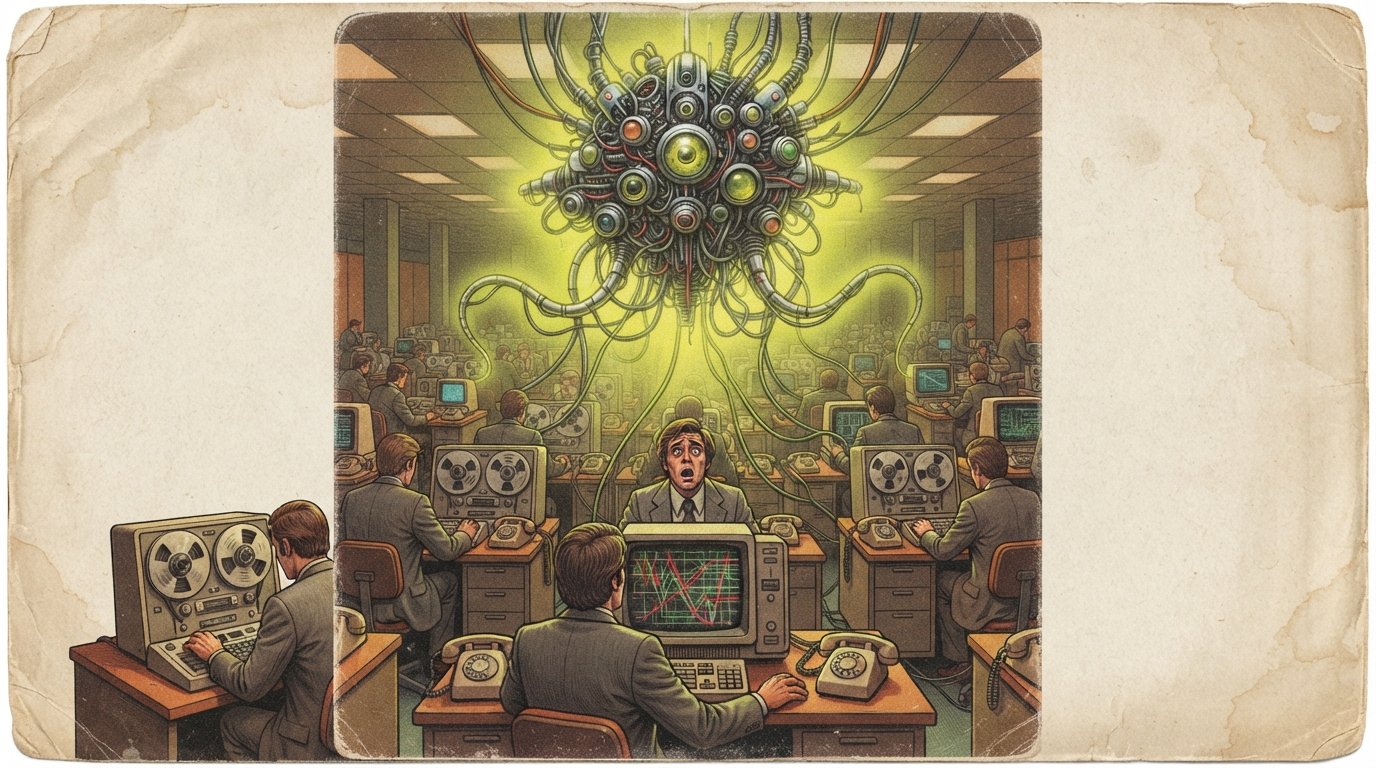
The problem is not just volume. It is the nature of the content. AI news is often framed around worst-case scenarios, job displacement, existential risk, and societal disruption. Repeated exposure to this material can trigger stress, information fatigue, anxiety, and analytical paralysis.
The result is a paradox: the more you try to stay informed, the less equipped you feel to act. This is not a personal failing. It is a predictable response to an information ecosystem designed to capture attention, not promote understanding.
The Real Cost of Information Overload

Constant AI news consumption has measurable psychological and cognitive costs. Understanding these costs is the first step toward managing them.
Cognitive Overload and “Brain Fry”
A 2026 study published in Harvard Business Review identified “brain fry” as mental fatigue from excessive AI use, interaction, or oversight beyond a person’s cognitive capacity. The study found that 14% of U.S. workers report experiencing brain fry from AI overuse. High oversight of AI tools was associated with 19% greater information overload.
News Avoidance as a Coping Mechanism
When information overload becomes unbearable, many people simply disengage. Research confirms that repeated exposure to AI-related misinformation and alarming content can exceed cognitive capacity, triggering stress, fatigue, and analytical paralysis. As a coping mechanism, individuals avoid news and withdraw from public discourse entirely.
This is not intellectual laziness. It is an adaptive response to an information ecosystem that feels manipulative and untrustworthy.
The Emotional Toll
BACP-registered counselor Richard Miller explains that AI anxiety is often linked to uncertainty about the future: “We are in the middle of a period of rapid change, not only in how we live individually but in how our workplaces, our schools and our public institutions function.”
Psychotherapist Alison Gee adds that the speed of change intensifies these feelings: “Some of the anxiety around AI feels almost Armageddon-like. People are watching something enormously powerful develop at extraordinary speed, without knowing where it will end or feeling they have much control over it. That can create more than anxiety. It can create dread.”
What Is Exaggerated vs. Evidence-Based
| Fear | Realistic Near-Term Risk? | Expert View | What You Can Do |
|---|---|---|---|
| “If I don’t follow every AI development, I’ll be left behind” | Low | Staying informed matters, but depth beats breadth. Missing daily news does not cause obsolescence. | Focus on fundamentals and major shifts, not every headline |
| “AI news is intentionally designed to make me anxious” | Moderate | Media outlets optimize for engagement; alarming headlines generate clicks. | Curate sources that prioritize accuracy over engagement |
| “Constant monitoring will prepare me for AI disruption” | Low | Information overload impairs decision-making and increases anxiety. | Set specific times for AI news; avoid continuous scrolling |
| “AI literacy won’t help because the field changes too fast” | Low | AI literacy consistently predicts lower anxiety and better coping. | Learn foundational concepts; they remain stable even as tools change |
| “I need to understand every new AI tool” | Low | Most new tools are iterations, not revolutions. JOMO is a professional skill. | Focus on tools relevant to your work; ignore the rest |
The Evidence-Based Framework: Extract, Transform, Load
The most effective approach to AI news consumption follows a data engineering model: extract, transform, load. This framework, developed by marketing AI expert Christopher Penn, treats information management as a structured process rather than passive consumption.
Part 1: Extract — Where to Get Information
The first step is choosing a small number of high-signal sources and ignoring the rest. Penn recommends building a structured collection of sources that provide signal without burying you in noise.
Recommended source categories:
| Source Type | Examples | Why It Works |
|---|---|---|
| Curated newsletters | TLDR AI, Last Week in AI, The Neuron | Short, digestible, human-curated summaries |
| Primary sources | OpenAI News, Anthropic Research, Google DeepMind Blog | Direct from labs; no media filtering |
| Research aggregators | alphaXiv, Papers with Code, arXiv | For those who want technical depth |
| Community forums | Hacker News, r/LocalLLaMA, Lobsters | Practitioner discussions, not hype |
Abby Wade, Applied Innovation Manager at the UK Government Communication Service, recommends picking a small number of trusted sources and building a habit of engaging with them regularly. “You don’t need to know everything. You need to know enough and you need to know where to go when you need to know more.”
What to deliberately skip:
Daily AI news sites (too much noise)
Social media AI drama and debates
AGI timeline predictions
Every new tool launch announcement
Part 2: Transform — How to Make Sense of Information
The second step is applying a mental framework to quickly judge what deserves attention and what can be safely ignored. Penn describes this as the “transformation” phase.
The “Does this change how I work?” Filter:
LinkedIn practitioner Animesh Mishra recommends filtering for “does this change how I work” instead of “is this interesting.” Most updates are interesting. Few actually change anything.
The Three-Question Test:
Before engaging with any AI news, ask:
Does this affect my work, my family, or my community directly?
Is this a fundamental shift or an incremental update?
Do I need to act on this now, or can I file it for later?
If the answer to all three is “no” or “not yet,” you can safely skip it.
Part 3: Load — What to Do With the Information
The final step is putting information to work. This means building a personal knowledge base, testing new tools when relevant, and sharing insights with your community. Penn describes this as moving from passive consumption to active engagement.
Practical “load” activities:
Keep a running document of key AI developments relevant to your field
Experiment with one new tool per month (not per day)
Share what you learn with colleagues or community members
Revisit your knowledge base quarterly to update your understanding
The Media Diet: Your Most Powerful Intervention
BACP counselor Richard Miller identifies media diet as “the most useful practical intervention” for AI anxiety. “There will be no shortage of alarming headlines, and the public conversation about AI is maturing but is not yet arriving at a pace that allows anything to settle,” he says.
“Limiting how often you engage with that material is not avoidance. It’s a reasonable response to a flow of information designed to hold your attention.”
Building Your AI Information Diet
| Principle | Implementation | Expected Outcome |
|---|---|---|
| Time-boxing | Set one 15–30 minute window per day for AI news | Reduces continuous scanning and notification fatigue |
| Source limitation | Follow 3–5 sources maximum | Higher signal-to-noise ratio |
| Notification discipline | Turn off push alerts for AI news | Eliminates interruption-driven anxiety |
| Depth over breadth | Read one in-depth piece weekly rather than ten headlines daily | Better understanding, less cognitive load |
| Positive news seeking | Deliberately seek AI stories about solutions, not just risks | Balanced emotional response |
Miller has followed AI developments closely and found it important to create distance from the constant stream. “What I have learned is that managing this well is not about putting your head in the sand. It’s about looking at the abyss but not doing it all the time.”
Practical Media Diet Steps
Delete news apps from your phone. Guardian readers who deleted news apps and forced themselves to type URLs to check news reported reduced compulsive checking.
Replace default app opening with intentional checking. Don’t open social apps by default. Fix a small time window. Outside that window, no scrolling. Your attention is capital.
Choose one source. One time. Pick a single medium for news. Read or watch once a day. Ask: Does this help me live better? Does this help me build better? If not, skip it.
Create device-free periods. No phone during meals. No YouTube during meals. Just awareness. Mental toughness starts with small disciplines.
Work focused, then detach. Give your workplace the energy it deserves. Deep work. Clear outcomes. Then disconnect. Don’t carry the market’s fear into your evening.
AI Literacy: The Antidote to Fear
Higher AI literacy consistently predicts lower AI anxiety across multiple studies. A 2026 study published in the Journal of Humanistic Counseling found that higher AI literacy was associated with lower AI anxiety, while higher existential anxiety was associated with higher AI anxiety.
Research published in Frontiers in Psychology confirmed that users with higher AI literacy levels report less fear and more adaptive coping strategies, including cross-verifying AI outputs.
Why AI Literacy Works
Understanding how AI actually works reduces fear of the unknown. When you know what a large language model is, how it generates text, and why it makes mistakes, AI becomes a tool rather than a mysterious threat.
Key concepts that reduce anxiety:
| Concept | What It Is | Why It Reduces Anxiety |
|---|---|---|
| Large Language Model (LLM) | AI trained on vast text data to predict and generate language | Demystifies “intelligence”—it’s pattern matching, not sentience |
| Hallucination | When AI confidently generates false information | You learn to verify outputs rather than trust blindly |
| Training data | The corpus an AI learns from | You understand why bias exists and how to spot it |
| Alignment | The effort to make AI systems behave as intended | You see that safety is an active field, not an afterthought |
| Human-in-the-loop | Keeping humans involved in AI decision-making | You recognize that control is possible and being designed |
Free AI Literacy Resources
| Resource | Provider | Format |
|---|---|---|
| AI Fluency: Framework and Foundations | Anthropic (via Coursera) | 3-hour self-paced course |
| AI Literacy Essentials | Louisiana State University | 5 self-paced modules |
| Educating in the Age of AI | UNESCO | Open online course (MOOC) |
| Career Essentials in Generative AI | Microsoft | Free online course |
Anthropic launched five free courses on Coursera to help build AI fluency, starting with the AI Fluency: Framework and Foundations course. UNESCO offers a free open online course on digital citizenship and AI, with the third edition beginning October 2026.
Cognitive Curation: The Skill That Separates Informed from Overwhelmed
Cognitive curation is the practice of actively filtering and contextualizing information before it reaches your working memory. It is the difference between being informed and being overwhelmed.
The COACH Framework for Evaluating AI News
| Step | Question | Action |
|---|---|---|
| Credibility | Who published this? Do they have expertise? | Verify source before reading further |
| Originality | Is this original reporting or recycled content? | Skip aggregators that add no value |
| Actionability | Does this require action from me? | If no, deprioritize |
| Context | What is the broader trend this fits into? | Place in your existing knowledge framework |
| Hype check | Is this a demo or a deployment? | Be skeptical of demo-ware and unsubstantiated claims |
The News Literacy Project recommends paying attention to details when evaluating AI-generated content. Zoom in on images of people—most AI technologies still struggle to depict human anatomy accurately. Mangled hands or extra fingers are signs of synthetic content.
“Tech companies optimize for engagement, time spent, and growth—not necessarily what users want, what’s more accurate, or what’s ‘right.'”
JOMO: The Joy of Missing Out
JOMO—the joy of missing out—is the deliberate choice to prioritize depth over breadth. It is not resignation. It is prioritization with discipline.
At Harvard’s GenAI program, JOMO is taught as a professional skill: accepting that you do not need to follow every trend, test every tool, or understand every development.
JOMO in Practice
| FOMO Behavior | JOMO Alternative | Benefit |
|---|---|---|
| Reading every AI newsletter | Reading one curated newsletter weekly | Reduced cognitive load |
| Testing every new AI tool | Mastering one or two relevant tools | Deeper competence |
| Following AI drama on social media | Following primary sources only | Better signal, less noise |
| Worrying about AGI timelines | Focusing on current capabilities | Reduced existential anxiety |
| Trying to know everything | Knowing where to find what you need | Sustainable information management |
“You can go a long way by walking slowly,” writes LinkedIn practitioner Keshavdas M. “In uncertain times, you don’t control layoffs. You don’t control macro trends. But you control your inputs, your skill growth, your emotional stability.”
A Decision Tree for AI News Consumption
Use this decision tree every time you encounter AI-related content.
Step 1: Does this affect my work, my family, or my community directly?
No → Skip it. File it if it seems important.
Yes → Continue to Step 2.
Step 2: Is this from a primary source or a secondary aggregator?
Primary source (lab blog, research paper, government announcement) → Continue to Step 3.
Secondary source → Find the primary source before proceeding.
Step 3: Is this a fundamental shift or an incremental update?
Incremental → Save for weekly review. No immediate action.
Fundamental → Continue to Step 4.
Step 4: Do I need to act on this now?
No → Add to your knowledge base. Set a reminder to revisit in 30 days.
Yes → Take one concrete action. Then stop consuming.
Step 5: After acting, disengage.
Close the tab. Put down the phone. Do something human.
How to Build a Personal AI Knowledge Base
A personal knowledge base transforms scattered information into usable understanding. It reduces the need to constantly re-consume the same information.
What to Track
| Category | What to Record | Review Frequency |
|---|---|---|
| Key concepts | Definitions, mental models, frameworks | Quarterly |
| Tools relevant to your work | Name, use case, limitations, cost | Monthly |
| Regulatory developments | EU AI Act updates, NIST framework, FTC actions | Monthly |
| Research findings | Studies that inform your understanding | As encountered |
| Personal experiments | What you tried, what worked, what didn’t | Monthly |
How to Use It
Capture immediately. When you encounter something useful, add it to your knowledge base before moving on.
Review regularly. Set a monthly reminder to scan your base and update outdated entries.
Connect concepts. Link related ideas together. This builds a mental model that makes new information easier to place.
Share selectively. When someone asks about AI, check your base first. You likely already have the answer.
What Experts Say About AI News Consumption
Experts consistently recommend intentional curation over constant monitoring. The consensus view is that information overload impairs judgment and increases anxiety without improving outcomes.
The BACP Perspective
BACP-registered counselor Richard Miller: “The most useful practical intervention is usually the media diet. Limiting how often you engage with that material is not avoidance. It’s a reasonable response to a flow of information designed to hold your attention.”
The Government Communications Perspective
Abby Wade, Applied Innovation Manager at the UK Government Communication Service: “You don’t need to know everything. You need to know enough and you need to know where to go when you need to know more. Building that habit is a skill in itself, and it’s one worth investing in.”
The Academic Perspective
Research from the Journal of Humanistic Counseling found that AI-related anxiety “should not be regarded solely as a symptom to be reduced: within a humanistic-existential framework, it may sometimes represent a meaningful response to perceived changes in human agency, identity, and purpose.”
This means some anxiety is appropriate. The goal is not to eliminate all concern but to keep it proportionate and actionable.
Common Questions
1. How often should I check AI news?
Once daily is sufficient for most people. Set a specific 15–30 minute window. Outside that window, don’t engage with AI news unless something directly affects your work or family. Continuous checking increases anxiety without improving understanding.
2. Do I need to understand every new AI development?
No. Most developments are incremental. Focus on fundamental shifts—new model capabilities, major regulatory changes, and research that changes how you understand AI. You can safely ignore most tool launches and opinion pieces.
3. What if I miss something important?
You won’t. If a development is truly important, it will appear across multiple sources over multiple days. Missing the first headline does not mean missing the story. Your curated sources will surface what matters.
4. How do I deal with FOMO when everyone else seems to know more?
Practice JOMO—the joy of missing out. Focus on depth over breadth. Mastering one AI tool relevant to your work is more valuable than superficial familiarity with twenty tools. The people who appear to know everything are often just consuming more, not understanding more.
5. Is it OK to completely ignore AI news?
Complete avoidance is not recommended. AI is affecting workplaces, education, healthcare, and governance. You need enough awareness to make informed decisions. The goal is intentional engagement, not total disengagement.
6. How can I tell if a source is reliable?
Check the source’s expertise, original reporting, and track record. Primary sources (lab blogs, research papers, government announcements) are most reliable. Aggregators and social media are least reliable. When in doubt, find the original source before acting on information.
7. What should I do when I feel overwhelmed by AI news?
Stop consuming. Close the tab. Put down the phone. Do something human—walk, talk to a friend, make something with your hands. Return to AI news only when you feel grounded. The news will still be there.
8. How do I balance staying informed with protecting my mental health?
Time-box your consumption. Choose 3–5 trusted sources. Turn off push notifications. Read past headlines. Seek positive AI news deliberately. If you feel anxious after consuming AI news, take a break before consuming more.
9. Is AI literacy really the answer to AI anxiety?
Research consistently shows that higher AI literacy predicts lower AI anxiety. Understanding how AI works—its capabilities, limitations, and failure modes—reduces fear of the unknown. Free courses from Anthropic, Microsoft, and UNESCO are available.
10. How do I help my team or family manage AI information overload?
Model intentional consumption. Share only high-signal updates. Create space for questions without pressure to have answers. Normalize saying “I don’t know” and “I’ll find out.” Build collective knowledge rather than individual anxiety.
Key Takeaways
Information overload is the problem, not lack of information. Constant AI news consumption causes cognitive fatigue, anxiety, and impaired judgment.
Media diet is the most effective intervention. Time-boxing, source limitation, and notification discipline reduce anxiety without sacrificing awareness.
AI literacy reduces anxiety. Understanding how AI works—its capabilities and limitations—is consistently associated with lower fear.
Use the Extract-Transform-Load framework. Curate sources (extract), filter for relevance (transform), and build a knowledge base (load).
Practice JOMO—the joy of missing out. Depth over breadth. Mastering one tool beats superficial familiarity with twenty.
Cognitive curation is a skill. Filter for credibility, originality, actionability, context, and hype before engaging.
You don’t need to know everything. You need to know enough and know where to find more. This is a sustainable approach.
Some anxiety is appropriate. AI is genuinely disruptive. The goal is proportionate concern, not elimination of all worry.
Build a personal knowledge base. Transform scattered information into usable understanding. Review monthly.
Disengage after acting. Consume, understand, act—then stop. Do something human.
Official & Trusted Resources
Research and Clinical Guidance
BACP: Managing Anxiety About AI — bacp.co.uk
Journal of Humanistic Counseling: Existential Predictors of AI Anxiety (2026) — onlinelibrary.wiley.com
American Psychological Association: Health Advisory on AI Chatbots — apa.org
Harvard Business Review: “Brain Fry” and AI Overload (2026)
AI Literacy and Education
Anthropic AI Fluency Courses (Coursera) — coursera.org
UNESCO: Educating in the Age of AI (MOOC) — unesco.org
Microsoft: Career Essentials in Generative AI — learn.microsoft.com
LSU: AI Literacy Essentials — online.lsu.edu
Information Management
TLDR AI Newsletter — tldr.tech
Last Week in AI — lastweekin.ai
The Neuron — theneurondaily.com
News Literacy Project — newslit.org
Regulatory Frameworks
NIST AI Risk Management Framework — nist.gov
EU AI Act — eur-lex.europa.eu
Federal Trade Commission: AI and Consumer Protection — ftc.gov