

What Jobs Are Safe From AI? 2026 Evidence-Based Guide
About 30% of jobs face almost zero risk of AI elimination, according to Anthropic’s March 2026 labor market report. The safest jobs require physical presence, manual dexterity, or in-person service. Anthropic’s examples include cooks, motorcycle mechanics, lifeguards, bartenders, dishwashers, and dressing room attendants. Jobs most at risk involve computers and data processing.
Quick Facts
| Item | Details |
|---|---|
| Most Common Fear | AI will eliminate jobs faster than the economy creates new ones, particularly entry-level and white-collar roles |
| Who Is Most Affected | Workers aged 22–25 in AI-exposed occupations; routine clerical and data-processing roles; lower-wage workers |
| Is the Fear Evidence-Based? | Partially. No widespread economy-wide displacement yet, but young workers in AI-exposed roles face a 16–19% employment gap (Stanford, 2026) |
| Expert Consensus | AI is unlikely to cause mass unemployment. 30% of jobs have near-zero AI exposure. Goldman Sachs estimates 9% of U.S. workers (15 million) displaced over 10 years. McKinsey projects 11 million occupational changes by 2035 |
| Related Research | Anthropic Labor Market Impacts (Mar 2026), Stanford Digital Economy Lab (Aug 2026), Goldman Sachs Top of Mind (Jun 2026), McKinsey “Workforce in Motion” (Sep 2026), Pew Research 37-Country Survey (Sep 2026), PwC Global AI Jobs Barometer (2026) |
| Where to Learn More | Anthropic Economic Index, Stanford Digital Economy Lab, Goldman Sachs Research, McKinsey Global Institute, NIST AI RMF |
| Updated For | October 2026 |
What Makes a Job Safe From AI?
A job is safe from AI when it requires physical presence, real-world manipulation, or human relationships that cannot be digitized. Anthropic’s March 2026 labor market report found that 30% of workers have virtually no exposure to AI because their jobs require physical presence or manual work.
The common denominators are consistent across research:
Physical work — manipulating objects in real, unpredictable environments
In-person service — face-to-face interaction with people
Real-world problem-solving — diagnosing and fixing things on-site with tools
Anthropic’s report identified six specific examples of least-AI-exposed jobs:
Cooks
Motorcycle mechanics
Lifeguards
Bartenders
Dishwashers
Dressing room attendants
“Currently, according to Anthropic’s report, 30% of jobs have almost zero risk of AI elimination,” Forbes reported. “The common denominators are pretty clear here: physical work, in-person service and real-world manipulation.”
Why this matters: These are not necessarily high-paying or prestigious roles. But they share a fundamental characteristic — AI has no physical form. A large language model can generate a recipe or diagnose a motorcycle problem from error codes. It cannot flip a burger, replace a carburetor, or pull a drowning swimmer from a pool.
The broader categories that share this protection include food service, hospitality, maintenance and repair, physical trades, agriculture, safety and supervision, and personal service jobs.
The Three Pillars of AI-Resistant Work
AI-resistant work rests on three pillars: physical dexterity, human relationships, and high-stakes judgment. Jobs that combine two or more of these pillars are the most protected.
Pillar 1: Physical Dexterity and Real-World Manipulation
Jobs requiring hands-on physical skill are highly resistant to AI because current AI systems have no embodiment.
Robotics has advanced significantly, but robots remain far less capable than humans at manipulating objects in unstructured environments. A robot can weld a car on an assembly line. It cannot diagnose why a specific motorcycle is making a strange noise, order the right part, and install it in a cramped garage.
Occupations in this category include:
Electricians and plumbers
HVAC technicians
Welders and machinists
Automotive and motorcycle mechanics
Construction workers (carpenters, roofers, ironworkers)
Wind turbine technicians
Solar photovoltaic installers
Tree trimmers and arborists
USA Today reported that Resume Now’s analysis of 894 occupations using O*NET data ranked firefighters as the single most AI-proof job, followed by airline pilots, tree trimmers, structural iron and steel workers, and derrick operators. These jobs require “superhuman” skills — endurance, navigation, and danger detection — that artificial intelligence lacks.
Pillar 2: Human Relationships and Emotional Intelligence
Jobs centered on human connection, empathy, and trust are resistant to AI because these qualities cannot be replicated by software.
AI can analyze language. It cannot read a room. It cannot sit with a grieving family, manage a team through a crisis, or build the trust required for a therapist-client relationship.
Occupations in this category include:
Registered nurses and nurse practitioners
Physical therapists
Occupational therapy assistants
Mental health counselors and social workers
Physicians and surgeons
Veterinarians
Teachers and educators
Emergency medical technicians (EMTs) and paramedics
A 2026 study by Planera found that emergency medical technicians ranked as the most automation-protected role, with just a 7% risk. Firefighters (9%) and police officers (13%) also ranked among the least likely to be automated. Healthcare social workers (12%) and registered nurses (14%) followed, “driven by the need for empathy, communication and complex human interaction.”
A framework developed by a 25-year Microsoft veteran who scored 35 careers across nine categories found that mental health counselors scored 98% on long-term AI resistance, surgeons and consultants scored 91–96%, and education scored 78–88%. “A chatbot cannot replace a therapeutic relationship built over months with a person in genuine distress,” he concluded.
Pillar 3: High-Stakes Decision-Making and Accountability
Jobs that require real-time judgment under pressure, with consequences for failure, are resistant to AI because accountability cannot be delegated to software.
AI can inform decisions. It cannot be held responsible for them. A surgeon who makes a split-second call during a complication owns that decision. A CEO who bets the company on a strategy owns that outcome. A lawyer who advises a client owns that counsel.
Occupations in this category include:
Surgeons and emergency physicians
Nurse anesthetists
CEOs and senior executives
Attorneys and judges
Airline pilots and flight engineers
Firefighters
Police officers and detectives
The most AI-resistant jobs combine physical skill with real-time judgment in unpredictable environments. Ken Colburn, writing for The Arizona Republic, summarized it: “Businesses least likely to be replaced by AI tend to involve physical work, human relationships, or unpredictable real-world environments. AI excels at processing information, but the real world is still messy, complicated, and very human.”
30% of Jobs Have Near-Zero AI Risk: The Anthropic Data
Anthropic’s March 2026 report, based on analysis of millions of real workplace interactions with its Claude AI model, found that 30% of workers have virtually no exposure to AI because their jobs require physical presence or manual work.
The report, titled “Labor Market Impacts of AI: A New Measure and Early Evidence,” used Anthropic’s own enterprise usage data to measure which tasks AI could actually perform in real workplaces — not what it could theoretically do.
Key findings from the Anthropic report:
30% of jobs have almost zero risk of AI elimination
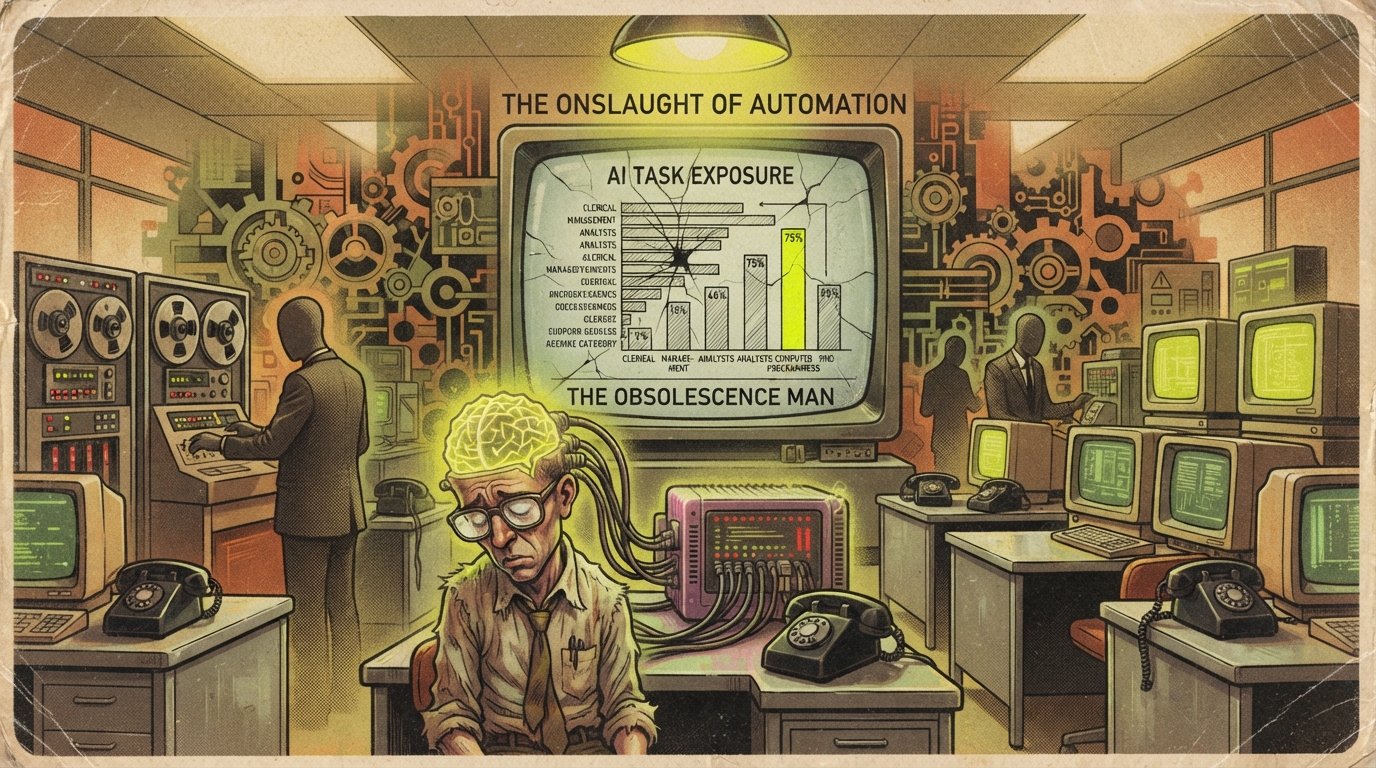
Computer programmers lead the list of most-exposed jobs, with 75% of their tasks covered by AI
Customer service representatives and data entry keyers follow, with 67% task coverage
Jobs involving computers and data are most at risk
AI could theoretically handle up to 94% of tasks performed by computer and mathematics professionals, but actual use remains around 33%
People in the most AI-exposed occupations tend to be older, more educated, more likely to be women, and higher-paid — with salaries 47% above average
Hiring of young workers in the most-exposed occupations is slowing, with a 16% fall in employment for people aged 22 to 25
There is a risk of a “great recession” for white-collar workers
“AI is far from reaching its theoretical capacity: real coverage remains a fraction of what is feasible,” the report states.
What this means: The AI displacement story is not uniform. It is a story about cognitive work being automated while physical work remains largely untouched. If you work with your hands or care for people in person, you are in the protected 30%. If you work primarily with data, documents, or code, you are in the exposed 70%.
The 19% Employment Gap for Young Workers
The most concerning labor market signal is not mass unemployment but the widening employment gap for young workers in AI-exposed occupations. Stanford’s research shows a 16% fall in employment for workers aged 22 to 25 in the most AI-exposed roles, with some measurements showing a gap as high as 19%.
The Stanford Digital Economy Lab’s “Canaries in the Coal Mine” paper, updated in August 2026, analyzed ADP payroll data through June 2026.
Key findings:
No widespread economy-wide job displacement from AI
Employment for 22-to-25-year-olds in AI-exposed occupations runs significantly below where it would be had it tracked their less-exposed peers
The gap is driven by reduced hiring rather than increased separations
Older workers and workers in less-exposed jobs are doing much better
Workers who use AI mainly to automate work had the largest employment declines
Workers who use AI to complement their work did much better
What this means for young workers: Entry-level roles in AI-exposed fields — software development, customer service, financial analysis, data processing — are being disproportionately affected. Companies are not firing experienced workers. They are simply not hiring junior staff for roles that AI can now handle.
The protection against this trend is twofold:
Choose occupations in the protected 30% — physical work, healthcare, skilled trades, education
If you work in an AI-exposed field, develop tacit knowledge — the kind you can only get through experience, mentorship, and real-world practice
Comparison: Jobs at Risk vs. Jobs Safe From AI
| Occupation | AI Exposure Level | Key Protection Factor | Near-Term Risk |
|---|---|---|---|
| Software developers | Very High (75% task coverage) | High salaries create transition buffer; senior roles more protected | High for entry-level; moderate for senior |
| Customer service representatives | Very High (67% task coverage) | Human escalation for complex issues | High; voice AI achieving 95% accuracy |
| Data entry keyers | Very High (67% task coverage) | Limited transferable skills | Very High |
| Financial analysts | High (60–70% task coverage) | Regulatory requirements; client relationships | Moderate to High |
| Writers and authors | High (57% task coverage) | Originality, voice, and creative direction remain human | Moderate to High |
| Radiologists | Moderate (professionalized role) | AI augments rather than replaces; demand growing | Low |
| Registered nurses | Low (14% automation risk) | Hands-on care, patient relationships | Very Low |
| Electricians | Very Low | Physical dexterity, situational judgment | Very Low |
| Cooks | Very Low | Physical work, real-world manipulation | Very Low |
| Motorcycle mechanics | Very Low | Diagnostic judgment, physical repair | Very Low |
| Lifeguards | Very Low | Physical presence, real-time rescue judgment | Very Low |
| Physical therapists | Very Low | Hands-on treatment, patient relationships | Very Low |
| Firefighters | Very Low (9% automation risk) | Physical rescue, high-stakes judgment | Very Low |
| EMTs and paramedics | Very Low (7% automation risk) | Emergency response, physical care | Very Low |
| CEOs and senior executives | Low | Accountability, strategic judgment | Low |
| Mental health counselors | Very Low (98% resistance score) | Therapeutic relationship, empathy | Very Low |
PwC: AI Is Creating a Two-Track Job Market
A counterintuitive finding from PwC’s 2026 AI Jobs Barometer: AI is not eliminating jobs. It is splitting the labor market into two tracks with very different outcomes.
PwC analyzed more than one billion online job postings across six continents.
Track 1: “Professionalised” roles — Jobs reshaped by AI to demand more expertise, judgment, and creativity. Examples include radiologists, employment recruiters, and air traffic controllers. These roles comprise about 22% of total advertised jobs and are growing twice as fast as democratised roles, with 42% higher wage growth since 2021.
Track 2: “Democratised” roles — Jobs where AI performs complex tasks, reducing skill barriers and shifting humans toward less specialized activities. Examples include software developers, loan officers, and finance managers. These roles make up 52% of advertised jobs.
“The clear lesson for both business leaders and workers: winning isn’t just about using technology; it’s about human skills,” PwC concluded. “The more AI is deployed, the more distinctly human expertise is valued.”
What this means: The AI job market is not simply destructive. It is transformative. Some roles are growing because AI makes workers more valuable. Others are being reshaped because AI makes workers less necessary for certain tasks. The key is to be in a role where AI amplifies your value rather than replacing it.
IBM CEO Arvind Krishna put it bluntly in a January 2026 Davos panel: “If you can’t explain to your 14-year-old why their chosen career won’t be replaced by AI, maybe that career needs rethinking.” Krishna also predicted that by the end of 2026, AI would likely handle most routine coding tasks — the kind junior developers typically do. But he expects demand for “forward-deployed engineers” and workers combining multiple skills to grow.
Goldman Sachs and McKinsey: The Big Picture on Displacement
Goldman Sachs estimates that more than 9% of the U.S. workforce — roughly 15 million workers — could be displaced during a 10-year AI transition. McKinsey projects that about 11 million American workers will need to leave their occupations entirely by 2035.
These are the most credible macro-level forecasts available. Neither predicts mass unemployment.
Goldman Sachs Research economist Joseph Briggs has stated: “We’re not expecting that displaced workers will be displaced over the long run. We do expect that ultimately there are going to be more than enough jobs created to accommodate them.”
Goldman Sachs baseline forecast:
Around 9% of U.S. workers will be reallocated to new positions during the AI transition
That corresponds to 15 million workers leaving or being displaced from their positions
The displacement will be spread over a 10-year period
The unemployment rate increase in any given year will likely be less than one percentage point
AI has reduced monthly payroll growth by roughly 16,000 jobs in the past year
McKinsey Global Institute key findings:
About 770,000 people per year would need to make an occupational switch — roughly 3.6 times the historical average
Lower-wage workers are 7.6 times as likely as higher-wage workers to need a new occupation
Only one in seven displaced workers has a direct path into a growing job that requires little retraining and pays at least as much
About 85% of growing jobs require a credential
Shrinking jobs are concentrated in office and administrative support, retail, and transportation
Job growth is in healthcare, construction, and management
“The next decade’s challenge is mobility, not scarcity,” McKinsey’s authors wrote.
What this means for workers: The jobs will exist, but getting into them is the problem. Workers in declining roles — particularly lower-wage administrative and retail positions — face the steepest climb. The safest path is to choose a field with growing demand and low AI exposure from the start.
Industry Spotlight: Where AI-Resistant Jobs Are Concentrated
Healthcare: The Most AI-Resistant Sector
Healthcare consistently ranks as the most protected sector. A framework scoring 35 careers found surgeons, general practitioners, and consultants scoring 91–96% on long-term resistance, with mental health counselors reaching 98%. Skilled trades scored 82–94%.
Planera’s study found EMTs (7% risk), healthcare social workers (12%), and registered nurses (14%) among the safest occupations. The sector benefits from three protections simultaneously: physical presence, human relationships, and high-stakes judgment.
Skilled Trades: Hands-On Work Wins
“Many of the hardest jobs to automate involve skilled trades that require working with your hands in constantly changing environments. Think electricians, plumbers, HVAC technicians, and auto mechanics. Every home, building, or vehicle presents a slightly different challenge requiring experience and real-time problem-solving. AI can help diagnose problems faster, but someone still has to show up with tools and fix the issue.”
Education: Human Connection Still Matters
Education scores 78–88% on AI resistance. “AI can deliver information, but it cannot notice that a child is struggling at home or adapt in real time to a difficult moment in a classroom.”
Construction: AI Adoption Lags
AI adoption in construction remains concentrated in data-rich and semi-structured tasks such as document review, estimating, reporting, and workflow monitoring. Research found “minimal alignment for site-based and manual activities.” Only one-third of white-collar staff at large contractors have tried AI at work.
Cybersecurity: A Growing Field With a Caveat
Cybersecurity is expanding — the global workforce gap stands at 4.76 million unfilled positions, up 19.1% year-on-year. However, AI is reshaping entry-level work. About 56% of cybersecurity professionals said AI has somewhat or significantly reduced the need for entry-level positions over the past year. At the same time, the share of cybersecurity job postings requiring AI skills doubled year over year across G7 countries, from 14.2% to 28.5%.
Is Your Job Safe? A Decision Tree
Use this decision tree to assess your personal AI displacement risk.
Step 1: Does your job require physical presence — manipulating objects, caring for people, or performing manual tasks?
Yes → You are in the protected 30%. Your risk is very low. Focus on deepening your expertise.
No → Proceed to Step 2.
Step 2: Does your job require real-time judgment under pressure, with consequences for failure?
Yes → You have significant protection. AI can inform but not replace accountability. Risk is low.
No → Proceed to Step 3.
Step 3: Is your job primarily knowledge-based and performed identically across companies?
Yes → You are at moderate to high risk. Proceed to Step 4.
No → You have some protection. AI struggles with roles requiring tacit knowledge and contextual judgment.
Step 4: Does your role involve routine tasks that can be codified in written procedures?
Yes → You are at high risk. AI excels at reproducing codified knowledge. Consider retraining.
No → You are at moderate risk. Develop skills in AI-augmented areas.
Step 5: Are you in the first 3–5 years of your career?
Yes → You face the highest risk. Entry-level roles in AI-exposed fields are being disproportionately affected.
No → You are more protected. Experienced workers show no comparable employment gap.
Step 6: Does your role involve tasks where AI complements rather than substitutes for your work?
Yes → You are at lower risk. AI may make you more productive and valuable.
No → You are at higher risk. Consider developing skills in AI-augmented areas.
Common Questions
What jobs are safe from AI?
About 30% of jobs have near-zero AI risk, according to Anthropic’s March 2026 report. The safest roles involve physical work, in-person service, and real-world manipulation. Examples include cooks, mechanics, lifeguards, electricians, plumbers, nurses, physical therapists, firefighters, and EMTs. Jobs requiring human relationships and high-stakes judgment are also highly protected.
Will AI take my job?
It depends on your occupation. Routine knowledge work in AI-exposed fields — software development, customer service, data entry, basic content creation — faces the highest risk. Goldman Sachs estimates 9% of U.S. workers will face displacement over 10 years. Jobs requiring physical presence, human judgment, and tacit knowledge are more protected.
What is the safest career for the AI era?
Careers combining physical skill and human judgment are safest: electricians, plumbers, HVAC technicians, nurses, physical therapists, surgeons, firefighters, and EMTs. PwC’s data shows that “professionalised” roles — jobs reshaped by AI to demand more expertise — are seeing twice the job growth and 42% faster salary increases.
Why are young workers hit hardest?
Entry-level roles involve routine tasks that AI can automate. Stanford found a 16–19% employment gap for workers aged 22–25 in AI-exposed occupations. Companies are reducing hiring for junior roles rather than firing experienced workers. As PwC noted, junior roles increasingly demand senior-level capabilities, requiring redesigned onboarding and mentorship programs.
Are trades safe from AI?
Yes. Skilled trades are among the most AI-resistant occupations. Electricians, plumbers, carpenters, welders, and mechanics require physical dexterity, situational judgment, and real-world problem-solving that current AI and robotics cannot replicate. The framework scoring 35 careers found skilled trades scoring between 82% and 94% for AI resistance.
Is healthcare safe from AI?
Healthcare is among the most AI-resistant sectors. Nursing, physical therapy, surgery, and emergency medicine require hands-on care, real-time judgment, and human relationships. Mental health counselors score 98% on AI resistance. AI augments these roles rather than replacing them.
What skills protect against AI displacement?
Four skills are most protective: high-stakes decision-making, adaptability, accountability, and emotional intelligence. PwC advises workers to “hone the skills with rising value in an AI era, such as creativity, people skills, leadership, judgment, and the ability to navigate complexity and ambiguity.”
Will AI create more jobs than it destroys?
Over the long run, likely yes. McKinsey projects 41 million new jobs versus 36 million eliminated by 2035. In the near term, the net impact is modestly negative. The challenge is mobility — getting displaced workers into growing roles. PwC found AI-exposed entry-level roles have grown 35% since 2019, while other entry-level roles declined 10%.
What should I study to be AI-proof?
Healthcare, skilled trades, engineering, education, and management are the most AI-resistant fields. Within any field, focus on roles requiring physical presence, human interaction, and judgment under uncertainty. PwC advises: “Consider moving toward roles made more expert by AI.”
How long will the AI job transition last?
Goldman Sachs projects a 10-year transition period. McKinsey’s forecast extends to 2035. The consensus is that disruption will be significant but time-limited, with new roles emerging as old ones decline.
What does the evidence say about AI job loss overall?
Anthropic’s report found “limited evidence” that AI has affected employment to date. The unemployment rate in exposed sectors has not risen systematically. However, hiring of young workers has slowed in high-exposure areas — a leading indicator worth monitoring.
Key Takeaways
About 30% of jobs have near-zero AI risk, according to Anthropic’s March 2026 report
The safest roles share three traits: physical work, in-person service, and real-world manipulation
Anthropic’s specific examples include cooks, motorcycle mechanics, lifeguards, bartenders, dishwashers, and dressing room attendants
Jobs most at risk involve computers and data: programmers (75% task coverage), customer service reps (67%), data entry keyers (67%)
Young workers aged 22–25 in AI-exposed roles face a 16–19% employment gap, per Stanford
Goldman Sachs estimates 15 million U.S. workers displaced over 10 years; McKinsey projects 11 million occupational changes by 2035
PwC found AI is creating a two-track market: professionalised roles growing twice as fast with 42% higher wage growth
Healthcare, skilled trades, education, and emergency services are the most AI-resistant sectors
The decision tree: if your job requires physical presence, human relationships, or high-stakes judgment, you are well-protected
PwC advises workers to build human-intensive skills — creativity, judgment, leadership, and people skills
Official & Trusted Resources
Anthropic: “Labor Market Impacts of AI: A New Measure and Early Evidence” (March 2026) — 30% of jobs have near-zero AI risk: anthropic.com/research/labor-market-impacts[reference:39]
Stanford Digital Economy Lab: “Canaries in the Coal Mine” (August 2026) — 16–19% employment gap for young workers: digitaleconomy.stanford.edu
Goldman Sachs Top of Mind: “An AI Job Apocalypse?” (June 2026) — 15 million U.S. workers displaced over 10 years: goldmansachs.com
McKinsey Global Institute: “Workforce in Motion” (September 2026) — 11 million occupational changes by 2035: mckinsey.com/mgi
PwC Global AI Jobs Barometer 2026 — Two-track labor market; professionalised roles growing 2x faster: pwc.com
Pew Research Center 37-Country Survey (September 2026) — Global attitudes on AI and jobs: pewresearch.org
Resume Now “Superhuman Skills” Ranking (July 2026) — Top 10 AI-proof jobs ranked by O*NET data: resume-now.com
Planera Study (April 2026) — EMTs ranked most automation-protected with 7% risk: workplacejournal.co.uk
NIST AI Risk Management Framework (AI RMF 1.0) — U.S. voluntary governance framework for AI risk management: nist.gov
EU AI Act (Regulation (EU) 2024/1689) — High-risk classification for employment-related AI: eur-lex.europa.eu