

Should You Be Worried About AI If You Work in an Office?
Office workers should be concerned about career disruption, not unemployment. Research from Anthropic and Stanford shows AI is replacing routine tasks — scheduling, data processing, document drafting — far faster than entire jobs. The real risk is concentrated in early-career hiring, where employment for workers ages 22–25 in AI-exposed roles has dropped roughly 16% since 2022. Experienced workers remain largely protected by tacit knowledge that AI cannot replicate.
Quick Facts
| Item | Details |
|---|---|
| Most Common Fear | That AI will eliminate white-collar jobs entirely |
| Who Is Most Affected | Entry-level office workers (ages 22–25) in admin, data, and writing roles |
| Is the Fear Evidence-Based? | Partially. Task displacement is documented; job elimination is not widespread |
| Expert Consensus | Office work is transforming, not disappearing. The entry-level pipeline is the most vulnerable point |
| Related Research | Anthropic Economic Index, Stanford Digital Economy Lab “Canaries in the Coal Mine,” Goldman Sachs workforce analysis, ILO Global Index of Occupational Exposure, UK Government Copilot Trials |
| Where to Learn More | Anthropic labor market research, Stanford Digital Economy Lab, EU AI Act Annex III, NIST AI Risk Management Framework |
| Updated For | September 2026 |
What Is Actually Happening to Office Jobs
AI is automating tasks inside office jobs, not eliminating the jobs themselves. Anthropic’s Economic Index analyzed millions of real Claude interactions to measure what it calls “observed exposure” — how much AI is actually being used in workplaces, not what it could theoretically do. Office and administrative roles show up to 90% theoretical task coverage, but only about one-third of tasks are actually being automated in practice. The gap between what AI can do and what it is doing remains enormous.
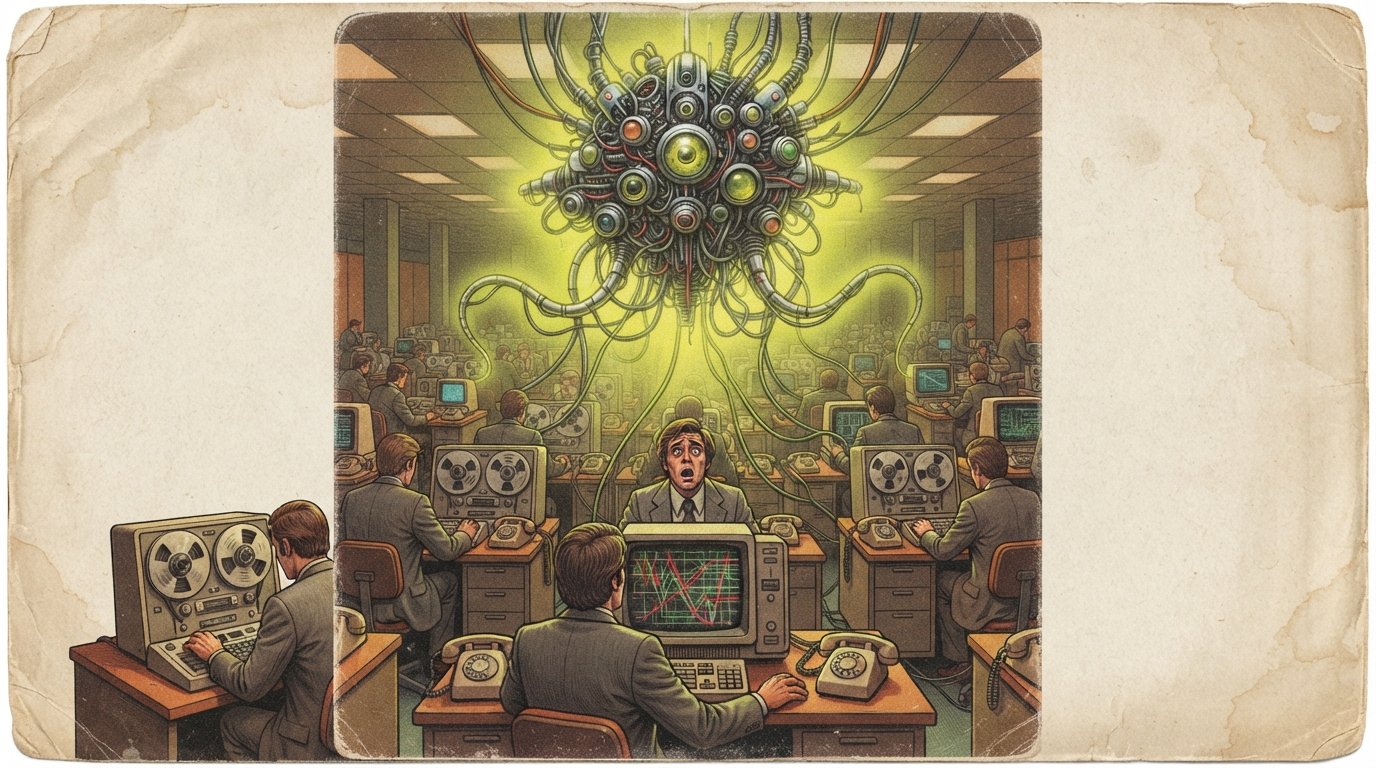
Goldman Sachs Research estimates AI could automate about 25% of work hours over the next decade, with office-heavy industries — banking, law, accounting, software development, customer service — most exposed. But Goldman Sachs CEO David Solomon has publicly pushed back on “AI apocalypse” narratives, saying he does not predict a major white-collar wipeout.
The paradox is this: office workers are more exposed to AI than any other category of worker, yet they are not — so far — being replaced en masse. What is happening is a redirection of work. Routine execution — data collection, standard reporting, basic code, first-draft documents — is being absorbed by AI. Value is migrating to judgment, validation, and strategic oversight.
The Theoretical vs. Observed Gap
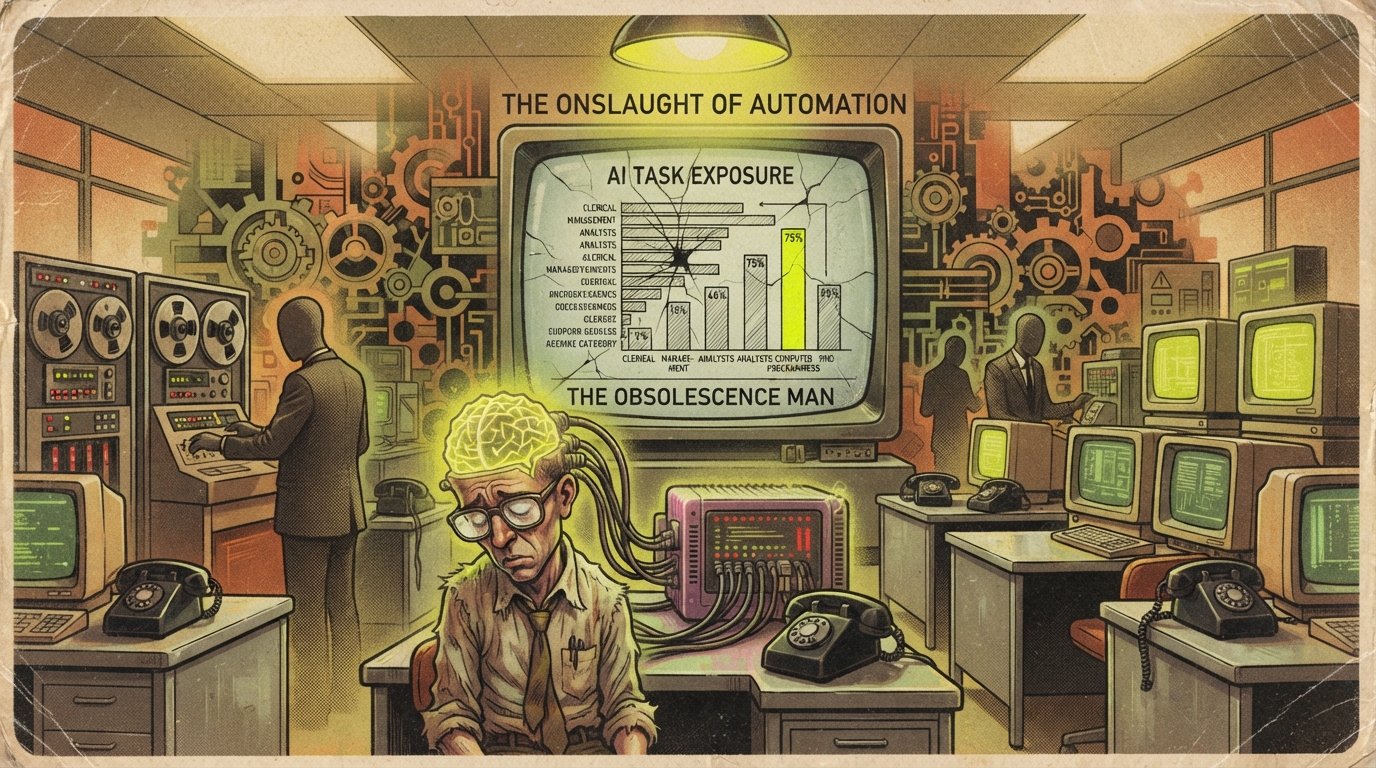
Anthropic’s research reveals a critical gap. In computer and mathematics occupations, 94% of tasks are theoretically automatable, but AI currently handles only about 33%. In business, finance, legal, and office administration roles, the pattern is similar: high theoretical exposure, moderate observed adoption.
Why the gap? Three reasons:
Integration friction. Enterprises are still building the workflows, governance, and training needed to deploy AI effectively
Quality control. AI output requires human review; errors in financial reports or legal documents carry real consequences
Cultural resistance. A WalkMe survey of 3,750 executives and employees found that 54% of workers deliberately completed tasks manually rather than use their company’s AI tools
The Office Jobs Most Affected by AI Right Now
Administrative and Clerical Roles
Administrative and office support roles show the highest task exposure at 46%, according to Goldman Sachs sector analysis. This includes data entry, document processing, scheduling, and routine correspondence.
The International Labour Organization found that roles at highest risk of AI-driven task automation account for 9.6% of female employment in higher-income countries — nearly triple the share for men. Clerical work has historically been a pathway to economic stability for women without advanced degrees, and that pathway is narrowing.
Customer Service and Support
Customer service representatives show approximately 70% task coverage by AI tools. Salesforce cut 4,000 support roles explicitly replaced by AI agents — the clearest documented case of direct AI-driven job replacement in a large company. However, Gartner found that only 20% of customer service organizations have actually reduced headcount. Most use AI to handle higher volumes with existing staff.
Legal Assistants and Paralegals
Legal support roles show 44% task exposure. AI now handles contract review, legal research, and document automation that once occupied most paralegal hours. An Am Law 100 study reported reducing document review time by two-thirds using generative AI. But paralegals are not disappearing — they are transitioning to supervising AI output, validating citations, and managing data workflows that AI cannot independently oversee. A study evaluating AI-generated legal responses found that 24% cited or applied law that the model misrepresented — underscoring why human legal review remains essential.
Financial Analysts and Junior Bankers
Financial analysis roles show over 50% theoretical task exposure. JPMorgan and Morgan Stanley have reportedly cut graduate analyst hiring by up to two-thirds as AI automates financial modeling and research tasks that defined those roles. UBS now requires new junior bankers to demonstrate AI proficiency as a hiring condition.
However, Goldman Sachs’ CEO told Bloomberg that AI will not cause a major white-collar wipeout in banking. BNY CEO Robin Vince has taken a different approach: rather than cutting analysts, he is telling them to embrace AI, framing it as a tool that will make their work more valuable, not obsolete.
Content Writers, Editors, and Marketing
Marketing and data analytics postings fell 25–31% in early 2026. AI can produce press releases, social media content, and marketing copy at scale. But the same pattern applies: AI produces text; humans decide what to say and why.
Codified vs. Tacit Knowledge: The Key Distinction
Stanford’s Digital Economy Lab draws the most useful line in this debate: codified knowledge (formal, documented, standardized — taught through manuals and procedures) vs. tacit knowledge (acquired through practice, mentorship, and repeated exposure to real situations).
Employment has declined among young workers in occupations relying heavily on codified knowledge. It has increased among experienced workers in occupations relying on tacit knowledge. This is the strongest evidence yet that AI is a tool for reproducing documented knowledge, not for replicating lived experience.
The Real Risk: A Broken Entry-Level Ramp
The most credible near-term danger for office workers is not that AI eliminates millions of jobs. It is that AI closes the door on entry-level positions that have historically served as the training ground for careers.
Stanford’s “Canaries in the Coal Mine” study found that employment among workers ages 22–25 in highly AI-exposed occupations has declined roughly 13–16% relative to less-exposed peers since late 2022. The adjustment is operating primarily through reduced hiring of young workers, not increased layoffs of existing staff.
A working paper released in November 2025 by the Stanford Digital Economy Lab found that workers aged 22 to 25 in the most AI-exposed occupations experienced a 16% relative decline in employment after the spread of generative AI.
The divergence affects those trying to enter the field, not those already established. Entry-level postings in the US have plummeted by 35% in the last 18 months, in large part because of AI, according to research firm Revelio Labs.
Anthropic CEO Dario Amodei has warned that AI could wipe out half of all entry-level white-collar jobs within one to five years and spike unemployment to 10–20% without intervention. Mustafa Suleyman, CEO of Microsoft AI, predicted in February 2026 that most professional tasks — including work done by lawyers, accountants, marketers, and project managers — would be “fully automated” within 12 to 18 months.
Not all experts share these views. Goldman Sachs Research estimates unemployment will increase by only half a percentage point during the AI transition. Approximately 60% of US workers today are in occupations that didn’t exist in 1940, and more than 85% of employment growth since then has been technology-driven.
What the Layoff Data Actually Shows
More than 180,000 corporate job losses have been linked to AI since May 2023, according to Challenger, Gray & Christmas, including 112,000 in 2026 alone
In early 2026, 95 tech firms including Amazon and Meta cut over 73,000 jobs
AI was cited in 22% of all 2026 layoffs through June
However, Oxford Internet Institute associate professor Carl-Benedikt Frey cautions that many companies are announcing AI-driven cuts primarily to impress investors rather than reflect genuine automation. “I haven’t seen any compelling evidence of the narrative that these firms are automating a lot of work,” he told the Financial Times
An FT analysis found that companies citing AI in job cuts underperformed the Nasdaq by almost 10% in the 30 trading days following their announcements
Jobs That Are NOT Being Replaced (And Why)
About 30% of occupations show almost no AI exposure because they require physical manipulation, spatial reasoning, or real-time human interaction in unpredictable environments.
Anthropic’s research identifies these roles as largely untouched: cooks, mechanics, lifeguards, bartenders, dishwashers, motorcycle repair technicians, and agricultural workers. The explanation is straightforward — AI has no hands. Computer-based cognitive labor is vulnerable; physical labor in unstructured environments is not.
For office workers specifically, the safest roles share these characteristics:
Client-facing relationship management — building trust, reading a room, navigating office politics
Complex decision-making under uncertainty — where the “right answer” depends on context AI cannot fully capture
Cross-functional leadership — coordinating between teams with competing priorities
Accountability roles — someone must be legally and ethically responsible for decisions
The Fear vs. Reality Comparison Table
| Fear | Realistic Near-Term Risk? | Expert View | What You Can Do |
|---|---|---|---|
| My entire office job will be automated | Low for most; moderate for routine task-heavy roles | Task replacement ≠ job replacement | Identify which tasks in your role are routine; build skills in judgment, relationship, and exception-handling |
| AI will cause mass white-collar unemployment | Low to moderate | Goldman Sachs: 0.5pp unemployment increase; Amodei: up to 20% without intervention | Monitor your industry; build portable skills; advocate for retraining programs |
| Young office workers can’t get entry-level jobs | High — documented | Stanford: 13–16% employment gap for 22–25 year olds in exposed occupations | Develop demonstrated skills via projects, certifications, and internships |
| AI will replace creative office work | Moderate for production; low for editorial judgment | AI produces text/images; struggles with what to say and why | Focus on taste, curation, and the “hardest first draft” |
| I’ll be forced to train my replacement | Moderate — already happening | Meta is tracking employee keystrokes and mouse movements for AI training data | Know your rights; document your contributions; build external proof of value |
| AI bias will discriminate in hiring/promotion | High in hiring, lending, and criminal justice | EU AI Act classifies employment AI as high-risk | Know your rights; organizations using AI for hiring must provide human review in the EU |
| AI surveillance will monitor my every move | High — already happening | Global market for employee-monitoring tech expected to exceed $4 billion in 2026 | Check your employment contract; EU workers have stronger protections |
| AI will make me worse at my job | Moderate — documented | University of Bath research warns AI could erode human capital and critical thinking | Use AI as a tool, not a crutch; periodically practice skills without it |
How AI Surveillance Is Changing Office Work
AI-enabled employee monitoring is expanding rapidly, with the global market for employee-monitoring technology expected to exceed $4 billion in 2026.
Meta began installing tracking software on US-based employees’ computers in April 2026 to capture mouse movements, clicks, and keystrokes for AI training data. This is not merely surveillance — it is training data collection. Every click an office worker makes becomes a data point for systems designed to automate that worker’s tasks.
A paper published in the Academy of Management found that employees perceive enterprise generative AI as an “additional, abstract surveillance agent capable of both enabling and constraining their work”.
The EU AI Act treats workplace performance monitoring as a form of “high-risk” AI, requiring transparency and human oversight. In the US, there is no equivalent federal protection, though some states have proposed legislation.
What the Experts Actually Say
The expert consensus is that AI will transform office work dramatically — but not eliminate it entirely.
Mustafa Suleyman (CEO, Microsoft AI): Predicted most professional tasks will be fully automated within 12–18 months. This is the most aggressive timeline from a major AI executive.
Dario Amodei (CEO, Anthropic): Warned AI could wipe out half of entry-level white-collar jobs within five years without government intervention. He has also proposed policies including a tax on AI companies and expanded worker retraining.
David Solomon (CEO, Goldman Sachs): Pushed back on AI apocalypse narratives, saying fears are “exaggerated.” Goldman Sachs economists project a 0.5 percentage point increase in unemployment during the transition.
Carl-Benedikt Frey (Oxford Internet Institute): Believes many AI-related layoffs are announced to “impress investors” rather than reflect genuine automation. “I don’t think AI-driven automation is the key story here”.
Erik Brynjolfsson (Stanford Digital Economy Lab): His research documents the entry-level employment decline but emphasizes that the effects are concentrated, not universal. Experienced workers in AI-exposed occupations show no comparable employment gap.
Research from the University of Bath: Warns that AI could erode human capital — eroding critical thinking, creativity, and expertise in the workplace. The study urges creation of “learning vaults” to protect these capabilities.
What Companies Are Actually Doing
Microsoft
Microsoft is pushing “professional-grade AGI” — AI systems designed to perform the full range of tasks handled by human professionals. The company is embedding Copilot across its enterprise suite. In a UK government trial involving 3,549 staff members, 90% of Copilot users reported time savings averaging 19 minutes per day, with the biggest gains in information search (26 minutes) and email writing (25 minutes). 65% reported feeling more fulfilled at work, and 73% reported improved output quality.
Anthropic
Anthropic publishes its Economic Index based on real Claude usage data. The company’s research shows 52% of AI interactions involve “augmentation” — humans and AI working together iteratively — compared to 45% classified as full task delegation.
OpenAI
OpenAI reportedly has a project codenamed “Mercury” to automate entry-level investment banking tasks, including IPO models and restructuring analyses. The company has hired over 100 former bankers and consultants for the project.
Salesforce
Salesforce cut 4,000 customer support roles explicitly replaced by AI agents — the most direct case of AI-driven job replacement documented at a major company. CEO Marc Benioff framed this as an “efficiency gain,” telling investors that the company’s support organization had “shrunk dramatically.”
Regulation and Government Response
The EU AI Act
The EU AI Act classifies AI systems used in employment and worker management as “high-risk.” This includes AI used for recruitment, promotion decisions, dismissal, task assignment, and monitoring of workers. High-risk systems are permitted but subject to strict compliance obligations: transparency, human oversight, and data governance requirements. The rules on high-risk systems take effect on 2 August 2026.
The Act also bans eight AI practices outright, including AI systems that infer emotions from biometric data in the workplace. Non-compliance can lead to fines of up to €35 million or 7% of annual turnover.
NIST AI Risk Management Framework
The US National Institute of Standards and Technology (NIST) published the AI Risk Management Framework (AI RMF 1.0) in January 2023. While voluntary, it has become the de facto standard for organizations deploying AI responsibly. The framework emphasizes transparency, accountability, and human oversight — principles directly relevant to workplace AI.
US Government Trials
The UK government conducted multiple controlled trials of Microsoft 365 Copilot across government departments. The Department for Work and Pensions trial (3,549 staff) found 90% of users saved time, averaging 19 minutes daily. The HMRC trial (3,000 staff) found 83% usage rates and an average satisfaction score of 7.1 out of 10. Across government, 20,000 civil servants reported saving approximately 26 minutes per day. These trials provide some of the most rigorous evidence available on how AI actually performs in large office environments.
How to Assess Your Own Risk: A Decision Framework
Step 1: List your daily tasks. Write down everything you do in a typical week.
Step 2: Mark each task as “codified” or “tacit.” Codified tasks have documented procedures and standard answers. Tacit tasks require judgment, relationship, or physical presence.
Step 3: Check AI exposure for your occupation. Use Anthropic’s labor market reports or the ILO’s occupational exposure index as starting points.
Step 4: Identify your “moat.” What can you do that AI cannot easily replicate? This usually falls into: complex judgment under uncertainty, relationship-based trust, physical dexterity in unstructured environments, or accountability (someone must be legally responsible).
Step 5: Build toward the moat. If your current role is heavily codified, pursue opportunities that build tacit knowledge — mentorship, cross-functional projects, client-facing work, or advanced training.
Step 6: Keep a 6–12 month runway. Both financial and skill-based. If your role is disrupted, you want options.
Step 7: Monitor, don’t panic. The Stanford data shows experienced workers in exposed occupations are not seeing employment declines. The risk is concentrated on the entry ramp.
What You Should Do Right Now
Stop treating AI as an afterthought. Learn to use AI tools deliberately — not casually.
Build AI literacy. Understand what large language models can and cannot do. Know their failure modes.
Move from task work to decision work. The professional who only collects data or writes standard reports has lost their shield. The professional who validates, decides, and takes responsibility has not.
Double down on non-automatable skills. Strategic negotiation, reading ambiguous scenarios, emotional intelligence, and leadership remain strictly human attributes.
Become an AI auditor in your domain. Learn how to manage, audit, and refine the output of AI tools in your area. The market will not fire those who use AI to expand their cognitive capacity.
Watch for signs your role is being reshaped. If your manager asks you to document your processes in detail, or if your company is deploying AI tools that shadow your work, ask questions about the intent.
Common Questions
Will AI take my office job entirely?
For most office workers, no — not in the near term. AI is replacing tasks within jobs, not entire occupations. The roles most at risk are those composed almost entirely of routine, codified tasks. If your job involves judgment, relationships, or accountability, your position is more resilient than headlines suggest.
Which office jobs are most at risk from AI?
Administrative and office support roles show 46% task exposure, followed by legal support (44%) and architecture and engineering (37%), according to Goldman Sachs sector analysis. Customer service, data entry, and routine content production face the highest near-term task displacement.
Are young office workers more vulnerable than experienced ones?
Yes. Stanford’s research documents a 13–16% relative employment decline for workers ages 22–25 in AI-exposed occupations. This is driven by reduced hiring, not increased layoffs. Experienced workers show no comparable gap because they possess tacit knowledge that AI cannot replicate.
Should I be worried about AI surveillance at work?
If you work in the US, your employer has broad latitude to monitor your work activity. Meta’s tracking of employee keystrokes for AI training is legal. In the EU, the AI Act classifies workplace monitoring as high-risk, requiring transparency and human oversight. Check your employment contract and know your local laws.
Is my company required to tell me if AI is used in HR decisions?
In the EU, yes — the AI Act requires employers to inform workers about AI systems used in the workplace, and employment AI is classified as high-risk. In the US, there is no equivalent federal requirement. Some states have proposed legislation.
Will AI create new office jobs?
Yes. AI strategists, conversational AI designers, automation analysts, and AI ethics officers are among the fastest-growing new roles. Gartner found that 42% of organizations are hiring for AI-focused positions. The challenge is that these roles often require different skills than the jobs being displaced.
How long do I have before AI significantly affects my office job?
Timelines vary wildly. Suleyman predicts 12–18 months; Goldman Sachs projects a 10-year transition; Stanford’s data shows the entry-level impact is already here. The honest answer is that the transition is uneven — some roles will change this year, others in five years. Prepare now rather than waiting for certainty.
Is AI making office workers less skilled?
Emerging research suggests it can. A University of Bath study warns AI could erode human capital, critical thinking, and expertise. Research in ScienceDirect found that generative AI enhances creative performance but erodes content diversity and, upon AI withdrawal, creative performance drops significantly while homogeneity increases — a phenomenon researchers call a “creativity illusion”.
What is the single most important thing I can do?
Build tacit knowledge — the kind acquired through practice, mentorship, and real-world problem-solving. This is the one asset AI cannot replicate. Every hour spent on judgment-building work (client negotiations, complex troubleshooting, cross-functional leadership) is an hour invested in career durability.
Is the fear exaggerated or evidence-based?
Both. The fear of mass white-collar unemployment is exaggerated relative to current data — employment for experienced workers in AI-exposed fields has not collapsed. But the fear of career disruption for entry-level workers is evidence-based and documented. The appropriate response is preparation, not panic.
Key Takeaways
AI is replacing tasks, not entire office jobs — for now. Office and administrative roles show up to 90% theoretical automation potential, but only about one-third of tasks are actually automated in practice.
The entry-level ramp is the most vulnerable point. Workers aged 22–25 in AI-exposed occupations face a 13–16% employment gap — the clearest documented harm.
Administrative support (46%), legal work (44%), and engineering (37%) show the highest task exposure. Customer service, data entry, and routine writing are most affected.
AI layoffs are real but modest. About 180,000 corporate job losses have been linked to AI since 2023 — 22% of 2026 layoffs, but a small fraction of total employment.
The EU AI Act treats employment AI as high-risk. Employers must provide transparency and human oversight; fines reach 7% of global turnover.
Experienced workers remain protected by tacit knowledge. Stanford’s data shows no employment decline for older workers in AI-exposed occupations.
AI surveillance at work is expanding. The global employee-monitoring market is expected to exceed $4 billion in 2026. Meta now tracks keystrokes for AI training.
The gap between theoretical and actual automation remains large. In computer/math occupations, 94% of tasks are theoretically automatable, but only 33% are actually automated.
Creativity and critical thinking may erode with over-reliance on AI. Research warns of a “creativity illusion” — improved output with AI, declining ability without it.
Preparation beats panic. Build tacit knowledge, learn AI tools deliberately, and focus on what cannot be programmed: judgment, relationships, and accountability.
Official & Trusted Resources
Anthropic Economic Index — Real-world AI usage data by occupation: https://www.anthropic.com/research/labor-market-impacts
Stanford Digital Economy Lab “Canaries in the Coal Mine” — Payroll data analysis of AI employment effects: https://digitaleconomy.stanford.edu
Goldman Sachs Research: How Will AI Affect the Global Workforce? — Macroeconomic projections: https://www.goldmansachs.com/insights/artificial-intelligence
ILO: Generative AI and Jobs: A Refined Global Index of Occupational Exposure — Global employment data: https://www.ilo.org
EU AI Act (Regulation 2024/1689) — High-risk classification for employment AI: https://eur-lex.europa.eu
NIST AI Risk Management Framework (AI RMF 1.0) — Voluntary risk management guidance: https://www.nist.gov/itl/ai-risk-management-framework
UK Government DWP Copilot Trial Evaluation — Controlled office AI productivity study: https://www.gov.uk/government/publications/an-evaluation-of-dwps-microsoft-copilot-365-trial
World Economic Forum Future of Jobs Report 2025 — Employer survey data on expected displacement: https://www.weforum.org