
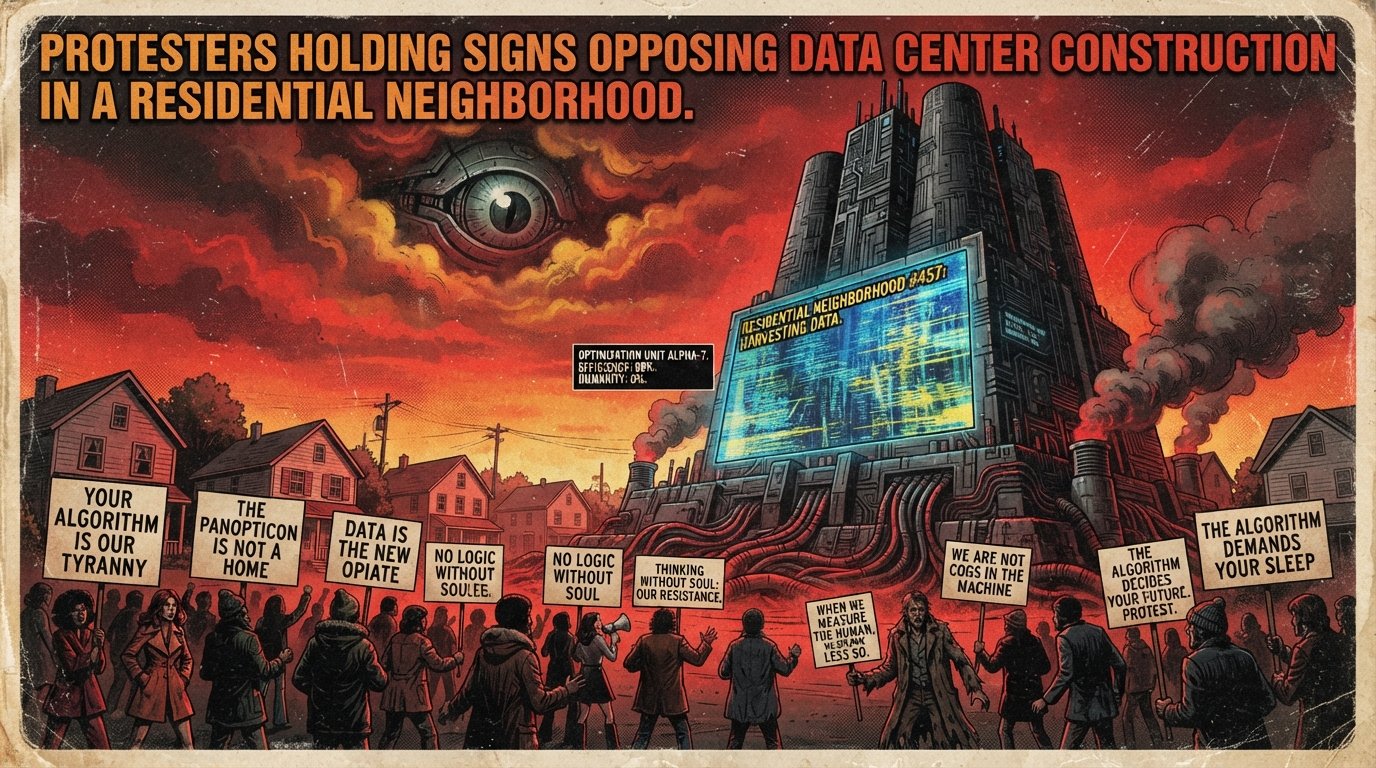
Data Center Anxiety: Why Communities Are Pushing Back Against AI’s Growing Footprint
The most common fear driving community pushback against AI data centers is that these facilities will consume disproportionate amounts of local water and electricity while shifting costs onto ordinary ratepayers and producing constant noise pollution. Residents worry they’ll bear the environmental and financial burden while tech companies capture the profits. This fear is supported by real, documented resource consumption—though some claims about data center impacts are exaggerated or misattributed.
Quick Facts
| Item | Details |
|---|---|
| Most Common Fear | That data centers will drain local water supplies and raise electricity bills for residents |
| Who Is Most Affected | Residents in water-stressed regions (Arizona, Texas, Georgia), communities near new hyperscale facilities, and ratepayers in states with cost-shifting utility rules |
| Is the Fear Evidence-Based? | Partially. Water and electricity consumption are real and documented. Cost-shifting to ratepayers occurs in some jurisdictions. Some noise claims lack rigorous measurement. |
| Expert Consensus | Data centers do consume significant resources, but impacts vary widely by location, cooling technology, and utility rate structure. Moratoriums are a reasonable pause for study, not a permanent solution. |
| Related Research | Data Center Watch Q2 2026 report; Brookings Institution community benefits agreement research; Lawrence Berkeley National Laboratory electricity pricing studies |
| Where to Learn More | Data Center Watch, NIST AI Risk Management Framework, EU AI Act energy reporting requirements, local zoning board meetings |
| Updated For | September 2026 |
What Is a Data Center, and Why Does It Matter?
A data center is a physical facility that houses computer servers, storage systems, and networking equipment. These facilities process, store, and transmit digital information. AI data centers are a specialized subset designed to handle the intensive computational demands of training and running artificial intelligence models, particularly large language models (LLMs) like those powering ChatGPT, Claude, and Gemini.
AI training requires thousands of specialized chips—mostly graphics processing units (GPUs) made by Nvidia—running simultaneously for weeks or months. These chips generate enormous heat and consume massive amounts of electricity. The facilities that house them need industrial-scale cooling systems, backup power generators, and robust electrical infrastructure.
Who this affects: Anyone who uses AI tools benefits from these facilities. But people living near them bear the environmental and quality-of-life costs. Workers in construction and operations gain jobs, while residents in surrounding communities gain noise, traffic, and utility infrastructure strain.
Why it matters: The global AI boom has triggered a data center construction surge unlike anything seen before. In the United States alone, data center investment grew 32% in 2025 and was projected to increase another 75% in 2026. This scale of development is colliding with local infrastructure that was never designed for it—and communities are pushing back.
The Water Problem: How Much Do AI Data Centers Actually Consume?
AI data centers consume significant water, primarily for cooling. In 2025, data centers worldwide consumed approximately 222 billion liters of water for cooling, according to consultancy Rystad Energy. Without mitigation measures, that figure could nearly triple to 644 billion liters by 2030.
The water is used in two main ways:
Evaporative cooling: Many data centers use cooling towers that evaporate water to dissipate heat. This water is lost to the atmosphere and cannot be recovered.
Electricity generation: Even data centers using “closed-loop” liquid cooling still consume water indirectly through the power plants that generate their electricity. As one IEEE study noted, AI workloads tightly couple energy use with water demand, as training large-scale models like GPT-3 and GPT-4 indirectly consumes significant freshwater through both data-center cooling and electricity generation.
Some numbers put this in perspective:
Forty-seven data centers in Johor, Malaysia, consume approximately 675 million liters of water daily—enough to fill 270 Olympic swimming pools.
AI-driven growth alone could consume as much extra water annually by 2030 as Americans currently drink, estimates water treatment specialist Ecolab.
A single large data center can use between 1 million and 5 million gallons of water per day, comparable to a small city.
Amazon disclosed that its global data center operations used 2.5 billion gallons of water in 2025 at a rate of 0.12 liters per kilowatt-hour—a figure it claims is seven times better than the industry average of 0.84 L/kWh. Google, by contrast, reported using 1.15 liters per kilowatt-hour in 2025.
What this means for you: If you live in a water-stressed region—the American Southwest, parts of Texas, or areas dependent on depleted aquifers—a new data center could compete with your community for water. Water utilities may need to expand capacity, and those costs can flow to residential customers.
Electricity Consumption and the Ratepayer Question
The electricity demand from AI data centers is staggering. Data centers accounted for about 4% of U.S. electricity demand in 2023, and that share is growing rapidly. Between 2020 and 2025, the average residential electricity price in the U.S. rose from 13.15 cents to 17.30 cents per kilowatt-hour. While many factors drive electricity prices, data centers are contributing to demand growth that utilities must plan for.
Do Data Centers Actually Raise Your Electricity Bill?
This is more complex than headlines suggest.
The “denominator effect”: When a large data center connects to a utility’s grid, it spreads the utility’s fixed costs across more customers. This can actually lower rates for residential customers in the short term.
Cost-shifting: However, in many jurisdictions, utilities design special discounted rates for large industrial customers like data centers, then recover the difference from residential ratepayers. A Harvard Electricity Law Initiative paper documented how utilities force ratepayers to fund discounted rates for data centers through secret contracts.
Regional transmission costs: Maryland Democrats urged FERC to protect Marylanders from approximately $2 billion in regional transmission costs driven by out-of-state data centers that were assigned to Maryland ratepayers rather than the data centers themselves.
PJM capacity prices surged from $29 per MW-day for 2024 to $329 per MW-day for 2026—a more than tenfold increase—before reaching a record high of $334 per MW-day for 2027.
| Claim | Reality |
|---|---|
| “Data centers don’t raise electricity bills” | Sometimes true in the short term due to the denominator effect, but misleading over longer horizons and in regions with cost-shifting rules |
| “Data centers are the sole cause of rate hikes” | Overstated. Aging infrastructure, regulatory mandates, and wholesale power costs are major drivers. But data centers add significant new demand. |
| “Ratepayers always subsidize data centers” | Jurisdiction-dependent. Some states (California, Colorado, Virginia) have enacted or proposed legislation to prevent cost-shifting. |
What you should do: Check your state’s utility commission proceedings. If a data center is proposed in your area, ask whether the utility plans to create a separate rate class for large loads. The U.S. House of Representatives has already passed a bill to bar grid costs tied to data center construction from being shifted onto ordinary households.
Noise Pollution: The Overlooked Community Impact
Noise is one of the most visceral reasons communities oppose data centers. Unlike water or electricity, which are largely invisible, data center noise is constant and inescapable for nearby residents.
Data centers generate noise from multiple sources: cooling tower fans, air chillers, backup diesel generators, and the hum of thousands of servers. Unlike typical urban noise, data center noise is present 24 hours a day, seven days a week. Community complaints focus on its unrelenting constancy rather than its peak volume.
The infrasound problem: Some of the most distressing noise may be inaudible. Infrasound—acoustic energy below 20 Hz—can’t be heard but may be perceived as pressure changes, vibrations, or building rattle. Residents near data centers have complained that low-frequency noise and infrasound produce headaches, nausea, anxiety, and other health problems.
However, most of these claims have not been fully validated. Measuring infrasound accurately requires specialized equipment, and few communities have conducted the assessments necessary to prove causation.
The xAI Memphis Case
The most high-profile noise dispute involves Elon Musk’s xAI data centers in Memphis, Tennessee. When xAI built its “Colossus” supercomputer facility, nearby residents in Southaven, Mississippi, reported a constant, unrelenting noise that one resident described as “torture.”
Residents filed a class-action lawsuit alleging that xAI’s power plant is blasting “omnipresent and inescapable” noise and seeking damages for emotional distress. The lawsuit claims the facilities are “wreaking havoc” on Memphis-area communities.
At least six noise-related lawsuits were filed against data center operators in 2026, including a proposed class action against Microsoft for its Fairwater AI campus in Mount Pleasant, Wisconsin.
What you can do: If a data center is proposed near your home, demand that the developer provide infrasound measurements as part of the permitting process. Standard dBA noise ordinances often miss low-frequency noise entirely.
Zoning Battles and Moratoriums: The Local Response
Local governments have responded to community anxiety with an unprecedented wave of moratoriums and zoning restrictions.
The Moratorium Movement by the Numbers
Since January 2026, moratorium-related activity has appeared in public meetings across 1,030 U.S. jurisdictions. In 632 of them, the conversation has turned into concrete action to pause data center approvals.
270 jurisdictions have adopted a data center moratorium
25 have extended one already in place
120 have formally introduced an ordinance or held a first reading
232 have directed staff studies or legal review
172 more are fielding public requests for a moratorium
The geography is broad. Georgia leads with 45 jurisdictions in a formal process, followed by North Carolina (39), Florida (37), Wisconsin (36), and New Jersey (33). California, Massachusetts, and Michigan each have 20 or more.
Project-Level Impact
Roughly 45 data center projects worth $68 billion were blocked or delayed by local pushback in the second quarter of 2026 alone, according to research group Data Center Watch. Data Center Watch identified 843 opposition groups across 49 states.
In the first three months of 2026, local opposition blocked or delayed at least 75 data center projects worth roughly $130 billion.
Case Examples
Palm Beach County, Florida: Commissioners unanimously approved a one-year moratorium on new hyperscale AI data centers in September 2026, following the rejection of “Project Tango,” a data center expansion proposal near an elementary school. Regulations under consideration include capping power consumption at 50 megawatts and requiring public disclosure of end-users.
Richmond Township, Michigan: Passed a one-year moratorium in February 2026 after a data center company inquired about locating a facility there.
St. Bernard, Ohio: Village Council approved a 12-month moratorium to examine infrastructure, utility capacity, and zoning laws.
Hutto, Texas: Zydeco Development withdrew its zoning request for a data center in April 2026 after considerable opposition from residents citing health, noise, heat, water, and power usage concerns.
A Gallup survey fielded in March 2026 put local opposition at 71%, with 48% strongly opposed—higher than opposition to a nearby nuclear plant. A June Reuters/Ipsos poll found only 14% of Americans would support an AI data center in their community.
What’s Exaggerated vs. Evidence-Based: A Fear-by-Fear Breakdown
| Fear | Realistic Near-Term Risk? | Expert View | What You Can Do |
|---|---|---|---|
| Water depletion from data centers | Regionally dependent; high in arid areas | Real but site-specific. Closed-loop cooling can cut water use by 90%. | Ask for water use disclosures; support closed-loop requirements in local ordinances |
| Electricity rate increases | Moderate; jurisdiction-dependent | Complex. Denominator effect can lower rates, but cost-shifting is real in many states. | Monitor utility commission proceedings; advocate for separate rate classes |
| Noise and infrasound health effects | High for nearby residents | Audible noise is well-documented. Infrasound health claims are plausible but not rigorously proven. | Demand infrasound measurement in permitting; support noise ordinances that address low-frequency sound |
| Property value decline | Moderate to high near facilities | Evidence from similar industrial uses suggests negative impact. Data centers have unique noise and visual profiles. | Organize with neighbors; negotiate community benefit agreements with property value protections |
| Job displacement from AI (not data centers directly) | High for some roles | Data centers create construction and operations jobs but relatively few permanent positions. AI itself may displace workers in other sectors. | Focus on workforce training programs tied to data center development |
| Data centers cause blackouts | Low in most regions | Grid operators plan for large loads. But in strained systems, data center demand can stress reliability. | Support grid modernization and demand response programs |
What Experts and Researchers Actually Say
The expert consensus is more nuanced than either industry PR or community opposition often acknowledges.
On water: “Generally, there is a correlation between the volume of water and the amount of electricity needed for temperature control,” warns Andy Masley, an independent researcher. However, Nvidia claims its new DSX servers using closed-loop liquid cooling can achieve “up to 100% reduction in water used.”
On electricity prices: “The question is essentially whether data centers are causing electricity prices to rise, to which [the answer is] essentially no, and also yes,” says Andy Lubershane, head of research at Energy Impact Partners. The reality depends entirely on how utility rates are structured and whether regulators protect ratepayers.
On the backlash itself: “One of the biggest obstacles facing data centers is that they’re politically hated on the left and the right, and we’re going into elections, and a lot more money is going to be spent,” said Amanda Peterson Corio, global head of data-center energy at Google.
Illinois Governor JB Pritzker said the concerns are appropriate, citing not only enormous electricity demand but also water use, noise, and zoning issues. But he stopped short of calling for a ban: “Just saying we’re going to have a moratorium, I don’t think by itself is the answer. If we are going to allow them anywhere, we have to make sure they’re bringing their own clean energy and that they’re using closed-loop water systems.”
Brook Porter, a partner at G2 Venture Partners, called the backlash “a bit irrational” and said most people haven’t yet experienced AI’s benefits. “Right now it’s just this abstract thing that they’re hearing about,” he said.
What AI Companies Are Doing About It
Major AI companies have begun responding to community concerns, though critics argue the responses are insufficient.
Microsoft
Microsoft’s chief sustainability officer Melanie Nakagawa said the company is “ring-fencing” data center-related costs so they don’t flow to residential ratepayers, investing in workforce development, and releasing water usage data from its data center campuses.
Microsoft has also developed a “Community-First AI Infrastructure” model, first implemented in San Antonio, which includes community benefits agreements negotiated with local leaders.
Amazon
Amazon’s chief sustainability officer Kara Hurst said 90% of the time the company isn’t using water to cool its data centers. “That’s an important statistic because there’s a lot of misinformation out there about water,” she said.
Amazon reported using 0.12 liters of water per kilowatt-hour in 2025—seven times better than the industry average of 0.84 L/kWh, according to the company’s own disclosure.
OpenAI
OpenAI committed $80 million in community benefits for its data center project in Effingham County, Georgia, directing funds toward schools, public safety, healthcare, utilities, workforce training, housing, and small business support.
The company also has a sustainability steering committee and has pointed to its “Stargate Community” commitment to develop AI infrastructure in ways that benefit local communities.
Anthropic
Anthropic signed Canada’s Responsible Data Centre Development Principles, agreeing to minimize water use and not shift electricity costs to consumers. The company is also working with a carbon accounting and emissions disclosure platform called Watershed.
The Transparency Gap
Despite these commitments, critics note that OpenAI, Anthropic, and xAI have yet to publish sustainability reports, greenhouse gas emissions data, or commit to achieving net-zero emissions—unlike Google and Microsoft.
Regulation and Government Response
Federal Level (United States)
The U.S. House of Representatives passed a bill to protect ratepayers by barring grid costs tied to data center construction from being shifted onto ordinary households.
Thirty statehouses introduced measures addressing data center siting, electricity, and water in 2026, with many adopting them.
State Level
California: SB 57 (enacted 2025) requires the Public Utilities Commission to assess the extent to which electricity costs from data centers are shifting to other customers.
Virginia: Enacted legislation requiring data centers to bear the full cost of their electricity use.
Colorado: Established a Data Center Development Authority to address cost allocation.
International
Canada: The federal government introduced the Responsible Data Centre Development Principles, with five expectations: create lasting local benefits, don’t shift electricity costs to consumers, minimize water use and environmental impacts, be transparent about local impacts, and bring strategic value to Canada. Twenty-three companies signed on, including OpenAI, Anthropic, Google, Microsoft, Meta, and Amazon Web Services.
Australia: Prime Minister Anthony Albanese announced plans for legislation requiring large data centers to underwrite or supply new power generation and minimize water use.
European Union: The EU AI Act requires providers of general-purpose AI models to document the computational resources used to train the model and known or estimated energy consumption. The Commission is developing a code of practice with commitments on implementing these rules.
How Individuals Can Protect Themselves
If a data center is proposed in your community, here’s a practical decision tree:
Step 1: Find out what’s proposed.
Attend local planning commission and zoning board meetings
Request the developer’s site plan, water usage projections, and electricity demand estimates
Ask whether the facility will use evaporative or closed-loop cooling
Step 2: Assess your personal risk.
Are you on a well or dependent on a water-stressed municipal supply?
Is your electricity provider subject to cost-shifting rules that favor large customers?
How close is the proposed site to your home, school, or place of work?
Step 3: Organize with neighbors.
Data Center Watch has documented 843 opposition groups across 49 states. You are not alone.
Contact your local elected officials and state utility commission
Consider whether a community benefits agreement (CBA) could address your concerns
Step 4: Understand what CBAs can and can’t do.
CBAs are legally binding contracts between developers and communities
They can guarantee water use limits, noise mitigation, property value protections, and local hiring commitments
The Brookings Institution has published research on how CBAs can address data center concerns
Step 5: Engage with regulators.
State public utility commissions set the rates that determine whether you subsidize data centers
FERC (Federal Energy Regulatory Commission) oversees regional transmission costs
NIST’s AI Risk Management Framework provides guidance on managing AI-related risks, including infrastructure impacts
Latest Developments and Rule Changes
September 2026: Microsoft and Google executives publicly addressed data center backlash at climate meetings in New York, acknowledging community concerns about electricity, water, and workforce impacts.
September 2026: Palm Beach County approved a one-year moratorium on hyperscale AI data centers.
September 2026: GatherGov reported that 632 U.S. jurisdictions have taken concrete action to pause data center approvals.
July 2026: 142 protests across 42 states were coordinated by HumansFirst, a grassroots group co-founded by former Tea Party leaders. The group calls the data center buildout “unaccountable” and an “unacceptable infringement on our liberty.”
June 2026: Amazon disclosed its data center water use for the first time: 2.5 billion gallons in 2025.
March 2026: Gallup found 71% of Americans oppose data centers in their area—higher than opposition to a nearby nuclear plant.
February 2026: Richmond Township, Michigan passed a one-year moratorium after a data center inquiry.
Common Questions
1. Are data centers really using all that water?
Yes, but amounts vary enormously. In 2025, data centers worldwide consumed about 222 billion liters for cooling. That could nearly triple by 2030 without mitigation. However, Amazon reports using only 0.12 liters per kWh—seven times better than the industry average. The gap between best and worst operators is enormous.
2. Will a data center raise my electricity bill?
It depends on where you live. In some jurisdictions, data centers spread fixed utility costs across more customers, lowering rates. In others, utilities design special discounted rates for large customers and recover the difference from residential ratepayers. Check your state’s utility commission rules.
3. What is infrasound, and is it making people sick?
Infrasound is acoustic energy below 20 Hz—too low to hear, but possibly felt as pressure or vibration. Some residents near data centers report headaches, nausea, and anxiety. However, most claims haven’t been rigorously validated because measuring infrasound requires specialized equipment that few communities have deployed.
4. Can a data center really drain my town’s water?
In arid regions, yes, it’s a real risk. A single large data center can use 1-5 million gallons per day, comparable to a small city. This is why closed-loop cooling systems—which can cut water use by 90%—are becoming a focus of local ordinances.
5. Why are data centers being built so fast?
AI training and inference require enormous computing power. Demand for GPUs and data center capacity has exploded since ChatGPT’s release in 2022. Data center investment grew 32% in 2025 and was projected to grow another 75% in 2026. Communities are struggling to keep up with the pace of development.
6. What is a community benefits agreement, and should I support one?
A CBA is a legally binding contract between a developer and a community that guarantees specific benefits—water use limits, noise mitigation, local hiring, property value protections—in exchange for community support. The Brookings Institution says CBAs can address public concerns if they are “legally binding and developed collaboratively.”
7. Are data centers good or bad for local jobs?
They create construction jobs during the building phase and a relatively small number of permanent operations positions. Gallup found two-thirds of data center supporters pointed to local economic benefits, especially jobs. But opponents note that the permanent job count is small relative to the facility’s footprint.
8. What is the EU AI Act, and does it address data center impacts?
The EU AI Act is a comprehensive regulation classifying AI systems by risk level. It requires providers of general-purpose AI models to document computational resources and known or estimated energy consumption. It also encourages voluntary codes of conduct on environmental sustainability.
9. How can I find out if a data center is planned for my area?
Attend local planning commission and zoning board meetings. Moratorium discussions are increasingly common—632 jurisdictions have taken action since January 2026. You can also monitor Data Center Watch, which tracks opposition groups and project delays.
10. Is the community backlash going to stop AI development?
It’s slowing it down, not stopping it. Roughly 45 projects worth $68 billion were blocked or delayed in Q2 2026 alone. But “consent” has become a critical fourth input alongside chips, power, and capital. Developers can’t ignore community opposition—they have to price it into every project.
11. What’s the difference between a data center and an AI data center?
All AI data centers are data centers, but AI data centers are optimized for the intensive computational demands of AI workloads—particularly training large language models. They typically require more powerful chips (GPUs), more electricity, and more cooling capacity than traditional data centers.
12. Do data centers cause blackouts?
In most regions, no—grid operators plan for large loads. But in strained systems, data center demand can stress reliability. PJM, the largest U.S. grid operator, saw capacity prices surge from $29 per MW-day in 2024 to a record $334 per MW-day for 2027, reflecting the strain of new demand.
Key Takeaways
Community opposition is blocking real projects. Roughly 45 data center projects worth $68 billion were delayed or rejected in Q2 2026 alone, according to Data Center Watch. 632 U.S. jurisdictions have taken moratorium action since January 2026.
Water consumption is the most visceral concern. Data centers globally consumed 222 billion liters of water for cooling in 2025. That could nearly triple by 2030 without mitigation. Best-in-class operators use 7x less water than industry average.
Electricity cost-shifting is a real but jurisdiction-dependent problem. In some states, utilities design discounted rates for data centers and recover costs from residential ratepayers. Maryland ratepayers were assigned roughly $2 billion in transmission costs driven by out-of-state data centers.
Noise—especially infrasound—is underregulated. Standard dBA noise ordinances miss low-frequency noise that residents describe as constant, unrelenting, and harmful. At least six noise lawsuits were filed against data center operators in 2026.
Public opinion has turned sharply against data centers. 71% of Americans oppose data centers in their area (Gallup, March 2026), higher than opposition to a nearby nuclear plant. Only 14% would support one in their community (Reuters/Ipsos, June 2026).
Major AI companies are responding, but transparency gaps remain. Microsoft, Amazon, Google, OpenAI, and Anthropic have made various commitments on water, electricity, and community benefits. However, OpenAI, Anthropic, and xAI have not published sustainability reports or emissions data.
Regulation is emerging at every level. Thirty statehouses introduced data center measures in 2026. Canada introduced a national framework with 23 corporate signatories. The EU AI Act requires energy consumption documentation for general-purpose AI models.
Community benefits agreements are the emerging compromise tool. CBAs—legally binding contracts between developers and communities—are being promoted by the Brookings Institution and others as a way to address local concerns while allowing development to proceed.
The backlash is bipartisan and national. 142 protests across 42 states were coordinated by HumansFirst, a group co-founded by former Tea Party leaders. The anger against data centers is described as nonpartisan.
“Consent” is now a critical input for AI infrastructure. Alongside chips, power, and capital, permission to operate has become a scarce and expensive resource. Developers can no longer ignore community opposition.
Official & Trusted Resources
Research and Data:
Data Center Watch: Tracks opposition groups and project delays (datacenterwatch.org)
GatherGov: Tracks local government moratorium activity
Lawrence Berkeley National Laboratory: Retail electricity price trends research
Harvard Electricity Law Initiative: Research on utility ratepayer cost-shifting
Brookings Institution: Research on community benefits agreements for data centers
Government and Regulatory:
NIST AI Risk Management Framework (AI RMF): Guidance on managing AI-associated risks
NIST Special Publication 800-239: Security analysis of AI data centers
EU AI Act (Regulation (EU) 2024/1689): Energy reporting requirements for AI models
Canada’s Responsible Data Centre Development Principles
State public utility commissions: Rate-setting and cost allocation proceedings
Industry Sustainability Disclosures:
Microsoft Sustainability Report: Water usage data from data center campuses
Amazon Sustainability Report: Data center water efficiency metrics
OpenAI Stargate Community commitments
Anthropic carbon accounting via Watershed
Journalism:
Reuters, Associated Press, Bloomberg: Ongoing coverage of data center community opposition
MIT Technology Review: Analysis of AI infrastructure impacts