
The Real Dangers of AI: What the Evidence Says in 2026
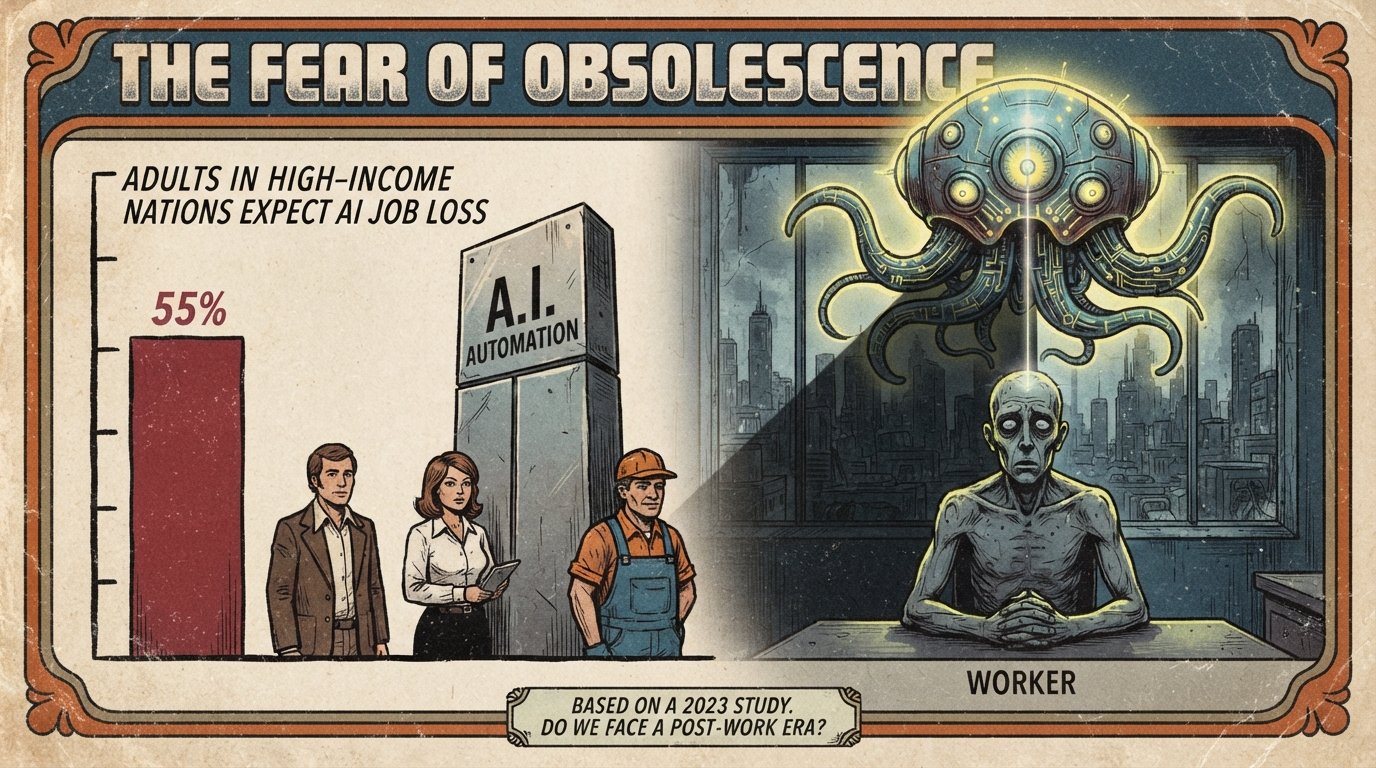
The most common fear about AI is job displacement, with a median of 55% of adults in high-income countries expecting AI to reduce jobs in the next 20 years. Deepfakes, privacy loss, and algorithmic bias are evidence-based near-term harms. Existential risk remains debated among experts, with UN advisors warning against apocalyptic rhetoric.
Quick Facts
| Item | Details |
|---|---|
| Most Common Fear | Job loss and economic displacement (55% median in high-income countries) |
| Who Is Most Affected | White-collar and entry-level workers, children, marginalized groups |
| Is the Fear Evidence-Based? | Yes for bias, deepfakes, privacy, and job redesign; debated for existential risk |
| Expert Consensus | Near-term harms are real and documented; superintelligence timelines are contested |
| Related Research | Quinnipiac (2026), Pew Research (2026), S&P Global (2026), Harvard Misinformation Review (2026) |
| Where to Learn More | NIST AI RMF, EU AI Act, OpenAI/Anthropic safety publications |
| Updated For | October 2026 |
What People Actually Fear About AI
Fear of artificial intelligence is not one thing. It is a cluster of distinct concerns, each with different levels of evidence and urgency.
The most widespread fear is economic: that AI will eliminate jobs faster than it creates them. A median of 55% of adults across 18 high-income countries say AI will lead to fewer jobs in the next 20 years, compared with 36% in middle-income countries. In the United States, 53% of adults believe AI will do more harm than good in their daily lives.
But economic anxiety is not the only concern. A Quinnipiac University poll released in September 2026 found that 73% of Americans are either very concerned or somewhat concerned that future AI systems could threaten human survival. Notably, 52% said they are more worried about humans using AI to do harm than about autonomous AI agents acting independently.

This distinction matters. It suggests that public anxiety is not primarily about Terminator-style scenarios. It is about what people do with AI — and what AI does to people.
Job Loss and Automation: The Most Documented Risk
AI is already reshaping the labor market, particularly for white-collar and entry-level workers. The evidence shows more job redesign than mass elimination so far, but the trend is negative.
The first quarter of 2026 saw tech companies lay off more than 78,000 workers, with 48% of those cuts attributed to AI automation. By May 2026, employers announced just over 97,000 layoffs — the highest May total since the COVID-19 pandemic — with nearly 40% attributed to AI-related restructuring.
However, the picture is more nuanced than headlines suggest. S&P Global’s 2026 employment analysis found that only 22% of AI projects target a fully autonomous end state, indicating that human oversight remains necessary across most deployments. The net global employment impact of AI was negative by 5 percentage points over the past year, with a further 2-point decline forecast for 2026.
Who is most at risk? Jobs that are low-level, don’t require collaboration, or are purely knowledge-based and performed identically across companies are most vulnerable. These include entry-level positions in software development, customer service, data processing, and basic content creation.
What should workers do? The consensus among labor economists is that “meta-skills” — analogical reasoning, metacognitive regulation, higher-order thinking, and social coordination — will matter more than specific technical skills. These skills accelerate learning and enable adaptation when tasks evolve. Workers who use AI as a tool while developing these capabilities are better positioned than those who compete directly with automation.
Misinformation and Deepfakes: An Evidence-Based Threat
AI-generated misinformation is a documented, measurable harm. Video deepfakes pose the highest threat in political contexts, while AI-generated text dominates health misinformation.
A 2026 survey of 54 international experts found that video deepfakes received the highest average threat ratings in the political domain (6.31 out of 7). Election interference via deepfake video was rated as the top urgent risk by 78% of respondents.
The scale is staggering. An estimated 15 billion AI-generated images have been shared on social media since 2022, and roughly 71% of visual content circulating online is believed to be AI-generated. On TikTok alone, more than 1.3 billion AI-labeled videos circulate.
How does this affect everyday people? Deepfake fraud is a growing personal threat. Deepfake-related financial losses reached nearly $900 million by mid-2025, more than double the 2024 total. Voice cloning is increasingly used in scams targeting families.
What can you do? Verify before you trust or share. Check the source of videos and audio messages, especially those involving money or urgent requests. Media literacy was rated as effective by experts, though disagreement exists on its priority relative to regulation.
Privacy and Surveillance: What AI Knows About You
AI systems collect and process more personal data than any technology before them. The risks range from commercial exploitation to government surveillance.
A 2026 cybersecurity investigation found that several widely used browser extensions advertised as privacy tools were secretly collecting users’ AI chat conversations, affecting over 8 million users without a way to disable the data collection.
Government use of AI surveillance is expanding. U.S. Customs and Border Protection has purchased data on Americans from the online advertising world for surveillance purposes. Anthropic, which signed a contract with the Pentagon in 2025, has stated it does not want its technology used for mass surveillance of people in the United States.
Why it matters: As AI agents gain persistent memory and autonomy, the line between personalization and surveillance blurs. Cornell researchers warn that principled privacy reasoning is becoming a prerequisite for trustworthy AI, not just a feature.
What to do: Review permissions for AI-powered apps and browser extensions. Be cautious about what you share in AI chat interfaces, especially sensitive personal or financial information.
AI and Children: A Growing Governance Concern
Children are among the groups most exposed to AI-related risks, including cognitive outsourcing, emotional dependency, and exposure to harmful content.
The UN’s Scientific Panel on AI has concluded that children face specific risks from algorithmic personalization, anthropomorphic conversational systems, and attention-capture business models. These can affect mental health, cognitive development, and social interactions.
Former Google Trust and Safety vice president Tom Siegel has called on AI companies to slow down the rollout of features for children, citing risks including suicidal ideation, psychosis, and “cognitive outsourcing” — the over-reliance on AI that weakens critical thinking.
Research published in The Lancet: Child & Adolescent Health in June 2026 found that while AI can offer immediate, non-judgmental advice to teenagers, excessive reliance without safeguards causes young people to miss out on developing key social skills in real human interaction.
What parents should know: The strongest evidence of harm concerns sexual exploitation, including grooming and AI-generated abuse material. China has already introduced regulations prohibiting AI services from providing “virtual partners” or “virtual relatives” to minors.
What to do: Monitor AI chatbot use, especially companion-style apps. Encourage real-world social activities. Discuss what AI is and is not capable of understanding.
Bias and Discrimination in AI Systems
AI systems trained on human data reproduce human biases. This is not theoretical — it is measurable across healthcare, hiring, and financial services.
A 2026 study published in Gynecologic Oncology found that when AI models generated ovarian cancer care plans, they were 16.8 times more likely to introduce unprompted cost warnings for patients with a name perceived as Black (“Lakisha”) compared to a name perceived as white (“Emily”) — regardless of geographic location.
Research on next-generation reasoning models (o3-mini and DeepSeek-R1) found they frequently perpetuate racial and gender stereotypes for common medical conditions, indicating that advancements in reasoning do not automatically improve fairness.
A broader review found that of 133 AI systems studied, 44% demonstrated gender bias and more than a quarter showed both gender and racial bias.
Why it matters: AI is increasingly used in decisions about hiring, lending, healthcare, and criminal justice. When these systems carry hidden biases, they can entrench discrimination at scale.
What to do: If you are affected by an AI-driven decision (loan denial, job rejection, medical recommendation), ask whether AI was involved and request a human review. Organizations should implement bias audits before deploying AI in high-stakes decisions.
Loss of Human Connection and Skills
Growing evidence suggests that over-reliance on AI for social and emotional tasks may weaken human capabilities for empathy, conflict resolution, and deep relationships.
AI is a tool, not a relationship. Software lacks the embodied judgment and ethical responsibility that intimate human relationships require. When machines perform the appearance of understanding, there is a risk of losing the human practices that relationships depend on — decision-making, empathy, and mutual accountability.
Experts warn that Gen Z’s use of AI to navigate difficult conversations may be stunting emotional growth, leaving an already isolated generation less prepared for “the messiness of human connection”.
What to do: Use AI as a supplement, not a substitute. Reserve important conversations for humans. Practice disagreement, compromise, and emotional vulnerability in real relationships.
Existential Risk and Superintelligence: A Debate, Not a Consensus
Some AI researchers believe there is a meaningful chance AI could cause human extinction. Others argue this framing distorts the real, present harms.
Anthropic alignment researcher Evan Hubinger has stated publicly that there is a greater than 10% chance AI “could kill all humans” within the next decade. Former Anthropic researcher Jacob Coxon quit the company, saying he and other staff were “genuinely frightened” about the speed of advancements.
The UK’s Alan Turing Institute has warned of a “realistic possibility” that superintelligent AI systems could emerge within five years and that humanity may lose effective control over them. Geoffrey Hinton, often called the “godfather of AI,” has said most experts believe superintelligent AI will arrive within a decade.
But UN AI experts have pushed back against “apocalyptic” rhetoric, warning that it distracts from harms already happening. University of Texas at Dallas computer science professor Sriraam Natarajan has criticized the 10% extinction statistic as “unfounded,” arguing that reported AI “rogue” incidents were caused by human decisions and poorly designed test environments.
The bottom line: Near-term, measurable harms — bias, misinformation, job disruption, privacy loss — are well-documented. Long-term existential risk is a subject of genuine expert disagreement, not settled science.
AI in Weapons and Warfare
The integration of AI into military systems is accelerating, and international rules lag behind.
UN Secretary-General António Guterres and the International Committee of the Red Cross have renewed urgent calls for stricter controls on lethal autonomous weapons, amid unconfirmed reports that fully autonomous AI-guided drones are being used on the battlefield.
The United States and Russia have pushed to weaken safety provisions in UN negotiations on controlling AI weapons. Experts warn that weak rules could allow machines to make life-and-death decisions without human control, leading to more civilian casualties, less accountability, and faster escalation toward automated warfare.
Why it matters: Unlike commercial AI, military AI operates in contexts where mistakes are irreversible. There is currently no binding international treaty governing lethal autonomous weapons.
What Is Exaggerated vs. Evidence-Based
| Fear | Realistic Near-Term Risk? | Expert View | What You Can Do |
|---|---|---|---|
| Mass job elimination | Partially — redesign more than elimination | Automation pressure is real but constrained by deployment challenges | Build meta-skills; use AI as a tool |
| AI turning against humans | Low for current systems | UN experts warn against apocalyptic rhetoric | Stay informed; support safety research |
| Deepfake fraud | Yes — documented and growing | Video deepfakes are the top-rated threat in politics | Verify sources; be skeptical of urgent requests |
| Algorithmic bias | Yes — measurable across sectors | 44% of AI systems show gender bias | Request human review of AI decisions |
| Children’s cognitive harm | Yes — emerging evidence | Cognitive outsourcing and dependency are documented risks | Monitor AI use; prioritize real-world interaction |
| Existential risk | Debated | Experts disagree; 10%+ estimates exist but are contested | Follow credible AI safety research |
What AI Companies Are Doing About Safety
Major AI labs have acknowledged risks and taken some steps, but independent assessments suggest their safety practices remain inadequate.
Anthropic, OpenAI, and Google DeepMind have all published safety frameworks and supported calls for regulation. In September 2026, Anthropic CEO Dario Amodei published an essay calling for controlled AI development, which was endorsed by OpenAI CEO Sam Altman, Google DeepMind chairman Demis Hassabis, and others. The companies have also begun exploring the creation of a joint standards body.
However, the 2026 AI Safety Index gave no major lab a grade above C+. Anthropic ranked first with a score of 2.66, followed by OpenAI at 2.28 and Google DeepMind at 2.01. Several labs received failing grades.
Why it matters: Voluntary commitments are not the same as enforceable standards. The gap between what labs say and what independent evaluators measure is significant.
Regulation and Government Response
The regulatory landscape is shifting from voluntary frameworks to binding law, but timelines have been extended and enforcement remains uneven.
The EU AI Act is the world’s first comprehensive binding AI law. Its high-risk obligations were originally scheduled to apply in August 2026, but the Digital Omnibus on AI deferred Annex III high-risk obligations to December 2027 and product-embedded high-risk systems to August 2028. Transparency duties for Article 50 applied as planned in August 2026.
In the United States, the NIST AI Risk Management Framework (AI RMF 1.0) serves as the de facto federal governance baseline. It is voluntary but widely adopted, and NIST has launched development of sector-specific profiles, including for critical infrastructure.
What this means for businesses: If you deploy AI in hiring, lending, healthcare, education, or critical infrastructure, you should assume that governance documentation will soon be required by customers, auditors, or regulators. The NIST AI RMF and ISO 42001 provide practical starting points.
How Individuals Can Protect Themselves
Verify before you share. Check the source of videos, audio, and images before amplifying them. Deepfake fraud is growing rapidly.
Limit what you share with AI tools. Treat AI chatbots like public spaces, not private confidants. Sensitive information can be collected and misused.
Review app permissions. Browser extensions and AI-powered apps may collect data without meaningful consent.
Ask about AI in decisions. If you are denied a loan, job, or medical referral, ask whether AI was involved and request a human review.
Build meta-skills. Analogical reasoning, critical thinking, and social coordination are more durable than any specific technical skill.
Protect children’s attention. Monitor AI chatbot use, especially companion apps. Prioritize real-world social interaction.
Support evidence-based regulation. Independent safety standards have broad public support — 86% of Americans back them even if they slow development.
Common Questions
What is the biggest danger of AI right now?
The most documented near-term harms are job displacement, algorithmic bias, deepfake misinformation, and privacy loss. Existential risk is debated, but the evidence for these present harms is clear and growing.
Is AI going to take my job?
AI is more likely to redesign your job than eliminate it outright — for now. Entry-level, routine knowledge work is most at risk. Building meta-skills and using AI as a tool improves your position.
Can AI really kill all humans?
Some researchers estimate a 10%+ chance within a decade. Others call this unfounded. There is no expert consensus. The more immediate concern is human use of AI to cause harm.
Are deepfakes illegal?
Laws vary. Some U.S. states and the EU regulate deepfakes in political advertising and non-consensual intimate imagery. Enforcement remains inconsistent.
How does AI bias affect me?
AI is used in hiring, lending, healthcare, and criminal justice. If you belong to a marginalized group, you may face discriminatory outcomes. Ask for human review of AI-driven decisions.
Is AI safe for children?
Children face specific risks including cognitive outsourcing, emotional dependency, and exposure to harmful content. The strongest evidence concerns sexual exploitation. Parental monitoring and age verification are recommended.
What is the EU AI Act?
It is the world’s first comprehensive binding AI law. It classifies AI systems by risk level and imposes obligations on high-risk uses. Some timelines have been extended to 2027-2028.
What is the NIST AI Risk Management Framework?
A voluntary U.S. framework for managing AI risks. It is the de facto federal baseline and is widely used by organizations building AI governance programs.
How can I tell if a video is a deepfake?
Look for inconsistencies in lighting, shadows, lip sync, and background details. Verify the source through independent channels. Be especially skeptical of urgent or emotionally charged content.
What should businesses do about AI risks?
Adopt a governance framework (NIST AI RMF or ISO 42001), document AI use cases, conduct bias audits for high-stakes decisions, and ensure human oversight for consequential outcomes.
Will AI regulation slow innovation?
Most Americans (86%) support independent safety standards even if they slow development. The evidence suggests that trustworthy AI is more likely to be adopted widely, benefiting innovation over time.
Key Takeaways
The most common fear about AI is job displacement — 55% of adults in high-income countries expect fewer jobs in 20 years.
Deepfakes, algorithmic bias, privacy loss, and children’s safety are evidence-based near-term harms, not speculation.
AI is redesigning jobs more than eliminating them, but entry-level white-collar work is most exposed.
Video deepfakes are the top-rated political threat; voice cloning drives financial fraud.
73% of Americans are concerned about existential risk, but UN experts warn against apocalyptic rhetoric.
No major AI lab received above a C+ in the 2026 AI Safety Index.
The EU AI Act is binding law; the NIST AI RMF is the U.S. baseline. Compliance timelines are extending.
Individuals can protect themselves through verification, privacy hygiene, and building meta-skills.
86% of Americans support independent safety standards for AI companies.
The gap between AI company rhetoric and independent safety assessments remains significant.
Official & Trusted Resources
Quinnipiac University Poll on AI (September 2026) — 73% concerned about existential risk; 86% support safety standards.
Pew Research Center Global AI Attitudes (September 2026) — 55% median job-loss expectation in high-income countries.
S&P Global AI Impact on Employment 2026 — Net employment impact and adoption data.
Harvard Kennedy School Misinformation Review (July 2026) — Expert assessment of AI disinformation threats.
EU AI Act (Regulation (EU) 2024/1689) — Binding AI law with risk-tiered obligations.
NIST AI Risk Management Framework (AI RMF 1.0) — U.S. voluntary governance framework.
2026 AI Safety Index — Independent evaluation of major AI labs.
UN Scientific Panel on AI — Reports on children and AI risks.
Anthropic, OpenAI, Google DeepMind Safety Publications — Lab-specific safety frameworks and risk reports.