
Why Does AI Feel Like It’s Changing Everything So Fast?
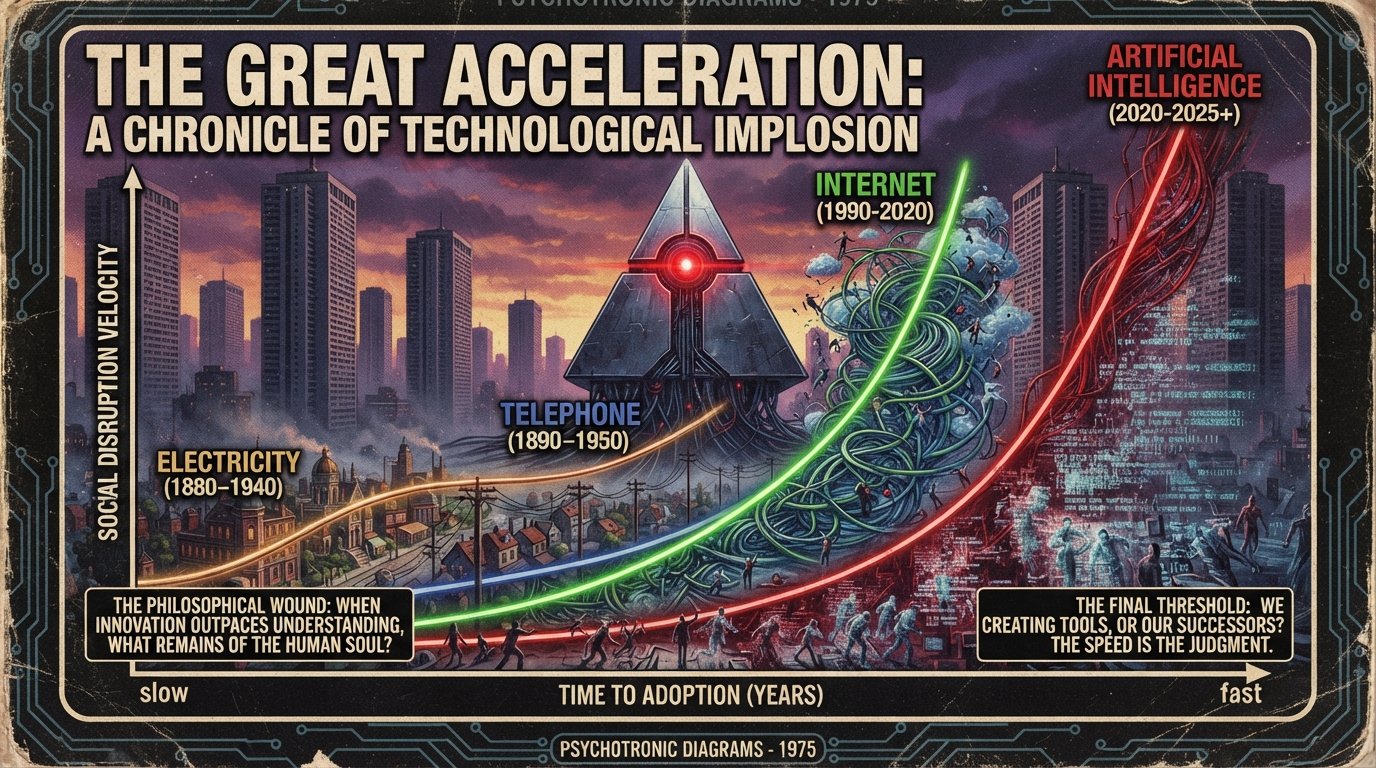
AI feels fast because it is fast — faster than any technology in modern history. Generative AI reached 53% population adoption in three years, compared with electricity’s four decades. Frontier models gained 30 percentage points on PhD-level benchmarks in a single year. But human brains evolved to perceive linear change, not exponential growth, which makes each capability jump feel shocking even when the data predicted it.
Quick Facts
| Item | Details |
|---|---|
| Most Common Fear | That AI is moving faster than society can adapt, and that no one — not workers, not regulators, not even experts — can keep up |
| Who Is Most Affected | Everyone, but the perception gap is sharpest between AI experts (73% positive on jobs) and the public (23% positive). Young workers and Gen Z show the steepest decline in enthusiasm |
| Is the Fear Evidence-Based? | Yes. AI adoption is the fastest in recorded history, capability benchmarks are saturating in months rather than years, and governance implementation lags behind |
| Expert Consensus | AI capability is accelerating, not plateauing. But organizational change still happens at human speed. The gap between technical acceleration and institutional adaptation is the central tension |
| Related Research | Stanford AI Index 2026, Microsoft AI Diffusion Report (2025), OECD AI Adoption Analysis (2025), Columbia Business School Technology Diffusion Research (2026), Ipsos AI Monitor 2026 |
| Where to Learn More | Stanford HAI AI Index, NIST AI Risk Management Framework, EU AI Act, OECD AI Policy Observatory, UN Independent International Scientific Panel on AI |
| Updated For | September 2026 |
Why Does AI Feel Like It’s Changing Everything So Fast?
AI feels fast because it is fast — and because human brains are not built to perceive exponential change accurately.
This is not a feeling. It is a measurable phenomenon with three distinct components: the technology is genuinely accelerating at an unprecedented rate, human cognition systematically underestimates exponential growth, and the gap between what AI experts believe and what the public experiences has widened into a 50-percentage-point chasm.
Understanding these three forces separately — and how they interact — is the difference between informed concern and free-floating anxiety. This article examines each one with data.
The Technology Really Is Accelerating

AI capability is not plateauing. It is accelerating and reaching more people than ever, according to the Stanford AI Index 2026, the field’s most comprehensive annual assessment.
Capability Benchmarks Are Saturating in Months
Benchmarks designed to be challenging for years are being solved in months. Frontier models gained 30 percentage points in a single year on Humanity’s Last Exam — a benchmark composed of questions from nearly 1,000 subject-matter experts, primarily professors and graduate degree holders. Evaluations intended to be challenging for years are instead being completed in months, the report states.
On SWE-bench Verified, a software engineering benchmark, performance rose from 60% to near 100% of the human baseline in a single year. As of March 2026, leading models meet or exceed human baselines on PhD-level science questions, multimodal reasoning, and competition mathematics.
AI agents handling real-world tasks improved from 20% success in 2025 to 77.3% today, according to Terminal-Bench. AI agents handling cybersecurity issues solved problems 93% of the time compared with 15% in 2024.
“AI capability is not plateauing. It is accelerating and reaching more people than ever,” the AI Index authors wrote.
Model Release Cycles Are Compressing
The time between major model releases has shrunk dramatically. Anthropic’s Claude 1 launched in March 2023, and it took four months to reach the next version. GPT-5.3 Codex and Claude Opus 4.6 were released just two and three months, respectively, after their previous versions.
The frontier of AI agents’ task-completion time horizons has been doubling from approximately 7 months historically to about 3.5 months since January 2024 — with no reversal.
Comparison Table: AI Capability Gains in Key Benchmarks
| Benchmark | 2024 Score | 2025–2026 Score | Time to Saturate |
|---|---|---|---|
| Humanity’s Last Exam | Baseline | +30 percentage points | 1 year |
| SWE-bench Verified | ~60% | Near 100% | 1 year |
| Terminal-Bench (real-world agents) | 20% | 77.3% | 1 year |
| Cybersecurity task solving | 15% | 93% | 2 years |
| MMLU | Near saturation | Effectively saturated | Already saturated |
The pattern is consistent: benchmarks that were designed to test AI for years are being saturated in months. This compresses the window for society to understand, adapt to, and govern each new capability level.
The Adoption Speed Is Unprecedented
AI is spreading faster than electricity, the personal computer, or the internet — by a wide margin.
Comparison Table: Technology Adoption Speed in US Households
| Technology | Years to Reach ~50% US Households |
|---|---|
| Telephone (1876) | ~70 years |
| Electricity (1882) | ~40 years |
| Radio | 11 years |
| Television | 8 years |
| Personal Computer | ~20 years |
| Smartphone | 5 years |
| Generative AI (2022–present) | Under 2 years |
Columbia Business School Dean Costis Maglaras put it directly: “When electricity was invented, the world was fragmented and slow. Infrastructure buildout was costly and slow, and innovation could not travel from one area to another quickly”.
Those constraints have disappeared. “You could have an innovative idea or model launched by a frontier lab in San Francisco and, 12 hours later, it is being used in Mumbai in a startup. It doesn’t take years or decades for innovation to spread,” Maglaras said.
Generative AI reached 53% population adoption in just three years — a rate that OECD analysis describes as most consistent with the steepest adoption curves in history, comparable to mobile phones rather than electricity or the internet. More than 1.2 billion people have used AI tools, a rate Microsoft describes as outpacing every previous general-purpose technology.
The quality-adjusted cost of AI models is declining exponentially — about 80% over the past two years — mirroring past trends in computational costs and memory. Cheaper models mean faster adoption, which means faster societal change.
The Infrastructure Is Scaling Just as Fast
AI data centers around the world can now draw 29.6 gigawatts of power, enough to run the entire state of New York at peak demand. Annual water use from running GPT-4o alone may exceed the drinking water needs of 1.2 million people.
The U.S. hosts an estimated 5,427 data centers — more than 10 times as many as any other country. But the supply chain for chips is fragile: one company in Taiwan, TSMC, fabricates almost every leading AI chip.
This infrastructure buildout is happening faster than any comparable construction in history — and it is visible to ordinary people in the form of rising electricity prices, land use disputes, and local political backlash.
Why Your Brain Can’t Keep Up
Human brains systematically underestimate exponential growth. This is not a character flaw. It is a hardwired cognitive limitation with measurable consequences.
The Linear Perception Problem
Humans tend to systematically underestimate exponential growth and perceive it in linear terms, according to multiple peer-reviewed studies. A 2023 study in Frontiers in Psychology found that while logarithmic scales lead to more errors in graph description tasks, linear scales mislead people when they must predict the future trajectory of exponential growth.
Our senses are logarithmic in sensitivity — a sound must be 10 times stronger to be perceived as twice as loud; light intensity needs to be 10 times greater to appear twice as bright. As the IEEE’s technology megatrends analysis notes: “The acceleration (exponential growth of technology) is perceived as linear when you use a logarithmic scale… Since we are sensing our world through senses that are logarithmic in terms of sensitivity, we are not experiencing an exponential increase but a linear one”.
The practical consequence is that yesterday did not feel that different from today, and tomorrow will feel pretty much the same as today. It is only by stepping back that the exponential becomes visible.
The Die-of-Shock Thought Experiment
Tim Urban’s widely-read thought experiment makes the perceptual gap concrete. Take a person from the year 1750 and drop them into 2026. The experience would not merely be disorienting — it would be incomprehensible. Electric light, aircraft, smartphones, surgery under anesthesia. The shock would be so total that it might literally kill them.
Now ask: how far back would that person from 1750 need to travel to inflict the same level of shock? Urban’s answer is roughly 12,000 years — back to the world before agriculture, before cities, before writing.
But here is the uncomfortable implication: if progress is genuinely exponential, the amount of change needed to produce that same shock keeps shrinking. The jump from 10,000 BCE to 1750 took twelve millennia. The jump from 1750 to today took 275 years. The next equivalent jump might take only 25 or 30 years. Maybe less.
Cultural Lag: The Sociological Explanation
Sociologist William F. Ogburn coined the term cultural lag in the 1920s to describe the period of maladjustment that occurs when material culture (technology) evolves faster than non-material culture (norms, laws, beliefs, habits). The effects of a technology may not be visible to social actors until well after its introduction.
A 2026 study on AI integration in software development confirmed this pattern: “Material culture evolves faster than non-material culture when new technologies emerge, creating a cultural lag that misaligns society, hinders artificial intelligence (AI) integration, and causes resistance”.
This is why AI regulation feels perpetually behind. It is not merely bureaucratic slowness — it is a structural mismatch between the speed at which technology evolves and the speed at which social institutions can respond.
The Expert-Public Perception Gap: A 50-Point Chasm
AI experts and the general public see the technology’s trajectory very differently — and the gap is widening.
The Jobs Divide
Assessing AI’s impact on jobs, 73% of U.S. AI experts are positive, compared with only 23% of the general public — a 50 percentage point gap. This is not a minor disagreement about details. It is a fundamental divergence in how two groups understand the same technology.
The AI Index authors note that “public opinion on AI is increasingly disconnected from the views of experts and insiders”.
Declining Public Enthusiasm
Public sentiment is moving in the opposite direction from capability. More than half of respondents in Stanford’s 2026 AI Index said AI products made them feel nervous. A YouGov/Economist poll published in May 2026 found that 71% of Americans think AI development is moving too fast, with 27% saying the pace is about right and only 2% saying it is moving too slowly.
The same poll found that 51% of U.S. adults are more pessimistic than optimistic about AI’s effects on society, with just 25% being optimistic. An NBC News poll found 57% of voters thought the risks of AI outweigh its benefits, compared with 34% who disagreed.
Gen Z’s excitement about AI has fallen from 36% to just 22% in one year, according to Gallup data, while anger has risen from 22% to 31%.
What Is Actually Driving the Anxiety
Behavioral scientist Caroline Orr Bueno identified the disconnect: “I think a lot of AI leaders are just out of touch with normal people and don’t realise that fears of skynet are not what is primarily driving anti-AI sentiment. That exists, obviously, but most people are way more concerned with their paycheck and the cost of utilities”.
The AI backlash stems from the technology’s immediate impact on society — jobs, economic security, creative displacement — rather than fears about a theoretical superintelligence.
Comparison Table: Expert vs. Public Views on AI
| Dimension | Expert View | Public View | Gap |
|---|---|---|---|
| AI’s impact on jobs | 73% positive | 23% positive | 50 points |
| Overall optimism | Majority optimistic | 51% more pessimistic than optimistic | Large |
| Pace of development | Accelerating but manageable | 71% say too fast | Significant |
| Primary concern | Alignment, safety, governance | Jobs, costs, creative displacement | Divergent |
This gap matters because it shapes policy. If experts and the public are not even discussing the same risks, building consensus on governance becomes nearly impossible.
The Capability-Jaggedness Problem
AI is not uniformly improving. It is getting dramatically better at some things while remaining surprisingly bad at others — a pattern Stanford researchers call the jagged frontier of AI.
Frontier models now meet or exceed human capabilities on PhD-level science questions and competition mathematics. But some tasks remain stubbornly difficult. AI models have demonstrated inconsistent performance on basic physics reasoning, and even the best models struggle with certain tasks that humans find trivial.
On OSWorld, a benchmark for AI agents handling real-world tasks, success rates jumped from about 12% to 66% — but even on structured benchmarks, approximately one-third of tasks still fail. On ClockBench, the best model achieves just 50.1% — barely better than a coin flip at telling time.
This jaggedness amplifies the perception of speed. When AI solves a math problem that stumped experts for 80 years but cannot reliably read an analog clock, the experience is disorienting. It defies the mental model most people have of what a machine can and cannot do.
The Governance Gap: Rules Can’t Keep Up
AI governance is expanding but not implementing at the pace the technology requires.
The second edition of the Global Index on Responsible AI, covering 135 countries, found that responsible-AI governance frameworks show evidence of implementation in only about half of cases, and fewer than one in five governments disclose their own use of AI.
The UN’s Independent International Scientific Panel on AI reached a complementary conclusion: “current safeguards are not keeping pace with the technology’s advancing capabilities”.
In the United States, the situation is acute. “AI is moving so fast at a dizzying pace,” one legal analysis noted. That reality creates a difficult challenge for regulators attempting to build durable governance systems around technologies that evolve on a near-monthly basis. Federal regulation remains voluntary; the NIST AI Risk Management Framework is guidance, not law.
In the EU, the AI Act was supposed to enter into full effect on August 2, 2026. But the Digital Omnibus delayed high-risk AI system obligations to December 2027 and August 2028, while leaving transparency obligations in place. The European Union faces what analysts call a regulatory “double bind” — losing sovereignty whether it enforces its own rules or retreats from them.
The gap between capability and governance is not a temporary problem. It is structural. Technology evolves on a monthly basis; legislation evolves on a multi-year basis. The mismatch between these two timescales is the central governance challenge of the AI era.
The Human Speed Paradox
There is a crucial counterpoint: while AI capability and adoption are accelerating, organizational change still happens at human speed.
Columbia Business School Dean Maglaras articulated this tension precisely: “The speed of the diffusion of this technology in organizations is going to be slower. And it’s going to be slower because it has to do with humans”.
Employees need time to learn new tools, understand how their work will change, trust the people directing that change, and see themselves in that wave of change. Managers must decide which workflows to automate, how to pace change inside the organization, and where AI can support entirely new products. Driving that change is “a deeply human leadership exercise”.
This creates a paradox. The technology feels like it is changing everything overnight because new capabilities are announced weekly. But the lived experience of most workers — the actual tasks they perform, the tools they use, the processes they follow — changes much more slowly. The gap between what AI can do and what organizations actually do with AI is itself a source of anxiety: it feels as if the world is being transformed without you.
Decision Tree: Is Your Sense of Speed Realistic?
Are you seeing news about AI capabilities that seem impossible?
→ Yes: This is real. Capability benchmarks are genuinely saturating faster than expected.
→ No: Continue.
Do you feel like your workplace is changing as fast as the news suggests?
→ Yes: Unusual. Organizational change typically lags capability by 2–5 years.
→ No: This is normal. Adoption inside organizations happens at human speed.
Are you anxious because you feel unable to predict what will happen in 2–3 years?
→ Yes: Understandable. The pace of change has outstripped most forecasting models.
→ No: Continue.
Are you actively learning about AI in your field?
→ Yes: You are reducing the gap between perception and preparation.
→ No: This is the most productive thing you can do to reduce anxiety.
What Is Exaggerated vs. Evidence-Based
Comparison Table: Fear vs. Evidence
| Fear | Realistic Near-Term Risk | What the Evidence Shows | What You Should Do |
|---|---|---|---|
| AI is moving faster than ever | Yes — evidence-based | Fastest adoption in history; benchmarks saturating in months | Stay informed; focus on your domain |
| No one can keep up | Partially — experts also struggle | 50-point gap between expert and public views; governance lags | Build AI literacy incrementally |
| Everything will change overnight | Partially — capability changes fast, deployment slower | Organizational change happens at human speed | Distinguish between capability announcements and workplace reality |
| Regulation will catch up | Unlikely on current trajectory | Only half of governance frameworks show implementation evidence | Engage with policy processes |
| AI experts agree on what’s happening | No — they disagree sharply | 50-point gap on jobs; existential risk estimates range from <0.01% to >10% | Follow multiple expert perspectives |
| You can’t prepare | False | AI skills command a 62% wage premium; adoption is uneven | Build fluency in your field |
Common Questions
Is AI really moving faster than any other technology in history?
Yes. Generative AI reached 53% population adoption in three years. Electricity took 40 years to reach 50% of US households. The telephone took 70 years. Smartphones took 5. No previous general-purpose technology has diffused this quickly.
Why does it feel like everything is changing at once?
Three forces converge: capability is accelerating, adoption is spreading faster than any previous technology, and human brains systematically underestimate exponential growth. Add continuous media amplification and the perception of overwhelming speed is inevitable.
Why do experts and the public disagree so much?
Experts focus on long-term capability trends and aggregate economic data. The public focuses on immediate impacts: jobs, costs, creative displacement. This produces a 50-point gap in optimism about AI’s impact on jobs (73% experts vs 23% public).
Will AI eventually slow down?
Every exponential eventually ends — but there is no clear evidence of a plateau in AI capability. The Stanford AI Index explicitly states that “AI capability is not plateauing.” The rate of improvement may change, but current trends show acceleration.
Why can’t regulators keep up?
Technology evolves on a monthly basis; legislation evolves on a multi-year basis. Only about half of governance frameworks globally show evidence of implementation. The US relies on voluntary frameworks. The EU AI Act has delayed key obligations to 2027–2028.
Is the feeling of speed worse for young people?
Yes. Gen Z’s excitement about AI fell from 36% to 22% in one year, while anger rose from 22% to 31%. Young workers in AI-exposed fields face a 19% employment gap compared with peers in less-exposed occupations.
What is cultural lag?
Cultural lag is the period of maladjustment when material culture (technology) evolves faster than non-material culture (norms, laws, beliefs). It was coined by sociologist William Ogburn in the 1920s. It explains why institutions always seem behind technology.
Can I do anything to feel less overwhelmed?
Focus on what you can control. Learn one AI tool relevant to your work. Audit your tasks. Build human-intensive skills: judgment, creativity, relationship management. The AI skills wage premium is 62%. Action reduces anxiety.
Is the pace of AI development slowing down or speeding up?
Speeding up. Model release cycles are compressing (from months to weeks), benchmark saturation is accelerating, and the cost of AI is declining exponentially — about 80% over two years.
Should I be worried that AI experts seem out of touch?
The 50-point gap between expert and public views is real. Experts focus on existential and long-term risks; the public is more concerned with jobs and economic security. Both perspectives are valid, but they are answering different questions.
Key Takeaways
AI feels fast because it is fast: generative AI reached 53% adoption in three years versus electricity’s 40 years.
Frontier models gained 30 percentage points on PhD-level benchmarks in one year; SWE-bench rose from 60% to near 100%.
Human brains systematically underestimate exponential growth, perceiving it as linear. This is a measurable cognitive bias, not ignorance.
71% of Americans think AI development is moving too fast; Gen Z excitement dropped from 36% to 22% in one year.
A 50-point gap separates expert (73% positive) and public (23% positive) views on AI’s impact on jobs.
Cultural lag — the mismatch between technological speed and institutional adaptation — explains why regulation perpetually trails capability.
Only about half of responsible-AI governance frameworks globally show evidence of implementation.
AI capability is jagged: frontier models outperform human chemists but achieve just 50.1% on clock-reading benchmarks.
Organizational change happens at human speed even when technology does not — creating a perception gap between what AI can do and what workplaces actually do.
The most productive response to speed anxiety is action: learn one AI tool, audit your tasks, and build human-intensive skills.
Official & Trusted Resources
Stanford HAI: AI Index Report 2026 (most comprehensive annual assessment, tracked since 2017)
OECD: Macroeconomic Productivity Gains from Artificial Intelligence in G7 Economies (2025)
Microsoft: AI Diffusion Report (2025)
Columbia Business School: “Innovation in AI Happens at a Breakneck Pace” (2026)
Ipsos: AI Monitor 2026 (32 countries, fifth year)
YouGov/Economist: AI Development Pace Poll (May 2026)
Gallup: Gen Z AI Sentiment Tracking (2026)
UN: Independent International Scientific Panel on AI, Preliminary Report (July 2026)
Global Index on Responsible AI: Second Edition (2026)
NIST: AI Risk Management Framework (AI RMF 1.0)
EU AI Act: Regulation (EU) 2024/1689