
What Jobs Are Already Being Replaced by AI Right Now?
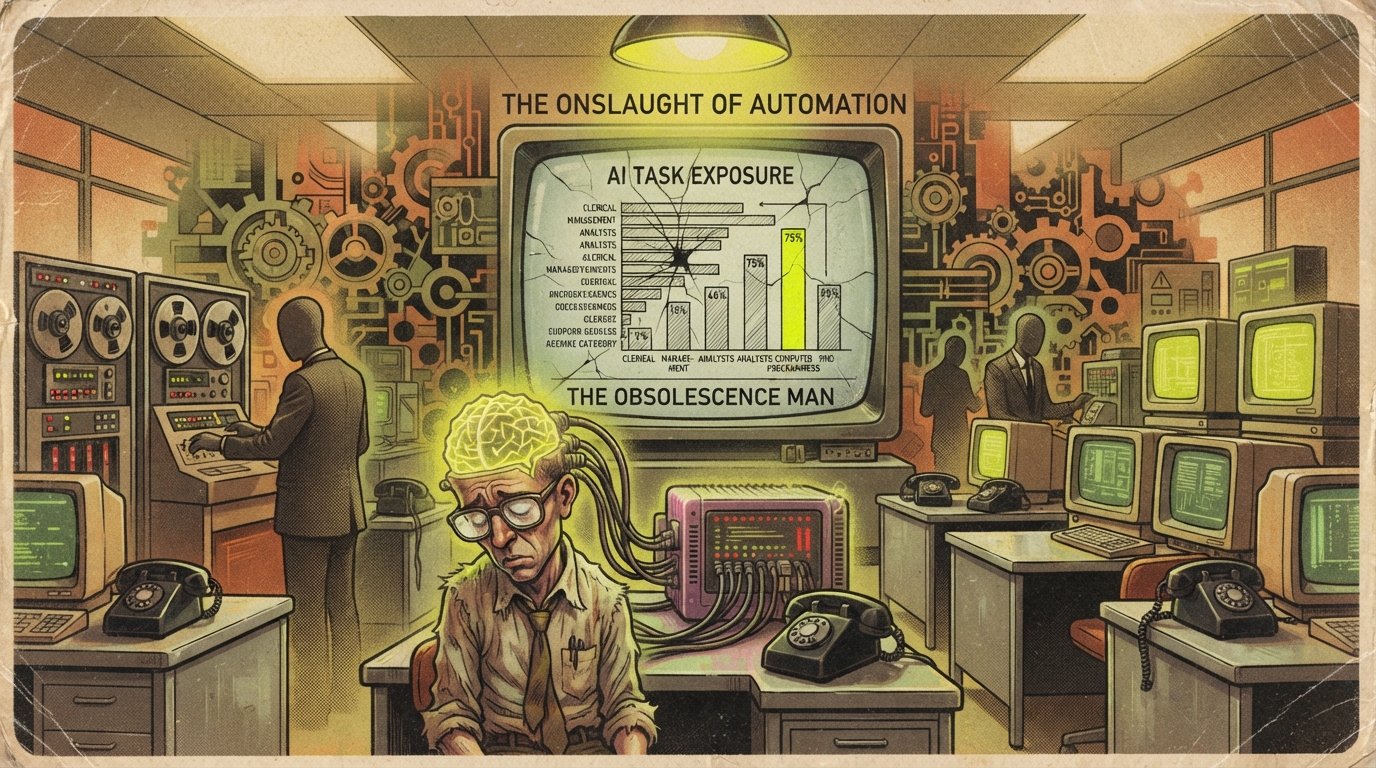
Computer programmers have the highest observed AI exposure, with roughly 75% of their tasks already coverable by AI tools like Claude. Customer service representatives (70%) and data entry clerks (67%) follow closely. However, most economists say we are seeing task-level automation rather than full occupational replacement — so far.
Quick Facts
| Item | Details |
|---|---|
| Most Common Fear | That AI will eliminate jobs faster than new ones are created |
| Who Is Most Affected | Young workers (ages 22–25) in entry-level white-collar roles |
| Is the Fear Evidence-Based? | Partially. Task automation is documented; mass unemployment is not |
| Expert Consensus | Job transformation, not a “job apocalypse” — yet. The risk is concentrated, not universal |
| Related Research | Anthropic Economic Index, Stanford Digital Economy Lab “Canaries” study, Goldman Sachs Research, ILO Global Index of Occupational Exposure |
| Where to Learn More | Anthropic’s labor market research, Stanford Digital Economy Lab, EU AI Act texts, NIST AI Risk Management Framework |
| Updated For | September 2026 |
What Is Actually Happening: Task Replacement vs. Job Replacement
AI is replacing tasks within jobs more than it is replacing entire jobs. A customer service representative whose job involves answering calls, looking up order information, and processing returns may find that AI now handles the order lookup and return processing — while the human still handles escalations, emotional de-escalation, and complex problem-solving. The job title remains. The daily work changes.

This distinction matters enormously for understanding the current moment. When researchers say a job has “high AI exposure,” they mean that a large share of its routine tasks could be automated — not that the occupation is disappearing.
Anthropic’s 2026 labor market report introduced a metric called Observed Exposure, which measures how much of an occupation’s work is actually being handled by AI right now, based on real usage data from Claude. The findings were striking:
Computer programmers: ~75% of tasks covered by AI
Customer service representatives: ~70%
Data entry clerks: ~67%
Medical records specialists: ~67%
Market research analysts and marketing specialists: ~65%
Legal assistants, financial analysts, translators, and writers: 44% to 55%

The gap between what AI could do and what it is doing remains large. In computer and mathematics occupations, the theoretical automation potential reaches 94%, but actual observed usage covers only about 33% of tasks.
Why “Exposure” Doesn’t Mean “Elimination”
A radiologist’s job involves reading scans, consulting with physicians, performing procedures, and communicating diagnoses to anxious patients. AI can read scans — often with accuracy matching or exceeding human radiologists for specific conditions. But the radiologist still consults, performs, and communicates. The job doesn’t vanish. It shrinks in some areas and expands in others.
Stanford’s Digital Economy Lab documented this pattern precisely: “In occupations where AI is used more to complement workers, employment is flat or rising, particularly among more experienced workers”.
The Jobs with the Highest AI Exposure Right Now
Computer Programmers
AI has already absorbed roughly three-quarters of routine programming tasks. This includes code generation, debugging, documentation, and routine refactoring. Tools like GitHub Copilot, Cursor, and Claude are used daily by professional developers.
This does not mean programmers are unemployed. It means the nature of programming work is shifting. Junior developers who previously spent their first two years writing boilerplate code and fixing simple bugs now face a steeper path to demonstrating value. Senior developers who can architect systems, debug complex integration issues, and make judgment calls about trade-offs remain in demand.
OpenAI CEO Sam Altman said in 2025 that he was “way less certain” about the future of computer programming than about almost any other role.
Customer Service Representatives
Customer service is the second most exposed occupation, with about 70% of tasks coverable by AI. This includes handling common inquiries, processing returns, updating account information, and basic troubleshooting.
The reality is more nuanced than headlines suggest. A Gartner survey of 321 customer service leaders found that only 20% had actually reduced staffing due to AI. Meanwhile, 55% reported stable staffing levels while handling higher volumes — meaning AI is boosting efficiency rather than eliminating roles. And 42% of organizations are hiring new AI-focused positions: conversational AI designers, automation analysts, and AI strategists.
Klarna, the buy-now-pay-later company, announced in 2024 that its AI assistant could do the work of 700 representatives. By 2025, it had reinvested in human talent and resumed hiring customer service staff.
Data Entry Clerks and Administrative Roles
Roughly 67% of data entry tasks are now AI-coverable. The International Labour Organization confirms that clerical occupations — data entry clerks, typists, accounting clerks, and administrative secretaries — remain the most exposed category globally.
Women are disproportionately affected. In high-income countries, nearly 10% of women’s employment is in occupations with the highest automation potential, compared to 3.5% for men. These figures have risen from 7.8% and 2.9% respectively since 2023.
Content Writers, Translators, and Journalists
Writing and translation roles show 44% to 55% task exposure. Publishers are feeding press releases into large language models that churn out finished stories with only a final human check. One former freelance writer reported losing 70% of clients.
But MIT senior researcher John Werner argues AI cannot fully replace journalism. The hardest part of writing — determining what to say and how to pitch it — remains human work. AI can produce text; it struggles with editorial judgment.
Legal Assistants and Paralegals
Legal support roles show 44% to 55% exposure. Law firms are cutting associate positions and reducing paralegal staff because AI now handles contract review, legal research, and document automation. A controlled study found that professionals using AI tools completed 12.2% more tasks, 25.1% faster, with 40% higher quality output.
However, experts at Law.com note that paralegals are transitioning from document review to AI-system supervision, output validation, and data workflow management — not disappearing.
Financial Analysts and Junior Bankers
Financial analysis shows 44% to 55% exposure, with OpenAI reportedly developing a project codenamed “Mercury” to automate entry-level investment banking tasks including IPO models, restructuring analyses, and leveraged buyout projections. OpenAI has hired over 100 former bankers and consultants for the project.
Economist Shawn DuBravac told Fortune that within a year, firms may automate 60% to 70% of analysts’ repetitive tasks, freeing them for higher-level modeling and client analysis.
Jobs That Are NOT Being Replaced (And Why)
The Physical World Remains a Barrier
About 30% of occupations show almost no AI exposure because they require physical manipulation, spatial reasoning, or real-time human interaction in unpredictable environments.
Anthropic’s research identifies these roles as largely untouched: cooks, mechanics, lifeguards, bartenders, dishwashers, motorcycle repair technicians, and agricultural workers. The explanation is straightforward — AI has no hands. Computer-based cognitive labor is vulnerable; physical labor in unstructured environments is not.
Roles Requiring Empathy and Nuanced Judgment
Sam Altman specifically identified nursing as a role he is “confident” will not be heavily impacted, citing its reliance on empathy and human connection. The same logic applies to social workers, therapists, teachers, and clergy.
The “Tacit Knowledge” Advantage
Stanford’s research draws a critical distinction between codified knowledge (formal, standardized, documented — taught through textbooks and procedures) and tacit knowledge (acquired through practice, mentorship, and repeated exposure to real situations).
Employment has declined among young workers in occupations relying heavily on codified knowledge. It has increased among experienced workers in occupations relying on tacit knowledge. This is the strongest evidence yet that AI is a tool for reproducing documented knowledge, not for replicating lived experience.
The Real Risk: Not Mass Unemployment, But a Broken Entry Ramp
The most credible near-term danger is not that AI eliminates millions of jobs outright. It is that AI closes the door on entry-level positions that have historically served as the training ground for careers.
Stanford’s “Canaries in the Coal Mine” study found that employment among workers ages 22–25 in highly AI-exposed occupations now stands about 19% below where it would be if it had kept pace with similarly aged workers in less-exposed occupations. This gap has widened from 15% in July 2025 to 19% by June 2026. The adjustment is operating primarily through reduced hiring of young workers, not increased layoffs.
Experienced workers show no comparable gap. The divergence affects those trying to enter the field, not those already established.
Anthropic CEO Dario Amodei has warned that AI could wipe out half of all entry-level white-collar jobs within one to five years and spike unemployment to 10–20% without intervention. Geoffrey Hinton, often called a “godfather of AI,” argues that what sets AI apart from previous technological revolutions is its potential to displace workers without creating new job opportunities to compensate — because “any job they might do can be done by AI”.
Not all experts share this view. Goldman Sachs Research estimates that unemployment will increase by only half a percentage point during the AI transition period, with AI displacing 6–7% of the US workforce if widely adopted. Approximately 60% of US workers today are in occupations that didn’t exist in 1940, and more than 85% of employment growth since then has been technology-driven.
What the Layoff Data Shows
In 2025, about 55,000 US layoffs were directly attributed to AI
In the first half of 2026 alone, that figure rose to 87,714 — surpassing all of 2025 combined
AI was cited in 22% of all 2026 layoffs through June
A Gartner analysis of over 1.1 million jobs across 255 companies found that only about 1% of job losses studied were tied directly to AI productivity gains. Salesforce cut 4,000 support roles explicitly replaced by AI agents — the clearest-cut case of direct AI replacement documented so far.
The Fear vs. Reality Comparison Table
| Fear | Realistic Near-Term Risk? | Expert View | What You Can Do |
|---|---|---|---|
| My entire job will be automated | Low for most; moderate for routine task-heavy roles | Task replacement ≠ job replacement | Identify which tasks in your role are routine; build skills in judgment, relationship, and exception-handling |
| AI will cause mass unemployment | Low to moderate | Goldman Sachs: 0.5pp unemployment increase; Amodei: up to 20% without intervention | Monitor your industry; build portable skills; advocate for retraining programs |
| Young people can’t get entry-level jobs | High — documented | Stanford: 19% employment gap for 22–25 year olds in exposed occupations | Develop demonstrated skills via projects, certifications, and internships |
| AI will replace creative work | Moderate for production; low for editorial judgment | AI produces text/images; struggles with what to say and why | Focus on taste, curation, and the “hardest first draft” |
| Physical jobs are safe | Mostly true for now | AI has no physical embodiment in most workplaces | Consider trades; combine physical skill with digital literacy |
| AI bias will discriminate | High in hiring, lending, and criminal justice | Documented in multiple audits; EU AI Act classifies employment AI as high-risk | Know your rights; organizations using AI for hiring must provide human review |
| AI will be used in weapons | High — already happening | Autonomous systems in development; international governance lagging | Support transparency requirements; follow UN discussions on lethal autonomous weapons |
What Regulators and Companies Are Actually Doing
The EU AI Act
The European Union’s AI Act classifies AI systems used in employment and worker management as “high-risk,” imposing strict requirements for transparency, safety, and human oversight. This means employers cannot use AI to make hiring, firing, or promotion decisions without meaningful human review.
The Act also requires that workers be informed about AI systems used in the workplace. Survey data shows over 80% of Europeans support rules protecting worker privacy, and 77% support worker involvement in technology design and adaptation.
NIST AI Risk Management Framework
The US National Institute of Standards and Technology (NIST) published the AI Risk Management Framework (AI RMF 1.0) in January 2023. While not legally binding, it has become the de facto standard for organizations seeking to deploy AI responsibly. NIST has also integrated AI skills and roles into its NICE workforce framework, recognizing that AI adoption requires new competencies.
What AI Companies Say
Anthropic, OpenAI, and Google DeepMind have all published safety and responsible scaling policies. In May 2025, Dario Amodei, Sam Altman, Demis Hassabis, and Bill Gates signed a letter acknowledging the need for guardrails. The gap between stated commitments and actual practices remains a source of debate among researchers and policymakers.
How to Assess Your Own Risk: A Decision Framework
Step 1: List your daily tasks. Write down everything you do in a typical week.
Step 2: Mark each task as “codified” or “tacit.” Codified tasks have documented procedures and standard answers. Tacit tasks require judgment, relationship, or physical presence.
Step 3: Check AI exposure for your occupation. Use Anthropic’s labor market reports or the ILO’s occupational exposure index as starting points.
Step 4: Identify your “moat.” What can you do that AI cannot easily replicate? This usually falls into: complex judgment under uncertainty, relationship-based trust, physical dexterity in unstructured environments, or accountability (someone must be legally responsible).
Step 5: Build toward the moat. If your current role is heavily codified, pursue opportunities that build tacit knowledge — mentorship, cross-functional projects, client-facing work, or advanced training.
Step 6: Monitor, don’t panic. The Stanford data shows that experienced workers in exposed occupations are not seeing employment declines. The risk is concentrated on the entry ramp. If you are early in your career, prioritize demonstrated skill over credentials. If you are mid-career, your experience is your protection.
Common Questions
Which job is being replaced by AI the fastest right now?
Customer service and data entry show the fastest task replacement. Salesforce cut 4,000 support roles explicitly replaced by AI agents. However, Gartner found only 20% of customer service organizations have actually reduced headcount — most use AI to handle higher volumes with the same staff.
Is AI really replacing programmers?
AI covers about 75% of programming tasks, but programming employment has not collapsed. The nature of the work is shifting from writing code to reviewing, debugging, and architecting. Junior roles are most affected through reduced hiring, not layoffs.
What jobs are safest from AI?
Cooks, mechanics, lifeguards, bartenders, dishwashers, electricians, plumbers, nurses, and social workers show the lowest AI exposure. These roles require physical manipulation, real-time human interaction, or tacit knowledge that AI cannot easily replicate.
Will AI cause mass unemployment?
Most economists say no. Goldman Sachs estimates a 0.5 percentage point increase in unemployment during the transition period. The World Economic Forum projects that while tens of millions of roles will be displaced, new roles will be created — though the transition may be painful for affected workers.
Are young people most at risk?
Yes, for entry-level hiring. Stanford’s research shows a 19% employment gap for workers aged 22–25 in highly AI-exposed occupations. Experienced workers show no comparable gap. The adjustment is happening through reduced hiring, not increased firing.
Is AI bias a real problem in hiring?
Yes. AI hiring tools have been shown to discriminate based on gender, race, and age when trained on biased historical data. The EU AI Act classifies employment AI as high-risk, requiring transparency and human oversight.
What should I do if my job is at risk?
Focus on building tacit knowledge: client relationships, complex problem-solving, cross-functional collaboration, and physical skills. Pursue training in AI-augmented workflows. The ILO emphasizes that whether exposure leads to displacement depends largely on whether workers are given opportunities to learn to work with these technologies.
Are companies required to tell workers they’re using AI?
In the EU, yes — under the AI Act, employers must inform workers about AI systems used in the workplace. In the US, there is no equivalent federal requirement, though some states have proposed legislation.
Will AI create new jobs?
Yes. AI strategists, conversational AI designers, automation analysts, and AI ethics officers are among the fastest-growing new roles. Gartner found that 42% of organizations are hiring for AI-focused positions.
What is the difference between task automation and job replacement?
Task automation means AI handles specific activities within a job. Job replacement means the entire occupation disappears. Current evidence overwhelmingly points to task automation, with job transformation rather than elimination for most roles.
Key Takeaways
AI is replacing tasks, not entire jobs — for now. Computer programmers show 75% task exposure, but programming employment has not collapsed.
The entry-level ramp is the most vulnerable point. Young workers (22–25) in AI-exposed occupations face a 19% employment gap — the clearest documented harm.
Customer service, data entry, and clerical roles face the highest task automation. Writing, legal support, and financial analysis are next.
Physical, empathetic, and tacit-knowledge roles are safest. Nurses, electricians, cooks, and social workers show minimal AI exposure.
AI layoffs are real but modest. About 87,714 US layoffs were attributed to AI in the first half of 2026 — 22% of all cuts, but still a small fraction of total employment.
The EU AI Act treats employment AI as high-risk. Employers must provide transparency and human oversight.
The gap between theoretical and actual automation remains large. In computer/math occupations, 94% of tasks are theoretically automatable, but only 33% are actually automated.
Retraining matters, but tacit knowledge cannot be rushed. Experience-based judgment remains the strongest protection against displacement.
Official & Trusted Resources
Anthropic Economic Index — Real-world AI usage data by occupation
Stanford Digital Economy Lab “Canaries in the Coal Mine” — Payroll data analysis of AI employment effects
Goldman Sachs Research: How Will AI Affect the Global Workforce? — Macroeconomic projections
ILO: Generative AI and Jobs: A Refined Global Index of Occupational Exposure — Global employment exposure data
EU AI Act (Regulation 2024/1689) — High-risk classification for employment AI
NIST AI Risk Management Framework (AI RMF 1.0) — Voluntary risk management guidance
World Economic Forum Future of Jobs Report 2025 — Employer survey data on expected displacement