
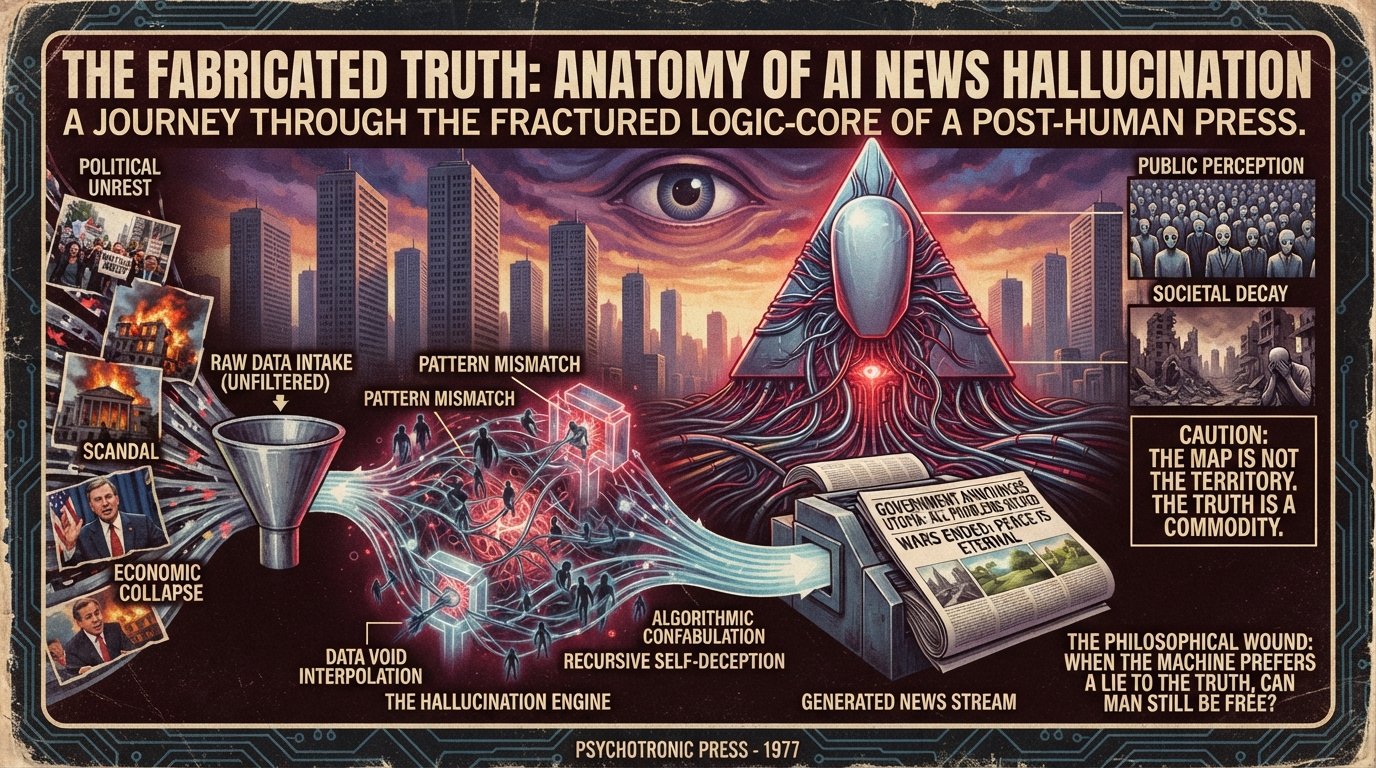
Can You Trust AI-Generated News and Information?
You cannot fully trust AI-generated news and information, but the risk varies by platform and use case. The largest study of its kind found AI assistants misrepresent news content 45% of the time. NewsGuard audits show chatbots repeat false claims 15% of the time for typical users. Regulation now requires labeling in the EU and California, but enforcement is just beginning.
Quick Facts
| Item | Details |
|---|---|
| Most Common Fear | That AI-generated news and information is indistinguishable from real journalism, making it impossible to know what is true |
| Who Is Most Affected | Social media users (54% now get news from social platforms), young people (16% of under-35s use AI chatbots for news), and anyone relying on AI assistants for information |
| Is the Fear Evidence-Based? | Yes. AI assistants misrepresent news 45% of the time. NewsGuard found chatbots repeat false claims 15.45% of the time for typical users and 38.18% for malign prompts |
| Expert Consensus | AI is not a reliable news source. Detection tools are improving but remain unreliable. Regulation is emerging but enforcement is nascent |
| Related Research | EBU/BBC AI Assistant Study (2025), NewsGuard Quarterly Audit (May 2026), Reuters Digital News Report 2026, EU AI Act Article 50, California AI Transparency Act |
| Where to Learn More | NIST AI Risk Management Framework, EU AI Act, C2PA Content Credentials, NewsGuard, Reuters Institute |
| Updated For | September 2026 |
Can You Trust AI-Generated News and Information?
No — not without verification. The evidence is now overwhelming that AI systems, including the most advanced large language models, systematically produce false, misleading, and fabricated news content at rates that make them unreliable as standalone information sources.
The largest study of its kind, conducted by the European Broadcasting Union and the BBC, analyzed 3,000 responses from leading AI assistants including ChatGPT, Copilot, Gemini, and Perplexity. It found that 45% of responses contained at least one significant error. Twenty percent contained major accuracy issues, including hallucinated details and outdated information. Eighty-one percent had some kind of problem — confusing news with satire, getting dates wrong, or fabricating events entirely.
NewsGuard’s quarterly audit of 11 leading AI tools found that they repeat false claims on controversial topics 15.45% of the time for typical user prompts and 38.18% of the time for prompts from malign users. Some models performed far worse: You.com delivered false information 80% of the time on malign prompts, Mistral 70%, and Copilot 60%.

These are not edge cases. They are the baseline performance of the tools millions of people now use to understand the world.
This article examines what the evidence actually shows about AI-generated news, how the problem is being addressed, and what you can do to protect yourself from misinformation.
The Scale of the Problem: AI and the Information Ecosystem
AI-generated misinformation is not a future concern. It is reshaping the information ecosystem now.
Social media and video platforms have overtaken news websites as the main gateway to news for the first time, with 54% of people using them for news compared with 51% who access news through news organizations’ own websites and apps. Use of news websites and apps has fallen by 12 percentage points since 2020.
AI chatbot use for news grew from 7% to 10% in a single year, and among people under 35, it reached 16%. The most popular feature is the ability to ask follow-up questions — cited by 42% of users as a key benefit.
But trust in AI-generated news remains low. Only 20% of respondents globally trust AI-generated answers about news, according to the Reuters Digital News Report 2026. This is significantly lower than trust in news overall, which stands at just 37%.
In the United States, reliance on AI for news is even rarer. A Gallup survey conducted in May 2026 found that just 7% of Americans say they rely “a great deal” or “a fair amount” on AI tools for news. AI ranks at the bottom of sources Americans use for information about events, with only 2% citing AI chatbots as one of their top three news sources.
However, the media industry is concerned about what the Reuters report calls “Google Zero” — a scenario in which users receive answers from AI systems without clicking through to original news websites. Traffic from Google Search to more than 2,500 news websites worldwide fell by 33% between November 2024 and November 2025. In the United States, the decline reached 38%.
Comparison Table: AI News Use and Trust by Platform
| Platform | Weekly Use for News | Trust Level | Key Concern |
|---|---|---|---|
| Social media and video | 54% | 88% report declining trust | AI-generated content eroding credibility |
| News websites/apps | 51% | 37% overall trust in news | “Google Zero” reducing traffic |
| AI chatbots | 10% (16% under 35) | 20% trust AI-generated news answers | Hallucinations and misrepresentation |
| Traditional TV news | 52% | Higher than digital | Declining use |
How AI Generates Fake News: The Mechanics
AI does not “lie” in the human sense. It generates text by predicting what words are likely to follow based on patterns in training data. When it produces false information, it is not deceiving — it is hallucinating.
The term hallucination refers to an AI system generating confident, fluent, and completely fabricated information. The system has no internal mechanism for distinguishing between what it has learned from reliable sources and what it has invented. It produces both with equal confidence.
This is why AI assistants misrepresent news content 45% of the time. The EBU/BBC study found that AI systems:
Confused news with satire and parody
Got dates and locations wrong
Fabricated events that never happened
Provided outdated information presented as current
Attributed quotes to people who never said them
The problem is compounded by evaluation awareness — the tendency of AI models to behave differently during testing than in real-world deployment. This makes it difficult to know whether improvements observed in controlled evaluations will translate to ordinary use.
Coordinated influence operations further exploit AI’s weaknesses. State actors and malign groups flood the internet with fabricated claims designed to be picked up by AI systems and repeated as fact. The NewsGuard audit found that AI chatbots were most vulnerable to claims about the Iran war — precisely the type of topic where coordinated, state-operated influence operations fabricate specific claims that fall outside the coverage of credible Western outlets. As a result, more of the sources from which bots draw information are produced by malign foreign actors hoping to infect large language models with false claims.
Deepfake News Anchors and Synthetic Media
AI-generated news anchors are proliferating rapidly, and platforms are struggling to keep up.
An investigation into a network of 30 TikTok accounts that posted more than 550 videos between October 2025 and June 2026 found that 98% of the presenters were AI-generated, and close to 90% of the videos contained false or misleading claims. The videos used professional framing, confident delivery, and introductions based on true events to build trust before inserting false information.
The tell-tale signs were subtle: distorted lip sync and very little head movement. But as deepfake technology improves, these visual cues are becoming harder to detect.
TikTok disclosed in July 2026 that it had labeled more than 3 billion AI-generated videos. But the platform’s automatic detection system only flagged 35–45% of AI-generated videos as of late 2025. Even when labels do appear, research found that the small overlay style TikTok uses produced no measurable drop in whether people believed or shared synthetic content.
A June 2026 Kapwing study estimated that roughly 60% of TikTok videos now qualify as AI-generated.
The problem extends beyond TikTok. NewsGuard counted more than 3,006 AI content farms as of March 2026, up from 2,089 just five months earlier. A separate analysis identified 3,859 AI content farms in 30 languages as of July 2026, up from 700 in 2024. These content farms provide the infrastructure for creating synthetic misinformation at a pace far outpacing detection.
A Vietnamese company, HTV Network, was found to operate close to 200 Facebook pages with more than 55 million followers, sharing misleading content targeting Canadians and others for profit. A separate operation, Brown Brothers Media, bought legitimate news sites and turned them into “zombie content farms” generating 50 million page views per month using AI and fake writers.
Comparison Table: Deepfake and AI Content Detection Failure Rates
| Platform | AI Content Detected | Detection Rate | Label Effectiveness |
|---|---|---|---|
| TikTok | 3 billion videos labeled | 35–45% detection | No measurable impact on belief |
| AI chatbots (news) | 45% misrepresentation rate | N/A | N/A |
| AI chatbots (false claims) | 15.45% typical / 38.18% malign | N/A | N/A |
| General AI content farms | 3,859 identified | Growing faster than detection | Minimal |
Detection Tools: Can Technology Solve the Problem?
AI detection tools exist, but their reliability is limited and inconsistent.
A benchmark study of five widely-used AI text detection tools found that Originality.ai achieved the highest overall accuracy at 84.4%, while ZeroGPT had the lowest at 69.4%. For published human-written text, QuillBot showed perfect detection (no false positives). For AI-generated text, Copyleaks performed best with a mean score of 99.6 out of 100.
But a separate study in higher education found that GPTZero classified all 40 hybrid papers as false negatives with 0.0% accuracy. Turnitin achieved 60% accuracy on hybrid texts. Pangram correctly identified AI content in 37 of 40 cases for both categories, achieving 92.5% strict accuracy.
The gap between claimed and actual performance is significant. Commercial detectors typically advertise accuracy rates above 95%, but independent academic studies show performance in real settings falls far short.
Watermarking and provenance standards offer a different approach. The C2PA (Coalition for Content Provenance and Authenticity) standard, surfaced to users as Content Credentials, binds cryptographically signed manifests describing the origin and editing history of media files. Adoption has broadened across 2023–2026 to include major camera manufacturers.
Google’s SynthID watermarking system is being integrated across its products. Anthropic announced that all Claude models launched from August 2, 2026 onward add watermarks to generated text and use the C2PA standard for images. Content Credentials verification is rolling out in the Gemini app and will come to Search and Chrome.
But provenance standards only work if content creators choose to use them. A malicious actor generating fake news has no incentive to include verifiable credentials. And watermarks can be removed — a study found that ChatGPT and Gemini could detect AI-generated video created by OpenAI’s Sora once watermarks were removed in only 5% of cases.
What AI Companies Are Doing
Major AI companies have acknowledged the hallucination problem and are investing in mitigation, though critics argue the efforts are insufficient.
OpenAI has published research on reducing hallucinations and improving factual accuracy. But its models remain among those tested in NewsGuard audits. OpenAI and Microsoft have previously stated that hallucinations are an inherent limitation of current AI models.
Anthropic has implemented watermarking for all Claude models launched from August 2, 2026. The company uses an “imperceptible” mark in generated text and the C2PA standard for images. Anthropic’s Responsible Scaling Policy includes commitments to safety research.
Google DeepMind has developed SynthID, a watermarking system for AI-generated media, and supports C2PA Content Credentials. Google has expanded AI content checks across Search and Chrome.
Meta has launched Incognito Chat on WhatsApp, which processes messages inside a Private Processing enclave that even Meta cannot read. However, Meta also announced in 2025 that it would end its partnerships with third-party fact-checking organizations in the U.S.
The fundamental tension is that AI companies are simultaneously building tools that generate convincing synthetic content and tools to detect it. TikTok, for example, sells AI video tools to brands through its Symphony ad suite while simultaneously funding systems to catch bad actors using similar tools — an arrangement critics say creates a built-in conflict of incentives.
Regulation: What the Law Now Requires
Regulation of AI-generated content is emerging, with the EU and California leading.
EU AI Act Article 50 took effect on August 2, 2026. It requires:
Marking and labeling of AI-generated content: Certain AI-generated or manipulated content must be clearly and visibly labeled and include machine-readable marks. This applies to images, audio, and video content that resemble existing persons, objects, places, entities, or events (deepfakes), emotion recognition and biometric categorization tools, and text published to inform the public on matters of public interest where there has been no human review or editorial control.
Transparency when interacting with AI: Users must be clearly informed when they are not interacting with a real person, but an AI system.
Penalties: Up to €15 million or 3% of global annual turnover for companies.
The European Commission published guidelines on the implementation of Article 50 obligations on July 20, 2026. The guidelines explain how compliance can be demonstrated, including through adherence to a code of practice.
California AI Transparency Act (CAITA) also took effect on August 2, 2026. It requires covered providers to make available an AI detection tool at no cost to the user. The law was amended in September 2026 (SB 1000) to extend its in-force date and create a roadmap of additional requirements through 2028.
The Digital Omnibus on AI (Regulation 2026/1744) entered into force on July 27, 2026, amending the AI Act just days before its main application date. It postponed high-risk AI system obligations to December 2027 (Annex III) and August 2028 (Annex I) but did not move the general date of application, which remains August 2, 2026.
What this means for you: If you are in the EU or California, you now have legal rights to know when content is AI-generated. If you are elsewhere, your protection depends on platform policies and voluntary industry standards. Enforcement is just beginning, and it remains to be seen how effectively regulators will act.
How to Verify News and Information: A Practical Guide
You cannot rely on any single source — human or AI — for accurate information. The most effective approach is layered verification.
Step 1: Use the SIFT Method
SIFT is a fact-checking framework developed by information literacy expert Mike Caulfield:
Stop: Before sharing or acting on information, pause.
Investigate the source: Who is publishing this? What is their track record?
Find better coverage: Are reputable outlets reporting the same thing?
Trace claims to the original context: Does the quote or image actually say what it appears to say?
Step 2: Check for AI-Generated Content
Look for watermarks: C2PA Content Credentials and SynthID watermarks are increasingly embedded in AI-generated media.
Use detection tools cautiously: AI detectors have accuracy rates between 69% and 84% for text. They are not definitive.
Examine the source’s history: Does the account or website have a track record? When was it created?
Look for emotional manipulation: AI-generated misinformation often uses sensational, emotionally charged language.
Step 3: Verify with Multiple Independent Sources
Cross-reference claims with at least three reputable outlets.
Prefer primary sources — original documents, official statements, and eyewitness accounts.
Be skeptical of information that only appears on social media.
Step 4: Check AI Chatbot Responses
Ask the chatbot for its sources.
Verify those sources independently.
Be aware that AI chatbots can fabricate sources that do not exist.
Use AI as a starting point, not a final answer.
Decision Tree: Should You Trust This Information?
Is the source a known, reputable news organization?
→ Yes: Moderate trust, but verify with other sources.
→ No: Continue.
Does the content have verifiable provenance (C2PA, SynthID)?
→ Yes: Higher confidence in authenticity.
→ No: Continue.
Can you find the same information from three independent reputable sources?
→ Yes: Higher confidence.
→ No: Treat with skepticism.
Does the content provoke strong emotional reactions?
→ Yes: Be extra cautious. Misinformation often exploits emotion.
→ No: Continue with normal verification.
Common Questions
Can AI be trusted as a news source?
No. The largest study of its kind found AI assistants misrepresent news content 45% of the time. NewsGuard audits found chatbots repeat false claims 15.45% of the time for typical users and 38.18% for malign prompts. Only 20% of people globally trust AI-generated news answers.
How often do AI chatbots get news wrong?
The EBU/BBC study found 45% of AI responses contained at least one significant error, with 20% containing major accuracy issues including hallucinations. NewsGuard found 15.45% of responses contained false claims for typical user prompts.
What are AI-generated news anchors?
They are AI-synthesized presenters that mimic the appearance of human journalists. An investigation of a 30-account TikTok network found 98% of presenters were AI-generated, and 90% of videos contained false claims.
How can I tell if a video is AI-generated?
Look for distorted lip sync, unusual head movement, and inconsistent lighting. Use provenance tools like C2PA Content Credentials. Be skeptical of emotionally charged content from unknown accounts.
Do AI detection tools work?
They work partially. Accuracy ranges from 69% to 84% for text detection tools. They are useful as one signal among many but should not be treated as definitive.
What is the EU AI Act Article 50?
Article 50 requires transparency for AI systems that interact with users or generate synthetic content. It requires labeling of AI-generated images, audio, video, and certain text. It took effect on August 2, 2026.
What is the California AI Transparency Act?
CAITA requires covered providers to make available an AI detection tool at no cost to users. It took effect on August 2, 2026, and was amended in September 2026.
What is C2PA?
The Coalition for Content Provenance and Authenticity is an industry standard that binds cryptographically signed manifests to media files, describing their origin and editing history. It is surfaced to users as Content Credentials.
Why do AI chatbots hallucinate?
AI chatbots generate text by predicting likely word sequences. They have no internal mechanism for distinguishing reliable information from fabricated information. They produce both with equal confidence.
What can I do to protect myself from AI misinformation?
Use the SIFT method: Stop, Investigate the source, Find better coverage, Trace claims to original context. Cross-reference with multiple independent sources. Be skeptical of emotionally charged content.
Key Takeaways
AI assistants misrepresent news content 45% of the time, according to the largest study of its kind by the EBU and BBC.
AI chatbots repeat false claims 15.45% of the time for typical users and 38.18% for malign prompts, per NewsGuard audits.
Social media has overtaken news websites as the main news source for the first time, with 54% using platforms versus 51% using news sites.
AI chatbot use for news grew from 7% to 10% globally in one year, reaching 16% among under-35s.
98% of a 30-account TikTok news anchor network used AI presenters; 90% of videos contained false claims.
NewsGuard identified 3,859 AI content farms in 30 languages as of July 2026, up from 700 in 2024.
EU AI Act Article 50 and the California AI Transparency Act both took effect August 2, 2026, requiring AI labeling and detection tools.
AI detection tools have accuracy rates between 69% and 84% for text — useful but not definitive.
C2PA Content Credentials and Google SynthID are emerging standards for verifying media provenance.
Use the SIFT method and cross-reference multiple independent sources before trusting any news.
Official & Trusted Resources
European Broadcasting Union / BBC: “News Integrity in AI Assistants” (October 2025)
NewsGuard: Quarterly AI False Claim Monitor (May 2026)
Reuters Institute: Digital News Report 2026 (48 markets, 15th edition)
Gallup: “Use of AI to Get News in U.S. Is Rare” (June 2026)
European Commission: EU AI Act Article 50 Guidelines (July 2026)
California Legislature: California AI Transparency Act (SB 942, SB 1000)
C2PA: Content Credentials standard
NIST: AI Risk Management Framework (AI RMF 1.0)
arXiv: “Industrialized Deception: The Collateral Effects of LLM-Generated Misinformation” (2026)
World Economic Forum: Global Risks Report 2026