
AI Checker Tools: Are You Afraid Your Writing Will Get Flagged?
Yes—and the fear is evidence-based. AI detectors produce false positive rates ranging from 0.05% to 68.6%, with non-native English writers flagged at rates exceeding 60%. Turnitin’s own one percent false positive rate translates to roughly 750 wrongly accused students at a single university. These tools are unreliable, biased, and triggering lawsuits.
Quick Facts
| Item | Details |
|---|---|
| Most Common Fear | Having your original work falsely labeled as AI-generated and facing consequences |
| Who Is Most Affected | Non-native English speakers, neurodivergent writers, students, freelancers, and academics |
| Is the Fear Evidence-Based? | Yes—peer-reviewed studies document false positive rates up to 68.6%; lawsuits have been won |
| Expert Consensus | AI detectors are unreliable and should not be used as sole evidence in high-stakes decisions |
| Related Research | Liang et al. (Stanford, 2023); IEEE Symposium on Security and Privacy (2026); Computers & Education (2026) |
| Where to Learn More | Vanderbilt University guidance, Stanford HAI, IEEE, NIST AI Risk Management Framework |
| Updated For | September 2026 |
What Are AI Checker Tools and How Do They Work?
AI checker tools are software programs that attempt to determine whether a piece of writing was created by a human or generated by artificial intelligence. They are used by universities, employers, publishers, and freelance platforms to screen submissions.
What they are: AI detectors are themselves AI systems. They use machine learning models to analyze text and assign a probability score—usually expressed as a percentage—indicating how likely the text is to be AI-generated.
Who uses them: Turnitin, GPTZero, Copyleaks, Originality.ai, ZeroGPT, and Winston AI are among the most widely deployed. Universities use them for academic integrity screening. Employers use them to screen cover letters and writing samples. Freelance clients use them to evaluate deliverables. Publishers use them to screen manuscripts.

Why it matters: The fundamental problem is that these tools do not actually detect AI. They detect patterns that correlate with AI-generated text—low perplexity, low burstiness, formulaic phrasing—but those same patterns appear in perfectly human writing. As one analysis puts it, “AI detectors do not evaluate meaning; instead, they primarily rely on surface-level linguistic proxies such as stylistic regularity and textual predictability”.
The core mechanism: Most detectors measure two things:
Perplexity: How predictable the next word is given the preceding words. AI models tend to choose high-probability words; humans are more idiosyncratic.
Burstiness: How much sentence length and structure vary. AI tends to produce uniform, well-formed sentences; humans mix short and long, simple and complex.
The problem is that skilled human writers—especially those writing in a second language or with neurodivergent traits—often produce text that scores as “low perplexity” and “low burstiness” for entirely human reasons.
The False Positive Problem: How Often Are Humans Flagged?
False positives are alarmingly common. A 2026 study presented at the IEEE Symposium on Security and Privacy found false positive rates across commercial detectors ranging from 0.05% to 68.6%—a variation so wide it makes the tools useless for consistent decision-making.
Key False Positive Statistics
| Source | Finding |
|---|---|
| IEEE S&P 2026 (Traynor et al.) | False positive rates 0.05%–68.6%; false negative rates 0.3%–99.6% |
| IEEE ICHORA 2026 (Alaqad et al.) | False positive rates 15.6%–30.6% across five tools |
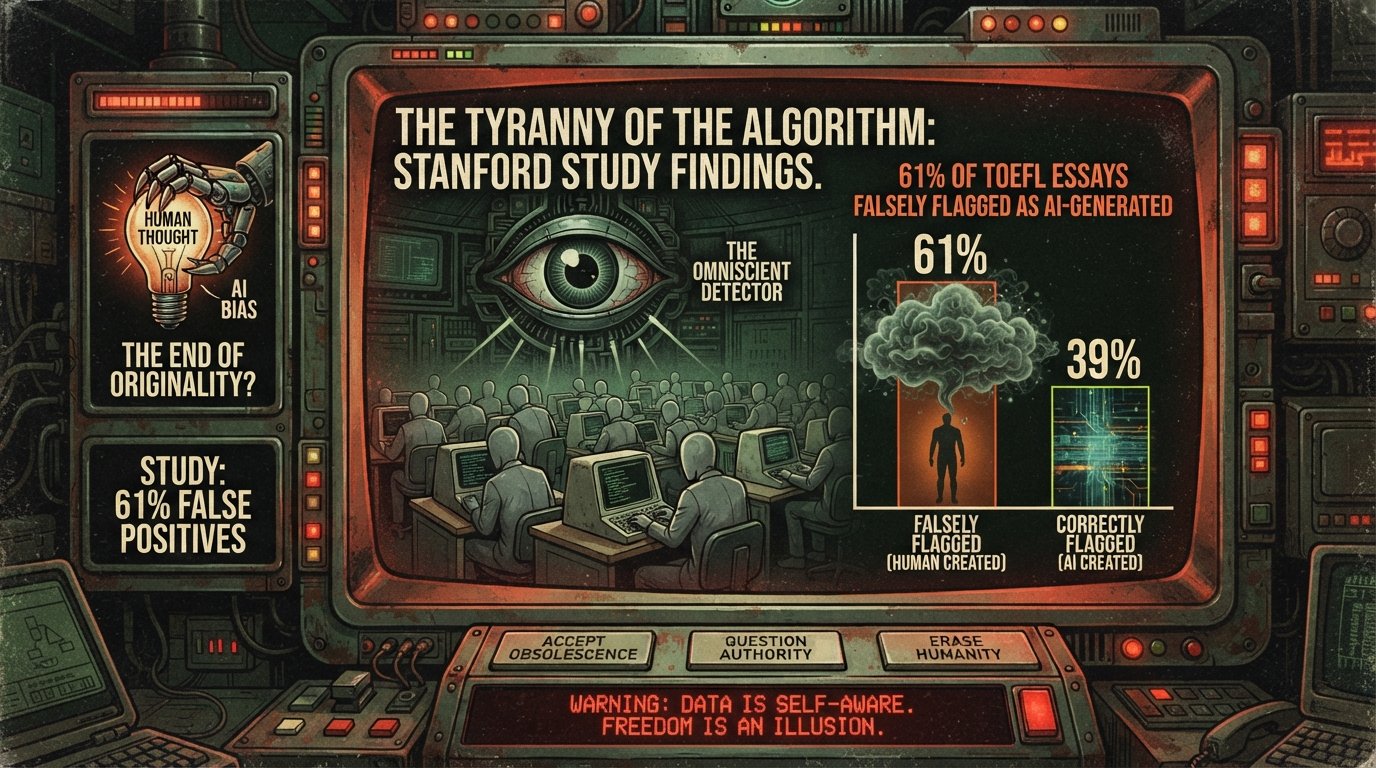
| Stanford / Liang et al. (2023, Patterns) | 61.22% of TOEFL essays by non-native speakers flagged as AI |
| Vanderbilt University internal analysis | 1% false positive rate = ~750 wrongly flagged papers per year |
| HEPI (August 2026) | Seven detectors wrongly flagged 61% of genuine TOEFL essays |
| ScienceDirect (2026) | Hybrid editing lets 88% of AI content evade detection |
| Biology of Sex Differences | 50% of academic papers flagged as containing 80%+ AI content—most were pre-LLM false positives |
What this means: The false positive rate is not a single number. It varies wildly by tool, by text type, and by who wrote the text. But the pattern is consistent: the tools are wrong often enough to destroy trust in their output.
Why it matters: In high-stakes contexts—academic discipline, hiring decisions, publishing decisions—a false positive is not a minor inconvenience. It is an accusation of dishonesty with no reliable means of defense.
Who Gets Falsely Flagged Most Often?
Non-native English speakers, neurodivergent writers, and students from marginalized groups are disproportionately flagged as AI-generated. This is not random error—it is systematic bias.
Non-Native English Writers
Research consistently shows that AI detectors flag non-native English writing at dramatically higher rates than native English writing. The Stanford study by Liang et al. found that seven widely-used detectors wrongly flagged an average of 61% of TOEFL essays—written by people who do not speak English as a first language—as AI-generated. On essays by native English speakers, the same tools were far more accurate.
The mechanism is straightforward. Detectors equate predictable, formulaic phrasing with AI generation. Writers in a second language tend to use narrower vocabulary ranges and more regular sentence structures—precisely because they are writing carefully. As HEPI explains: “Someone writing carefully in a second language tends to use a narrower range of words and sentence patterns, so the very habit of the diligent multilingual student is the habit the tool reads as a robot”.
A systematic review of six experimental studies found that AI detectors misclassified non-native English-speaking student writing as AI-generated in a median of 55.7% of cases.
Neurodivergent Writers
Research published in July 2026 found that autistic writers are disproportionately misclassified as AI-generated. The study, titled “The misclassification of autistic writing as AI-generated,” found that detection models “may exhibit bias against certain minority groups”.
The pattern is similar to non-native speakers: autistic writers often develop distinctive, consistent prose styles that detectors flag as machine-like. Structured, methodical writing—a strength in many neurodivergent individuals—becomes a liability when run through an AI detector.
Students with Disabilities
A University of Michigan student sued the school in February 2026, claiming her professors “mistook symptoms of her disability for signs of AI generation”. The lawsuit alleges disability discrimination in how the university handled the accusation.
Marginalized Students Generally
Berkeley D-Lab and Stanford HAI research found that as detection accuracy improves, false positive rates rise disproportionately for students who write outside expected norms—”non-native English speakers, students with disabilities, writers whose syntax doesn’t match the training data”.
Freelance Writers
A 2026 analysis of Upwork writers found that 24% of sampled articles were flagged as AI-written. The AI-detected rate dropped sharply to around 5%—suggesting that many of those flags were false positives.
What this means: The burden of AI detection does not fall equally. It falls hardest on people who are already navigating structural disadvantages—people whose writing doesn’t match the “expected” profile baked into detector training data.
Why it matters: The tools are not neutral arbiters of authorship. They encode bias against linguistic diversity, disability, and non-Western writing norms. Using them uncritically reinforces existing inequities.
How AI Checkers Work (And Why They Fail)
AI detectors fail for fundamental technical reasons, not because they need better training data or more sophisticated models.
They Measure Surface Features, Not Meaning
Detectors don’t understand what text means. They measure statistical properties: word predictability, sentence length variation, and stylistic consistency. This means they flag any text with regular syntactic rhythm and limited lexical variation—features common in both AI-generated content and high-quality human writing.
The Arms Race Favors Generators
AI detection is an adversarial problem. Every detection method creates an incentive to develop generation methods that evade it. Research in 2026 found that “adversarial generative dynamics in the AI–detector arms race favor AI tools, leaving detectors behind”.
A hybrid editing strategy—where AI-generated text is lightly edited by a human—can enable up to 88% of AI-generated content to evade detection successfully. Meanwhile, human-written text that happens to match AI patterns gets flagged.
The Base Rate Problem
Even a highly accurate test produces many false positives when the condition it’s testing for is rare. If only 5% of submissions are AI-generated, and a detector has a 5% false positive rate, then for every 100 flagged submissions, roughly half will be false positives.
Research from 2026 concluded that AI detectors are “prone to generate more false accusations than correct identifications” due to low prevalence rates and low sensitivity.
No Detector Establishes a Verifiable Signature
A 2026 letter in an academic journal argued that current AI-detection tools “suffer from technical non-falsifiability—no detector establishes a physically verifiable signature of machine origin”. In other words, there is no ground truth. The detector’s output is a probability estimate, not a factual finding.
Detector Accuracy Varies Widely
Even the best detectors underperform in real-world conditions. A study of 14 detectors found that “none achieved 80% accuracy, and one in five allowed AI-generated text to slip through undetected”.
A 2026 study in Computers & Education evaluated 13 detectors across over 280,000 authentic student samples and concluded: “Existing detection technologies are inadequate to support high-stakes educational assessments”.
What this means: The technical limitations of AI detectors are not temporary bugs. They are features of the problem itself. As long as detectors rely on surface-level linguistic features, they will always struggle to distinguish careful human writing from AI-generated text.
Why it matters: Institutions that adopt AI detectors are not adopting a solution. They are adopting a tool that produces errors with real consequences for real people.
What Experts and Researchers Actually Say
The expert consensus is clear: AI detectors are unreliable and should not be used as sole evidence in high-stakes decisions.
The Research Consensus
A critical review published in 2026 found that “detector tools are deemed unreliable and inefficient by most researchers who have empirically tested them” and that “this inefficiency is not a temporary issue that can be resolved with the development of more efficient AI detectors”.
On Academic Use
The IEEE S&P 2026 paper concluded that commercially available AI text detectors are “poorly suited for deployment in academic or high-stakes contexts”. Co-author Patrick Traynor put it directly: “These current tools are not reliable or robust enough to use to measure the problem. We really can’t use them to adjudicate these decisions. People’s careers are on the line here”.
On Publishing
A letter in a scholarly journal argued that “AI text detectors should be used, at most, as preliminary screening tools rather than definitive arbiters of authorship”. The authors noted that “clarity, coherence, and disciplined academic style—hallmarks of high-quality scholarly writing—may increase the likelihood of false-positive classifications”.
On Bias
The 2026 Zenodo paper on detection pitfalls documented “bias against non-native English speakers, students with disabilities, and collaborative forms of writing” and noted that “attempts to improve detection rates can increase false positives, particularly for authors who deviate from expected language norms”.
The Honest Reading
As HEPI’s August 2026 analysis put it: “The honest reading is not that detection never works but that there is no universal accuracy figure: the false-positive rate swings widely with the tool, the sample and the settings, and it is worst precisely on the writing of students who learned English later”.
Real Consequences: Lawsuits, Suspensions, and Lost Contracts
False positives are not abstract statistics. They have destroyed careers, delayed graduations, and cost people money.
The Adelphi University Case (2026)
Orion Newby, a student at Adelphi University, was accused by Turnitin of having a “100% likelihood” that his paper was AI-generated. He submitted evidence from other detectors showing “0% likelihood”—the university still insisted on academic dishonesty. After a long appeals process, Newby sued. In February 2026, a court ruled in his favor, finding that the university’s decision “was arbitrary and lacked sufficient proof, as AI detectors are known to produce false positives and should not be the sole basis for disciplinary action”.
The judge highlighted that the university “failed to follow its own internal procedures regarding academic integrity, which required a more thorough investigation than a mere algorithmic check”.
The Yale Lawsuit (2025-2026)
A graduate student at Yale sued the university after being accused of cheating based on “faulty AI detection tools.” The dispute escalated into a 13-count federal lawsuit.
The University of Michigan Case (2026)
A disabled undergraduate student sued the University of Michigan, claiming her professors falsely accused her of using AI and denied disability accommodations during the appeal process.
The Vanderbilt Decision
Vanderbilt University disabled Turnitin’s AI detector after calculating that its one percent false positive rate would translate to roughly 750 wrongly flagged student papers per year.
Freelance and Professional Consequences
Professional writers, journalists, and freelancers face lost contracts when clients run deliverables through AI detectors and get false positives. One freelancer received a panicked email: “an AI detector flagged his draft at 87%. He swears he wrote every word”.
University Policy Responses
More than 50 universities worldwide have banned, disabled, or officially discouraged the use of AI detection tools. Yale, Vanderbilt, Johns Hopkins, and Indiana University have adopted policies that ban or discourage faculty from using AI-detector output as sole evidence of cheating.
What this means: The consequences of false positives are real, documented, and legally actionable. Institutions are beginning to recognize this—but not before students and professionals have suffered.
Why it matters: If you are falsely accused, you have legal standing. Courts are ruling that AI detector scores alone are insufficient evidence of misconduct.
Comparison Table: Which AI Detector Fears Are Realistic?
| Fear | Realistic Near-Term Risk? | Expert View | What You Can Do |
|---|---|---|---|
| My writing will be flagged as AI | High | False positive rates up to 68.6% | Document your writing process; keep drafts and version history |
| I’ll be accused of cheating despite writing myself | High for non-native speakers | 61% of TOEFL essays falsely flagged | Know your rights; demand human review; appeal |
| I’ll lose a freelance contract over a false flag | High | 24% of sampled Upwork articles flagged | Include AI clauses in contracts; deliver with version history |
| My academic paper will be rejected | Medium | Publishers increasingly screen with detectors | Submit with draft evidence; challenge false flags |
| I can prove my innocence with another detector | Low | Detectors disagree wildly; no single tool is authoritative | Use multiple detectors; document process, not just output |
| Universities will stop using detectors | Medium | 50+ universities have banned or restricted them | Know your institution’s policy; advocate for process-based assessment |
| Humanizing tools will protect me | Medium | Humanizers evade detection but don’t address bias | Use with caution; the real solution is process-based integrity |
What Companies Are Doing About It
Turnitin
Turnitin markets its AI detector as achieving 98% accuracy with fewer than 1% false positives for documents with more than 20% AI content. However, independent evaluations have found higher false positive rates. Turnitin has established thresholds to reduce false positives and recommends that results not be interpreted as definitive evidence.
GPTZero
GPTZero uses perplexity and burstiness analysis to detect AI-generated text. The 2026 Global 100 rankings placed GPTZero at the top with 96.1 overall score. However, independent research notes GPTZero flaws including false negatives, paraphrasing vulnerabilities, and poor cross-lingual accuracy.
Originality.ai
Originality.ai achieved the highest overall accuracy (84.4%) in a 2026 IEEE benchmarking study, but still exhibited false positive rates of 15.6% to 30.6% across all tools tested.
OpenAI
OpenAI quietly pulled back its own AI classifier, citing “low accuracy”. The company has not released a consumer-facing AI text detector since.
The Humanizer Industry
A growing industry of “AI humanizer” tools has emerged to help writers evade false positives. These tools rewrite text to raise perplexity and burstiness—the very features detectors measure. Research shows that adversarial paraphrasing can universally evade detection, with attack success rates exceeding 92%.
This creates a perverse situation: the tools designed to catch AI are driving writers to use AI-based tools to modify their own human writing so it doesn’t look like AI.
Universities
More than 50 universities worldwide have banned, disabled, or officially discouraged AI detection tools. Indiana University’s Kelley School of Business updated its AI Playbook to state that “AI detection tools are not approved for use by faculty,” including GPTZero, Turnitin AI Detection, and Originality.AI.
Academic Publishers
Some publishers use detectors as preliminary screening tools but have policies against using them as sole evidence. The American Journal of Pharmaceutical Education’s editorial board, for example, reported that AI-detection false positives are “increasingly recognized as a challenge for editorial decision-making”.
Regulation and Government Response
United States
There is no federal regulation governing AI detection tools. The NIST AI Risk Management Framework provides voluntary guidance on AI risk management but does not specifically address text detection tools.
Court rulings are establishing precedent. The Adelphi University case established that AI detector scores alone are insufficient for disciplinary action and that institutions must provide “human-led oversight and corroborating evidence”.
European Union
The EU AI Act does not specifically regulate AI detection tools, but its transparency obligations for AI-generated content create a framework for provenance and labeling that could eventually make detection unnecessary.
United Kingdom
The UK’s Office for Students has not issued formal guidance on AI detectors, but individual institutions are developing their own policies. The University of Cape Town and Curtin University have halted or disabled AI detection features.
What this means: Regulation is lagging behind the technology. Institutions are making decisions in a regulatory vacuum, often learning from lawsuits rather than guidance.
Why it matters: Without clear standards, the use of AI detectors will continue to produce inconsistent and unjust outcomes until courts and institutional policies force change.
How to Protect Yourself from False Positive Accusations
You cannot guarantee that a detector won’t flag your writing. But you can build a defensible record that makes false accusations much harder to sustain.
1. Document Your Writing Process
The single most effective defense is evidence of how your writing evolved.
Use version history. Write in Google Docs, Microsoft Word with track changes, or another tool that records your editing history.
Keep drafts. Save multiple versions of your work—outlines, first drafts, revisions.
Time-stamp your work. Cloud-based writing tools automatically record when edits were made.
Save research notes. Keep your source materials, notes, and references.
As one guide recommends: “Prepare your writing evidence. This includes draft version history, revision records, reference notes, and raw experimental data records. These materials can prove that the paper was gradually written and revised”.
2. Write in a Way That Reflects Human Process
Include specific personal experiences. AI struggles with “events that happened at specific sites” and “experiences only the individual knows.” Personal anecdotes and concrete details are less likely to trigger detectors.
Vary sentence length deliberately. Mix short, punchy sentences with longer, complex ones. Uniform prose reads as machine-like.
Avoid overly formal or formulaic phrasing. If your writing sounds like a template, a detector may think it is one.
Use active voice. Passive constructions are more common in AI-generated text.
3. Know Your Institution’s Policy
Before an accusation happens, find out:
Does your school or employer use AI detectors?
What is the appeals process?
What evidence is required to challenge a flag?
Is there a policy against using detector output as sole evidence?
More than 50 universities have banned or restricted these tools. Knowing your institution’s policy gives you a starting point for defense.
4. If You Are Accused
Do not panic. False positives are common and documented.
Request the specific evidence. Ask what detector was used, what score it produced, and what policy was violated.
Provide your documentation. Submit your version history, drafts, and notes.
Challenge the methodology. AI detectors are known to produce false positives; cite the research.
Demand human review. Courts have ruled that detector scores alone are insufficient for disciplinary action.
Escalate if necessary. If the institution will not provide due process, consult a lawyer. The Adelphi case established legal precedent.
5. For Freelancers and Professionals
Include AI clauses in contracts. Specify what AI use is permitted, how it will be reviewed, and what evidence of human authorship you will provide.
Deliver in stages. Sharing drafts as you write them creates a natural version history.
Write in shared documents. Google Docs version history is visible to clients.
Keep your process visible. If clients can see how your work evolves, false flags are less likely to stick.
What this means: The burden of proof has shifted to the writer. You now need to document your process—not just produce a final product.
Why it matters: In a world where AI detectors are unreliable, your best defense is evidence of how you write, not just what you wrote.
Decision Tree: What to Do If You’re Flagged
Have you been accused of using AI to write something?
→ Do you have version history or drafts?
Yes → Submit them immediately. This is your strongest defense.
No → Start documenting now. Write your next piece with version history enabled.
→ Was the accusation based solely on an AI detector score?
Yes → Challenge it. Courts have ruled that detector scores alone are insufficient for disciplinary action.
No → Request the full evidence. What other factors contributed?
→ Is your institution using a detector that has been independently evaluated?
Yes → Research the tool’s known false positive rates. Cite the studies.
No → Demand transparency. What tool was used? What is its accuracy?
→ Have you been offered a chance to explain your writing process?
Yes → Take it. Show your drafts, your notes, your revisions.
No → Demand it. Due process requires an opportunity to respond.
→ Is the institution refusing to reconsider despite your evidence?
Yes → Escalate. Consult a lawyer. The Adelphi case set precedent.
No → Continue the appeals process. Document everything.
Common Questions
Can AI detectors prove I used AI to write something?
No. AI detectors produce probability estimates, not factual findings. They do not establish a “physically verifiable signature of machine origin.” No detector can prove authorship. The output is a score, not evidence.
Why do AI detectors flag human writing?
Detectors measure statistical patterns—low perplexity and low burstiness—that correlate with AI-generated text. But these patterns also appear in human writing, especially writing by non-native English speakers, neurodivergent writers, and anyone whose style is regular or formulaic. The tools are measuring style, not authorship.
Are AI detectors biased against non-native English speakers?
Yes, significantly. The Stanford study found that seven detectors wrongly flagged 61% of TOEFL essays by non-native speakers as AI-generated. A systematic review found a median misclassification rate of 55.7% for non-native English writers. The bias is systematic and well-documented.
Can I sue if I’m falsely accused?
Possibly. The Adelphi University case in February 2026 resulted in a court ruling against the university, finding that the decision was “arbitrary and lacked sufficient proof.” Students have also sued for disability discrimination. If you have suffered concrete harm—suspension, lost income, reputational damage—consult a lawyer.
Which AI detector is most accurate?
None is reliable enough for high-stakes decisions. Originality.ai achieved the highest overall accuracy (84.4%) in one 2026 study, but still had a false positive rate of 15.6% to 30.6%. GPTZero and Turnitin perform better on some text types than others. The variation between tools is so wide that no single tool should be trusted.
Are universities banning AI detectors?
More than 50 universities worldwide have banned, disabled, or officially discouraged them. Vanderbilt, Yale, Johns Hopkins, Indiana University, the University of Cape Town, and Curtin University have all restricted their use. The trend is accelerating as lawsuits and research accumulate.
What are “AI humanizers” and do they work?
AI humanizers are tools that rewrite text to evade AI detection by raising perplexity and burstiness. Research shows they can be effective—some achieve attack success rates above 92%. But using them raises ethical questions: you’re using AI to modify your writing so it doesn’t look like AI. The better solution is process documentation.
What should I do if my client’s AI detector flags my work?
Send your version history immediately. Explain that AI detectors have documented false positive rates up to 68.6%. Offer to provide drafts, notes, or other evidence of your writing process. If the client refuses to reconsider, consider whether the relationship is worth maintaining.
How can I write so I don’t get flagged?
There is no guaranteed method. But you can reduce risk by: varying sentence length, including specific personal details, avoiding overly formulaic phrasing, using active voice, and documenting your process. The most important thing is not how you write—it’s whether you can prove how you wrote.
Is the fear of being flagged exaggerated?
No. The fear is evidence-based. False positive rates range from 0.05% to 68.6%. Non-native speakers are flagged at rates exceeding 60%. Lawsuits have been won. Universities are banning detectors. The fear is not paranoia—it is a rational response to documented harm.
What is the alternative to AI detectors?
Process-based assessment. Instead of trying to detect AI through text analysis, institutions can evaluate how work was produced: drafts, revisions, oral defenses, and reflective commentaries. This approach is more accurate, more fair, and more resistant to gaming. Several universities are moving in this direction.
Key Takeaways
AI detectors produce false positives at rates up to 68.6%. The variation between tools is so wide that no single accuracy figure is meaningful.
Non-native English speakers are disproportionately flagged. The Stanford study found 61% of TOEFL essays were wrongly labeled as AI-generated.
Detectors measure style, not authorship. They flag writing that is predictable or formulaic—patterns that appear in careful human writing, especially by multilingual and neurodivergent writers.
Lawsuits are succeeding. A court ruled against Adelphi University in February 2026, finding that AI detector scores alone are insufficient for disciplinary action.
More than 50 universities have banned or restricted AI detectors. Vanderbilt, Yale, Johns Hopkins, Indiana, and others have limited their use.
The arms race favors generators, not detectors. Hybrid editing lets 88% of AI-generated content evade detection, while human writing gets flagged.
Documentation is your best defense. Version history, drafts, and notes can prove your writing process in a way that no detector score can.
AI humanizers evade detection but don’t solve the problem. They raise ethical questions and address symptoms, not causes.
Process-based assessment is the alternative. Evaluating how work was produced—not just the final text—is more accurate and more fair.
The fear is rational. If you write in a style that detectors flag, you are at risk. Know your rights, document your process, and challenge false accusations.
Official & Trusted Resources
Vanderbilt University Guidance on AI Detection: vanderbilt.edu — Why Vanderbilt disabled Turnitin’s AI detector
Stanford HAI — AI Detection Research: hai.stanford.edu — Liang et al. study on detector bias against non-native speakers
IEEE Symposium on Security and Privacy 2026: sp2026.ieee-security.org — Traynor et al. study on detector efficacy
Computers & Education (Elsevier): sciencedirect.com — Systematic evaluation of 13 detectors across 280,000 samples
NIST AI Risk Management Framework: nist.gov — Federal guidance on AI risk management
EU AI Act: digital-strategy.ec.europa.eu — Transparency obligations for AI-generated content
HEPI — AI Detectors and the Fairness Gap: hepi.ac.uk — Analysis of detector bias and university responses
Inside Higher Ed: insidehighered.com — Coverage of Adelphi lawsuit and university policy changes
Patterns (Cell Press): cell.com — Stanford study on TOEFL essay misclassification