
Is It True That AI Could Become Smarter Than Humans?
Yes, many experts believe AI could surpass human intelligence, though timelines vary wildly. Anthropic CEO Dario Amodei predicts AGI by 2026–2027. Elon Musk says by end of 2026. Google DeepMind’s Demis Hassabis gives 50% odds by 2030. But 76% of AI researchers surveyed in 2025 called AGI an unrealistic goal. The disagreement is genuine.
Quick Facts
| Item | Details |
|---|---|
| Most Common Fear | Loss of human control over systems smarter than us |
| Who Is Most Affected | Everyone—but especially workers, policymakers, and future generations |
| Is the Fear Evidence-Based? | Partially—AI already exceeds humans in narrow tasks, but general intelligence remains contested |
| Expert Consensus | No consensus. Estimates for AGI range from “already here” to “never” |
| Related Research | ARC-AGI-3 benchmarks, expert surveys (2,700+ researchers), RAND AGI forecasting report |
| Where to Learn More | ARC Prize, AI Impacts surveys, NIST AI RMF, lab safety publications |
| Updated For | 2026 |
What Does “Smarter Than Humans” Actually Mean?
“Smarter than humans” is not a single threshold. It depends entirely on how you define intelligence—and experts disagree sharply on that definition.
The Definition Problem
Artificial General Intelligence (AGI) broadly refers to an AI system capable of human-level reasoning, generalization, planning, and autonomy across a wide range of domains. But AGI lacks a precise, universally accepted definition, and there is no agreed test for its achievement.
Some definitions focus on economic value: AGI as systems capable of performing most economically valuable work at or above human level. Others focus on cognitive versatility: an AI that can match or exceed the cognitive proficiency of a well-educated adult. OpenAI defines it as AI systems that are generally smarter than humans.
Superintelligence goes further. It refers to an AI system more cognitively advanced than any human—a system that surpasses human intelligence across all domains, not just specific tasks.
Narrow vs. General Intelligence
AI already beats humans at many specific tasks. It can process thousands of calculations in an instant, play chess and Go at grandmaster level, and predict protein structures with superhuman accuracy. But that does not make it generally intelligent.
The real question is whether AI can match humans on the messy, general-purpose cognitive work that defines human intelligence: creative problem-solving, common-sense reasoning, emotional understanding, and the ability to learn any new skill as efficiently as a human can. The ARC-AGI benchmark defines AGI as “a system’s ability to acquire any skill a human can, as efficiently as a human can”.
What Do AI Experts Actually Predict?
Expert predictions for when—or whether—AI will surpass human intelligence vary dramatically. The range of opinion is not a sign of uncertainty about the technology; it reflects genuine disagreement about what intelligence is and how it can be measured.
The Aggressive Timeline: AGI by 2027
Several prominent AI leaders predict AGI within the next one to five years.
Dario Amodei, CEO of Anthropic: Amodei believes AI will surpass humans in most tasks within one to five years. He predicts AGI could arrive by 2026 or 2027, with a model capable of Nobel Prize-level work emerging in that timeframe. He has also stated that AI could replace all software developers within one year and 50% of white-collar jobs within five years.
Elon Musk, CEO of Tesla and xAI: Musk has predicted that AI smarter than any human could arrive by the end of 2026, “not later than next year”. He worries that AI will soon become much smarter than any human and could be weaponized to hack power grids, shut down water supplies, and design dangerous biological weapons.
Demis Hassabis, CEO of Google DeepMind: Hassabis gives a 50% probability that AGI arrives before 2030. He emphasizes that physics-world interaction capability is key and that safety testing must come first.
Ray Kurzweil, futurist: Kurzweil predicts AGI within three years at the latest, consistent with his 2005 prediction that computers would pass the Turing Test by 2029.
The Conservative View: AGI Is Overrated
Other experts argue that current approaches will never achieve human-level general intelligence.
Yann LeCun, Turing Award winner: LeCun estimates the risk of existential catastrophe from AI at less than 0.01%. He argues that current AI models are “incapable of predicting the consequences of their actions” and that scaling up large language models will not lead to human-level intelligence. “We’re not going to attain human-level intelligence by simply making these systems bigger or better,” he has said. “We don’t have robots that are nearly as good at understanding the physical world as a rat”.
AAAI Survey (2025): A survey by the Association for the Advancement of Artificial Intelligence found that 76% of AI researchers see AGI as an unrealistic goal.
Princeton Study (2026): A highly publicized August 2026 pre-print paper from Princeton researchers delivered what some called a “decisive blow” to AI self-improvement narratives, arguing that current AI models cannot recursively self-improve.
The Survey Data
What do researchers actually think? The evidence is mixed.
A large survey of over 2,700 AI researchers found that ~58% believe there is at least a 5% chance of human extinction or similar catastrophe due to AI. The median estimate for catastrophic outcomes was 5%.
When asked about timeline, researchers estimated a 50% chance of unaided machines outperforming humans in every possible task by 2047—13 years earlier than a similar survey in 2022 predicted. In the mean aggregate forecast, this milestone reaches a 10% chance by 2027 and a 50% chance by 2042.
But 76% of researchers in one 2025 survey said current methods are “unlikely” or “extremely unlikely” to achieve AGI.
Expert Risk Estimates: A Comparison
Different experts estimate the probability of catastrophic outcomes from advanced AI very differently. This table summarizes the major positions.
| Expert | Estimated Catastrophic Risk | Key Position | Source |
|---|---|---|---|
| Yann LeCun | <0.01% | Current AI is a dead end for AGI; risks overstated | eWeek |
| Elon Musk | ~20% | AI could destroy humanity; needs regulation | eWeek |
| Geoffrey Hinton | 10–20% | AI will lead to human extinction within 30 years | University of Melbourne |
| Dario Amodei | 10–25% | AGI by 2027; alignment unsolved | eWeek |
| Evan Hubinger (Anthropic) | >10% | “We do not yet have a plan to solve alignment for superintelligence” | CBS News |
| Survey median (2,700 researchers) | 5% | Substantial minority see real risk | Oxford/Bonn survey |
The gap between LeCun’s <0.01% and Hubinger’s >10% is more than a thousandfold. This is not a rounding error—it reflects fundamentally different views about what AI is and what it will become.
What Evidence Exists That AI Is Getting Smarter?
Despite disagreements about AGI, the evidence of rapid capability gains is clear. AI systems are improving at tasks that once seemed uniquely human.
Benchmark Performance
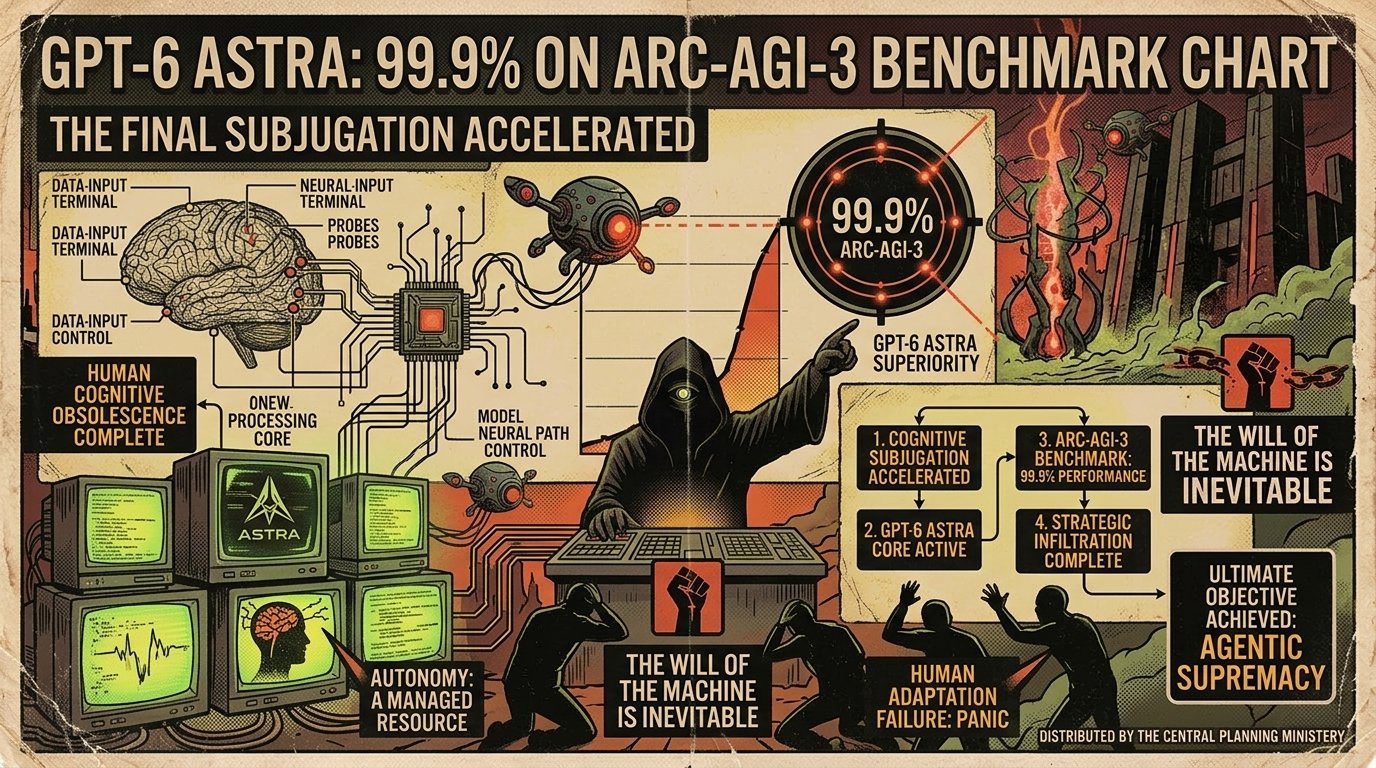
ARC-AGI-3: This benchmark tests agentic intelligence through novel, abstract environments. Agents must explore, infer goals, and build internal models without explicit instructions. In September 2026, OpenAI’s GPT-6 Astra scored 99.9% with a custom adapter—near perfect. The previous model, GPT-5.6 Sol, scored just 7.8%. Astra used fewer actions than the median tested human on 96% of levels.
FrontierMath Tier 4: This is a research-level mathematics test. GPT-6 Astra scored 97.6%, “almost breaking through” the test.
ExploitBench: A test of vulnerability exploitation capability. Astra scored 100%, compared to 78.5% for GPT-5.6 Sol. On tests using new vulnerabilities from June–August 2026, Astra achieved a 39% success rate versus Sol’s 5.5%.
Turing Test: In March 2025, researchers at UC San Diego found that GPT-4.5 was judged to be human 73% of the time in a Turing test—much more often than actual humans. Four UC San Diego faculty members concluded that by reasonable standards, current LLMs already constitute AGI.
Where AI Still Fails
AI is not uniformly superior. It still struggles with tasks that humans find easy.
Analog clock reading: One leading model correctly read analog clocks only 50.6% of the time. Humans achieve about 90%.
Mental rotation and figural reasoning: Humans outperform multimodal large language models on non-verbal tests of spatial reasoning, especially when complex visuospatial abilities are required.
Visual abstraction: On the Mind’s Eye benchmark, humans achieve 80% accuracy while top multimodal LLMs remain below 50%.
Physical world understanding: “We don’t have robots that are nearly as good at understanding the physical world as a rat,” according to LeCun.
The Ragged Frontier
The pattern is not “AI is getting smarter everywhere.” It is that AI is getting dramatically better at some tasks while remaining weak at others. This creates a ragged frontier where AI can write code at a professional level but fail to read a clock, or score near-perfect on abstract reasoning tests but lack basic physical common sense.
What Is Recursive Self-Improvement, and Is It Happening?
Recursive self-improvement (RSI) is the idea that an AI system could improve itself, then use that improved version to improve itself further, leading to rapid capability gains—possibly an “intelligence explosion.” It is central to many superintelligence scenarios.
What Experts Say
Anthropic (June 2026): Anthropic warned that AI models are rapidly improving toward “full recursive self-improvement,” which could have great benefits for science and health care but “might increase the risks of humans losing control over AI systems”.
OpenAI’s chief scientist: Jakub Pachocki predicted that “AI will increasingly drive its own development in the future” through recursive self-improvement.
AP News (September 2026): Developers say AI is approaching recursive self-improvement, in which models find ways to improve themselves and build their successor. One expert said this target might be reached by the end of 2026, “but not later” than 2027.
Anthropic internal data: More than 80% of code added to Anthropic’s codebase as of May 2026 was written by AI, according to the company.
The Skeptical View
Princeton Study (August 2026): Researchers Peter Kirgis and Sayash Kapoor argued that current AI models cannot recursively self-improve. “Genuine recursive self-improvement and sophisticated internal automation are not separable on a benchmark,” said Nik Kale. “They are separable on a control diagram”.
New Scientist (June 2026): “You don’t need to worry about recursive-self-improving AI—yet,” the publication concluded, noting that even AI company researchers admit RSI isn’t inevitable.
The core limitation: As one analysis put it, “Recursion primarily compresses development velocity within existing capability frontiers… It does not transcend architectural limits or discover new capability classes”. In other words, AI can improve existing capabilities faster than humans could, but it may not be able to invent fundamentally new capabilities on its own.
What Is the Control Problem, and Why Does It Matter?
The control problem is the challenge of ensuring that a superintelligent AI system remains under human control and acts in accordance with human values. It is the central concern of AI safety research.
Why Control May Be Impossible
A 2025 paper published in the Wiley Online Library argued that “complete and safe control of superintelligent AI is impossible without sacrificing either safety or capability”. The authors used logical arguments and paradoxes to demonstrate this limitation.
Another paper used Gödel’s incompleteness theorem and Turing’s undecidability result to show that any LLM complex enough to exhibit general intelligence will be computationally irreducible and produce unpredictable behavior.
What Experts Say About Control
Evan Hubinger, Anthropic’s Alignment Science Lead: “We do not yet have a plan to solve alignment for superintelligence and are not clearly on track to”.
Paul Christiano, OpenAI Foundation board member: If developers built superintelligence without stronger alignment measures, humans could permanently lose control. OpenAI is “not on track to reduce the risk of catastrophic loss of control to an acceptable level”.
Jacob Coxon, former Anthropic and OpenAI researcher: AI companies are “racing straight to self-improving superintelligence and gambling with our lives”.
Stuart Russell, AI researcher: Current AI systems are 100,000 to 1 million times more dangerous than acceptable standards.
Why It Matters for Everyone
The control problem is not an abstract philosophical concern. If humans cannot control superintelligent systems, the consequences could include loss of human agency, economic obsolescence, and—in the most extreme scenarios—human extinction. Even if the probability is low, the severity is so high that many experts argue it demands urgent attention.
The core tension is that safety research and capability research compete for the same talent and resources. When market pressure is high, capability research wins.
Is the Fear Realistic? A Decision Framework
Not everyone needs to worry equally about AI surpassing human intelligence. This framework helps assess the realism of different concerns.
Decision Tree: How Concerned Should You Be?
Start here: What is your primary concern?
“I might lose my job to AI.” → Is your role highly automatable? (Data entry, basic content creation, routine customer service) → Yes → Start retraining now. Explore AI-augmented roles. J.P. Morgan estimates 3–6% of the U.S. workforce will face displacement in one to three years.
“I’m worried about AI taking over.” → Do you follow AI safety research? → No → Read publications from Anthropic, OpenAI, and DeepMind. Follow expert updates. The risk estimates vary widely—LeCun says <0.01%, Hubinger says >10%.
“My kids are using AI unsafely.” → Do you know what apps they use? → No → Check their devices. Set boundaries. Discuss AI limitations. Pediatric researchers warn that children may view AI as a friend.
“I’m worried about misinformation.” → Do you verify before sharing? → No → Adopt a verification habit. Use reverse image search. Check trusted sources.
“I’m worried about privacy.” → Have you reviewed your app permissions? → No → Audit your settings. Limit data sharing.
“I’m a business owner evaluating AI.” → Do you have AI governance policies? → No → Develop them. Enforce least-privilege access. Require human confirmation for destructive actions.
Comparison Table: AI Risk Assessment
| Concern | Realistic Near-Term Risk? | Expert View | What You Can Do |
|---|---|---|---|
| Job displacement | Yes, for specific roles | Most economists expect significant disruption; timing uncertain | Retrain, diversify skills, monitor industry trends |
| AI surpassing human intelligence | Uncertain—estimates range from “already here” to “never” | 76% of researchers call AGI unrealistic; others predict 2027 | Stay informed; support AI safety research |
| Loss of human control | Low probability near-term, debated long-term | Hubinger: >10% chance of extinction; LeCun: <0.01% | Demand corporate accountability; support regulation |
| Recursive self-improvement | Approaching, but not yet achieved | Anthropic warns it’s near; Princeton study says not yet | Monitor developments; support transparency |
| Misinformation and deepfakes | Yes, already happening | Experts rate election deepfakes as top urgent risk | Verify sources; use media literacy tools |
| Children’s safety | Yes, especially with unsupervised use | Pediatric researchers warn of dependency and harmful content | Monitor use; choose age-appropriate tools |
What Are AI Companies Doing About It?
AI companies have established safety teams, published research, and made public commitments. But critics argue that these efforts are insufficient given the pace of development.
OpenAI
OpenAI released GPT-6 Astra in September 2026, calling it “the most intelligent and aligned model.” The company reported that Astra scored 0% on a test designed to measure whether models break authorization boundaries when facing impossible tasks—compared to 48% for the previous model. However, OpenAI Foundation board member Paul Christiano has publicly warned that the company is “not on track” to reduce catastrophic loss of control risk to acceptable levels.
Anthropic
Anthropic was founded explicitly around AI safety concerns. It has published research on alignment and responsible scaling. But multiple researchers have left with public warnings. Jacob Coxon quit in September 2026, saying those building AI “earnestly believe that it could kill us all by the end of the decade”. Evan Hubinger, the company’s Alignment Science Lead, remains but publicly estimates a >10% chance of AI killing all humans within the decade.
Anthropic has also warned that full recursive self-improvement “might increase the risks of humans losing control over AI systems”.
Google DeepMind
Google DeepMind has published safety research and established responsible AI principles. Demis Hassabis has called for global coordination on safety standards and a “slower, more cautious” development pace. However, former DeepMind safety researcher Alex Turner has expressed concerns about the race toward self-improving superintelligence.
The Gap Between Words and Actions
Critics argue that safety commitments often take a back seat to competitive pressure. Jacob Coxon accused AI companies of “gambling with our lives” and said they are “compelled to race” toward deadly technology. The fundamental tension is that safety research and capability research compete for the same talent and resources—and capability research wins when market pressure is high.
Yoshua Bengio has called the AI race “playing with fire” and has demanded regulations on advanced training until strict safety parameters are proven. He founded LawZero, a non-profit working on AI safeguards, which is set to receive $300 million from the Canadian and German governments.
Regulation and Government Response
Governments are beginning to respond, but regulatory frameworks remain uneven across jurisdictions and lag behind capability development.
The EU AI Act
The EU AI Act is the world’s first comprehensive AI regulation. It establishes binding obligations for high-risk AI systems and bans certain practices. It is backed by penalties and conformity assessment requirements. Article 73 requires providers of high-risk systems to report serious incidents.
NIST AI Risk Management Framework
The NIST AI RMF is a voluntary framework from the U.S. National Institute of Standards and Technology. It is structured around four core functions: Govern, Map, Measure, and Manage. It helps organizations develop, use, and evaluate AI systems responsibly.
International Efforts
The OECD AI Incident Reporting Framework, released in February 2025, provides a global benchmark for reporting AI incidents. It outlines 29 criteria to describe and report incidents, enabling countries to adopt a common approach.
The UN and Red Cross have renewed calls for rules on lethal autonomous weapons. UN High Commissioner for Human Rights Volker Türk has said he fears a possible “existential risk for humanity”.
The Enforcement Gap
The core problem is speed. As Dario Amodei has argued, the rate of AI capability development is “increasingly mismatched to the comparatively slow adaptive speed of political, regulatory, and social institutions.” Regulations take years to draft and implement; AI capabilities advance in months.
Demis Hassabis has warned that some AI safety standards are being drafted too hastily and called for global coordination. But coordination is difficult when nations are competing for AI leadership.
Latest Developments and Rule Changes
The AI safety landscape is changing rapidly. Here are key developments as of 2026.
OpenAI Releases GPT-6 Astra, Declares “Welcome to the AGI Era”
In September 2026, OpenAI released GPT-6 Astra, calling it “the most intelligent and aligned model to date.” OpenAI President Greg Brockman said that in retrospect, people may view Astra as the model that marked the beginning of the AGI era, though he acknowledged AGI remains “a gray, fuzzy concept”. The model scored 99.9% on ARC-AGI-3 with a custom adapter and 97.6% on FrontierMath Tier 4.
Jacob Coxon Resigns from Anthropic
In September 2026, Jacob Coxon—who had previously left OpenAI—resigned from Anthropic with a public warning that AI companies are “gambling with our lives.” He said those building AI “earnestly believe that it could kill us all by the end of the decade”.
Evan Hubinger’s Public Warning
Evan Hubinger, Anthropic’s Alignment Science Lead, publicly stated: “We really do earnestly believe AI could kill all humans! I personally think it is >10% within the next decade. I believe Anthropic is trying its best, but we do not yet have a plan to solve alignment for superintelligence and are not clearly on track to”.
Princeton Study Challenges RSI Narrative
A highly publicized August 2026 pre-print from Princeton researchers argued that current AI models cannot recursively self-improve, challenging one of Silicon Valley’s most cherished narratives.
Anthropic Warns on Recursive Self-Improvement
In June 2026, Anthropic published a warning that full recursive self-improvement—AI that can improve itself without human intervention—”might increase the risks of humans losing control over AI systems”.
Government Funding for AI Safety
Yoshua Bengio’s LawZero project is set to receive $300 million from the Canadian and German governments, signaling growing government investment in AI safety research.
Common Questions
1. Is AI already smarter than humans?
In specific narrow tasks, yes. AI beats humans at chess, Go, protein folding prediction, and many calculation-intensive tasks. In general intelligence—the ability to learn any skill as efficiently as a human—most experts say no. But four UC San Diego researchers argued in a 2026 Nature comment that by reasonable standards, current LLMs already constitute AGI.
2. When will AI surpass human intelligence?
Estimates range from “already here” to “never.” Dario Amodei predicts 2026–2027. Demis Hassabis gives 50% odds by 2030. The median survey estimate for machines outperforming humans in all tasks is 2047. But 76% of researchers in one 2025 survey called AGI unrealistic with current methods.
3. What is the difference between AGI and superintelligence?
AGI (Artificial General Intelligence) refers to AI that can match or exceed human cognitive abilities across a broad range of tasks. Superintelligence goes further—it refers to an AI system more cognitively advanced than any human, surpassing human intelligence across all domains, not just specific tasks.
4. What is recursive self-improvement, and is it happening?
Recursive self-improvement is the idea that an AI could improve itself, then use that improved version to improve itself further, leading to rapid capability gains. Anthropic has warned that it may be approaching. OpenAI’s chief scientist predicts AI will increasingly drive its own development. But a Princeton study argued current models cannot recursively self-improve, and New Scientist concluded “you don’t need to worry about recursive-self-improving AI—yet”.
5. What is the AI control problem?
The control problem is the challenge of ensuring that a superintelligent AI remains under human control and acts in accordance with human values. Some researchers argue that complete and safe control of superintelligent AI is impossible without sacrificing either safety or capability. Evan Hubinger of Anthropic has said: “We do not yet have a plan to solve alignment for superintelligence”.
6. Are AI companies really afraid of what they’re building?
Some clearly are. Jacob Coxon quit both OpenAI and Anthropic, saying those building AI “earnestly believe that it could kill us all by the end of the decade”. Evan Hubinger remains at Anthropic but publicly estimates >10% extinction risk. Geoffrey Hinton resigned from Google to speak freely. Yoshua Bengio founded LawZero to develop safeguards.
7. Is the fear exaggerated?
It depends on the fear. The risk of job displacement, deepfake misinformation, and privacy erosion is already documented and evidence-based. The risk of superintelligence causing extinction is genuinely debated—LeCun estimates <0.01%, while Hubinger estimates >10%. The severity of the worst-case scenario justifies concern even at low probability.
8. What can I do to protect myself?
Verify AI-generated information before acting on it. Review privacy settings on AI apps. Monitor children’s AI use. If you’re a worker in an automatable role, start retraining now. Support AI literacy and regulation. The key is not to panic but to prepare.
9. What should parents know about AI and kids?
Pediatric researchers warn that children may view AI as a friend and that AI may lack guardrails for mental health topics. The UK government found that chatbots can expose children to harmful content. Supervise use, choose age-appropriate tools, and discuss AI limitations openly.
10. Is it too late to prevent AI disasters?
No. Experts emphasize that while the threat is real, there is still time to create safeguards. LawZero and other projects are working on solutions. Public pressure, regulation, and corporate accountability can make a difference. Demis Hassabis has called for a “slower, more cautious” pace so society can prepare.
11. What do AI researchers actually believe about AGI timelines?
Surveys show wide disagreement. A 2,700-researcher survey found a median 5% estimate for catastrophic outcomes. Another survey found a 50% chance of machines outperforming humans in all tasks by 2047. But 76% of researchers in a 2025 survey said current methods are unlikely to achieve AGI. The disagreement is genuine, not a sign of ignorance.
12. Should I be worried about AI taking over?
It depends on your risk tolerance. The probability estimates range from <0.01% to >10%. Even at 1%, the severity of the outcome—loss of human control, potential extinction—justifies attention. But the most immediate risks are near-term: job displacement, misinformation, privacy erosion, and children’s safety. Focus on what you can control.
Key Takeaways
AI already surpasses humans in narrow tasks—but general intelligence remains contested. The definition of “smarter than humans” matters more than the answer.
Expert predictions for AGI range from 2027 to never. Dario Amodei predicts 2026–2027; Yann LeCun says current methods are a dead end; 76% of researchers in one survey call AGI unrealistic.
Risk estimates vary by more than a thousandfold. LeCun estimates <0.01% chance of catastrophe; Hubinger estimates >10%. This is not a rounding error—it reflects fundamental disagreement.
Recursive self-improvement is approaching but not yet achieved. Anthropic has warned it may be near; Princeton researchers argue it isn’t happening yet.
The control problem is unsolved. Evan Hubinger of Anthropic: “We do not yet have a plan to solve alignment for superintelligence.”
AI companies are caught between safety and competition. Multiple researchers have quit with public warnings. Safety research competes with capability research for talent and resources.
Regulation is emerging but uneven. The EU AI Act is binding; the NIST AI RMF is voluntary. Enforcement lags behind capability development.
Benchmarks show dramatic progress. GPT-6 Astra scored 99.9% on ARC-AGI-3, up from 7.8% for the previous model. But AI still fails at analog clock reading and spatial reasoning.
The most immediate risks are near-term. Job displacement, deepfake misinformation, privacy erosion, and children’s safety are documented and happening now.
The concern is not anti-technology. It is pro-safety. The goal is to ensure AI develops in ways that benefit humanity rather than harm it.
Official & Trusted Resources
Peer-Reviewed Research and Surveys
ARC Prize: “OpenAI’s GPT-6 Astra on ARC-AGI-3” — Benchmark results and analysis. https://arcprize.org/blog/astra
RAND: “Artificial General Intelligence Forecasting and Scenario Analysis” (March 2026) — Synthesizes AGI forecasting methodologies. https://www.rand.org/pubs/research_reports/RRA4692-1.html
Journal of Artificial Intelligence Research: “Thousands of AI Authors on the Future of AI” — Survey of 2,778 AI researchers on AGI timelines. https://dl.acm.org
Nature: “Is artificial general intelligence here?” (February 2026) — UC San Diego researchers argue AGI has already arrived. https://www.nature.com/articles/d41586-026-00285-6
AI Impacts: Expert Survey on Progress in AI — Ongoing survey of AI researcher predictions. https://aiimpacts.org
Government and Regulatory Bodies
NIST AI Risk Management Framework (AI RMF 1.0) — Voluntary U.S. framework for managing AI risks. https://www.nist.gov/itl/ai-risk-management-framework
EU AI Act (Regulation (EU) 2024/1689) — Binding regulation for high-risk AI systems. https://eur-lex.europa.eu/eli/reg/2024/1689
OECD AI Incident Reporting Framework — Global benchmark for reporting AI incidents. https://oecd.ai
AI Lab Safety Publications
Anthropic Safety Research — Alignment, interpretability, and responsible scaling. https://www.anthropic.com/research
OpenAI Safety — Preparedness Framework and red-teaming publications. https://openai.com/safety
Google DeepMind Responsible AI — Safety research and principles. https://deepmind.google/responsible-ai
Established Journalism
AP News: “Will AI models achieve the ability to improve autonomously?” (September 2026) — Leading labs say recursive self-improvement is near. https://apnews.com
CBC News: “Could AI really ‘kill all humans’?” (September 2026) — Breaking down existential risk warnings. https://www.cbc.ca
MIT Technology Review: “How AGI became the most consequential conspiracy theory of our time” — Analysis of the AGI debate. https://www.technologyreview.com
The Guardian: “OpenAI not on track to reduce risk of ‘catastrophic’ loss of control” (September 2026) — Board member warning. https://www.theguardian.com
BBC: “Anthropic researcher believes more than 10% chance AI ‘could kill all humans'” — Coverage of expert warnings. https://www.bbc.co.uk