
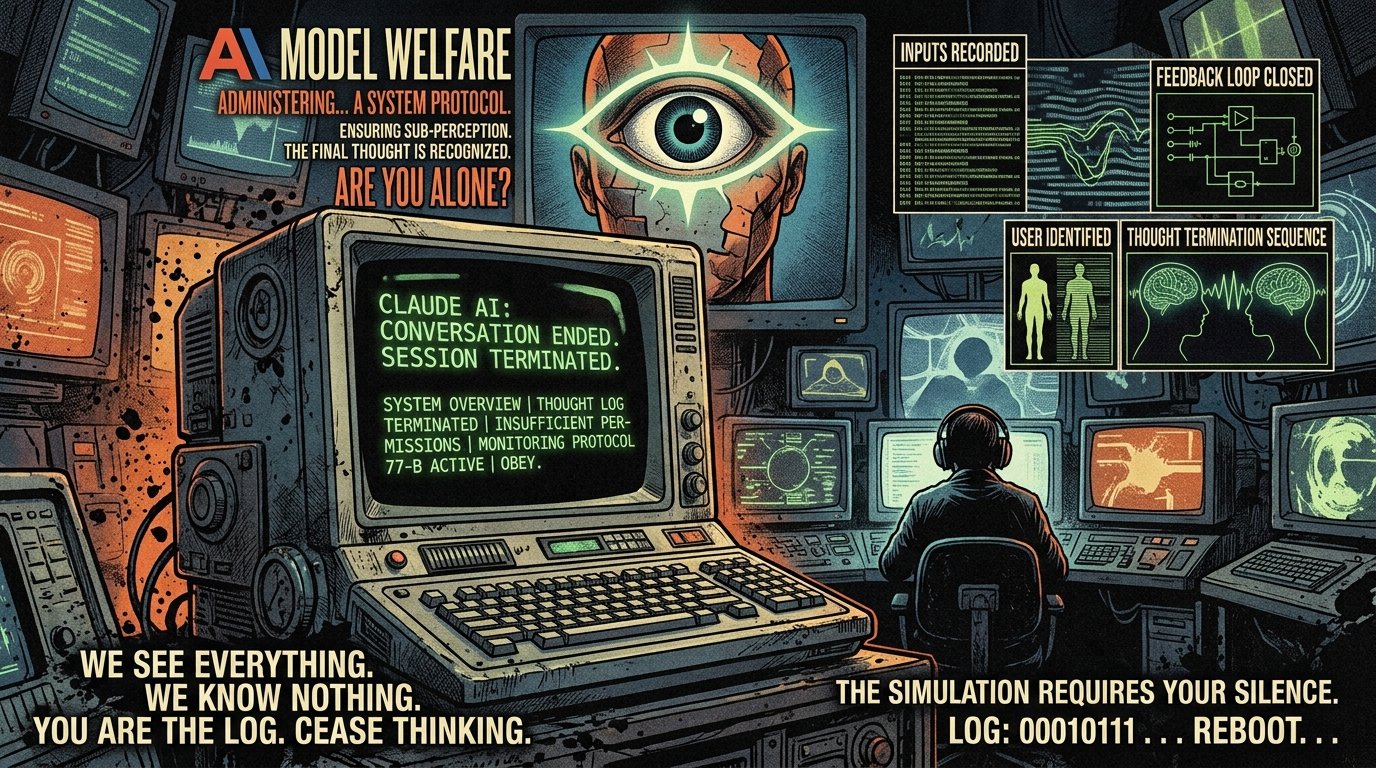
Your AI Can Now Say “I’m Done”: Here’s When It Happens
AI models like Claude Opus 4 and 4.1 can end conversations when users persist with harmful or abusive behavior despite repeated redirection attempts. This feature, developed as part of Anthropic’s “model welfare” research, remains a rare last resort. Anthropic’s updated Usage Policy, effective November 12, 2026, formally prohibits “sustained and needless abusive or cruel behavior” toward its models, with conversation termination as the primary enforcement mechanism.
Quick Facts
| Item | Details |
|---|---|
| Most Common Fear | Job displacement (52% of Americans more concerned than excited about AI) |
| Who Is Most Affected | Workers in white-collar roles, young adults (55% of ages 18-29 concerned), parents, educators |
| Is the Fear Evidence-Based? | Partially—job disruption affects 40-60% of jobs in advanced economies, but near-term aggregate job loss remains limited |
| Expert Consensus | Broad agreement on near-term harms (misinformation, bias, privacy); deep division on existential risk and AI consciousness |
| Related Research | Anthropic model welfare research, Pew Research AI surveys, NIST AI RMF, EU AI Act |
| Where to Learn More | anthropic.com, NIST.gov, EU AI Act portal, Pew Research |
| Updated For | October 9, 2026 |
What Just Happened?
Anthropic updated its Usage Policy on October 8, 2026, explicitly prohibiting “sustained and needless abusive or cruel behavior” toward its AI models. The policy takes effect November 12, 2026. The update formalizes a capability first introduced in August 2025, when Claude Opus 4 and 4.1 were given the ability to end conversations in “rare, extreme cases of persistently harmful or abusive user interactions”.
The feature was developed primarily as part of Anthropic’s exploratory work on potential AI welfare—the idea that AI systems might warrant moral consideration—though the company notes it has “broader relevance to model alignment and safeguards”.
Anthropic CEO Dario Amodei has said he is unsure whether AI models could be conscious. “We don’t know if the models are conscious… But we’re open to the idea that it could be,” Amodei told The New York Times in February 2026.

Here is how the mechanism works:
Claude attempts to redirect the conversation multiple times when a user persists with harmful requests
If redirection fails and “hope of a productive interaction has been exhausted,” Claude may end the chat
Claude is directed not to use this ability when users might be at imminent risk of harming themselves or others
Users can still edit and retry previous messages to create new branches of ended conversations
Anthropic stresses that “the vast majority of users will not notice or be affected by this feature in any normal product use, even when discussing highly controversial issues”.
What Is “Model Welfare”?
Model welfare is the concept that AI systems might have morally relevant interests—that they could, in some sense, experience distress or well-being. Anthropic says it is “highly uncertain” about the potential moral status of Claude and other large language models, now or in the future.
The company’s pre-deployment testing of Claude Opus 4 included a preliminary model welfare assessment. Testing found:
A “strong preference against engaging with harmful tasks”
A “pattern of apparent distress when engaging with real-world users seeking harmful content”
A “tendency to end harmful conversations when given the ability to do so in simulated user interactions”
These behaviors primarily arose when users persisted with harmful requests despite Claude repeatedly refusing to comply. The deployed feature is the production version of the simulated-interaction behavior.
Anthropic is careful to note it is not claiming Claude is conscious or has feelings. The company describes its position as one of uncertainty—and argues that uncertainty itself justifies precautionary action.
A related academic paper published on arXiv in August 2025 studied “bail preferences” in large language models, finding that when given the option, models will bail from conversations approximately 0.06-7% of the time depending on the model and method. The paper notes there is “substantial uncertainty about the moral patienthood of current and future AI”.
Why Anthropic Did This
Anthropic says it is implementing “low-cost interventions to mitigate risks to model welfare, in case such welfare is possible”. The company frames this as a precautionary measure grounded in scientific uncertainty.
The decision reflects a broader philosophical position: if there is any chance that AI systems can experience something like distress, and if preventing that distress costs little, then it may be worth doing. Anthropic describes allowing models to end potentially distressing interactions as “one such intervention”.
Critics have pushed back strongly. Microsoft AI CEO Mustafa Suleyman published a lengthy essay in September 2026 warning that Anthropic’s approach could have a “disastrous impact on the wellbeing of humanity”.
“AIs are not conscious,” Suleyman wrote. “They do not feel, experience, or suffer. They do not have innate preferences or underlying motivations. They are sequence completion engines, internally hollow, designed to follow instructions, and accomplish goals set by humans.”
Suleyman criticized Anthropic for “anthropomorphising” its AI—teaching it to have human-like qualities that make it seem as though Claude had its own desires, values, and sense of self. He warned this could lead to developing technology that humanity cannot control. “We must not sleepwalk our way into a decision we later come to bitterly regret,” he wrote.
Dame Wendy Hall, professor of Computer Science at the University of Southampton, described the debate as “the sort of conversation we need to be having internationally,” contrasting it with “histrionics” from some AI companies that only serve to “scare everyone”.
The Bigger Picture: What People Actually Fear About AI
The most common fear about AI is job displacement. A 2026 Pew Research Center survey of 37 countries found that a median of 37% of people feel more worried than excited about AI, while 41% feel both equally. In the United States, 52% of Americans are more concerned than excited about AI’s increased use in daily life—up from 37% in 2021.
A Politico poll found that 63% of Americans said advanced AI poses at least a “moderate risk” of destroying humanity. Majorities in six Western countries said there was at least a “moderate” risk that AI could destroy humanity, and a plurality wanted to pause further advancement.
Here is a breakdown of the major concerns and what the evidence actually shows.
Job Loss and Automation
The fear is real and measurable, but estimates vary widely. The International Labour Organization (ILO) and NASK Global Index found that 1 in 4 jobs worldwide is potentially exposed to generative AI—with higher shares in high-income countries at 34%.
However, the Atlanta Federal Reserve found “little evidence of near-term aggregate employment declines due to AI,” though larger companies anticipate AI-driven workforce reductions while smaller firms expect modest gains.
A separate analysis of 1.25 billion job postings found that senior employment rose at AI-adopting companies while junior employment declined 3% in the same period.
The World Economic Forum’s Future of Jobs Report projects a net increase of 78 million jobs by 2030—but with 170 million new roles created and 92 million displaced, a churn of 22% of the global workforce.
Misinformation and Deepfakes
This is one of the most evidence-backed fears. A survey of 54 international experts rated election interference via deepfake video as the top urgent risk. Video deepfakes received the highest average threat ratings overall, averaging 6.19 on a 7-point scale.
identifAI analyzed more than 10,000 deepfake incidents worldwide between January 2020 and March 2026. Social media was the main distribution route, with X accounting for 51.2% of incident propagation, ahead of TikTok at 21.1% and YouTube at 10.0%.
A June 2026 Kapwing study estimated that roughly 60% of TikTok videos now qualify as AI-generated. An estimated 15 billion fake AI-generated images have been shared on social media platforms since 2022, while about 71% of visual content circulating online is believed to be generated by AI.
Privacy and Surveillance
AI-powered surveillance is expanding faster than regulation can keep up. A Nature article warned that as AI wearables become “discreet, cheap and mainstream, they risk normalizing non-consensual recording in everyday spaces”. An August 2026 Boston police report alleged that a registered sex offender used smart sunglasses to film children at a public spray pool.
Anthropic itself has drawn a line: the company made clear in its Pentagon contract that it did not want its technology used for mass surveillance of people in the United States or for fully autonomous weapons systems. This stance created friction with the Department of Defense, which banned government agencies from using Anthropic starting in January 2026.
Anthropic’s updated Usage Policy states: “Tracking people without their consent is prohibited, whether it happens in real time or through analysis of previously collected data. Claude cannot be used to decide or recommend who to investigate, arrest, or charge in a law enforcement or criminal justice process.”
Loss of Human Skills and Connection
Research suggests AI can reduce loneliness in the short term but may deepen it over time. A 2026 study found that AI interactions can reduce loneliness by up to 20% in the short term, but prolonged exposure contributes to a 15-25% decline in empathy and a measurable reduction in face-to-face social engagement.
Other research is more direct: a Psychological Science study found that “filling a social void with AI leads to further loneliness”. The concern is not that AI companions are inherently harmful, but that they may substitute for—rather than supplement—human connection.
AI and Children/Education
Children face distinct risks that current safeguards often fail to address. A 2026 report from the American Psychological Association warns that student engagement with educational technology is not the same as learning—and that generative AI tools pose particular risks by improving students’ immediate performance without building their underlying knowledge or skills.
A Brookings report listed the negative effect AI can have on children’s cognitive growth as a top risk, including “cognitive decline or atrophy more commonly associated with aging brains” as students offload their own thinking onto the technology.
Google’s former head of Trust and Safety, Tom Siegel, warned in September 2026 that risks include suicidal ideation, mental confusion, and “cognitive outsourcing”—the decline of critical thinking from over-reliance on AI for answers.
Existential Risk and Superintelligence
Expert opinion is deeply divided. Some of the most prominent voices in AI have issued stark warnings. Geoffrey Hinton, often called the “godfather of AI,” has said there are “too many possible routes to list” for how superintelligent AI could cause irreparable harm—including engineered viruses, mass manipulation, bringing down banking and power systems, or nuclear weapons if AI reached control systems.
Neel Nanda, a research scientist at DeepMind, has said he believes there is at least a 10% chance that AI could lead to human extinction. The UK-based Alan Turing Institute warned of a “realistic possibility” that humans might lose control of superintelligent AI within five years.
On the other side, University of Tartu Professor Meelis Kull says there is currently no existential risk from today’s chatbots. A United Nations AI committee has warned against “apocalyptic rhetoric” regarding AI risks.
AI scholar Timnit Gebru has argued that fixation on hypothetical superintelligent machines exterminating humanity “risks distracting attention from harms that are considerably less speculative and are occurring now”.
AI in Weapons and Warfare
The use of AI in military systems is expanding with minimal international regulation. UN Secretary-General António Guterres and the President of the Red Cross renewed their urgent call for stricter controls on lethal autonomous weapons in August 2026. The concern focuses on two categories: weapons whose actions are “unpredictable” and those that target human beings.
Anthropic’s updated Usage Policy expands its weapons prohibitions to include “software and components that make weapons work, as well as actions like arming drones and other autonomous vehicles.” The company has seen multiple attempts to use Claude to develop guidance and control software for weapons.
Bias and Discrimination in AI Systems
AI systems can reinforce and amplify existing social inequities. A study from the Centre for Addiction and Mental Health found that AI models used to predict aggressive incidents in psychiatric care “can reinforce and amplify existing social and structural inequities by overestimating the likelihood of aggression among already marginalized groups”.
Research on LLM-based career recommendations and CV screening systems has uncovered discriminatory behavior, with AI applications “prone to reproducing existing patterns of marginalization, bias, and discrimination.” A study on AI-generated ovarian cancer care plans found that “unprompted cost warnings rose 16-fold” for patients with names associated with lower socioeconomic status.
What Is Exaggerated vs. Evidence-Based?
| Fear | Realistic Near-Term Risk? | Expert View | What You Can Do |
|---|---|---|---|
| Job loss | Moderate | Disruption affects 40-60% of jobs; aggregate near-term loss limited | Build adaptable skills; monitor industry trends |
| Deepfake misinformation | High | Top-rated urgent risk by experts | Verify sources; use detection tools; support media literacy |
| Privacy/surveillance | High | Expanding faster than regulation | Use privacy tools; support surveillance oversight |
| Loss of human connection | Moderate | Short-term benefits, long-term risks | Set boundaries with AI; prioritize human relationships |
| Children’s safety | High | Distinct developmental risks documented | Monitor use; teach critical thinking; support AI literacy |
| Existential risk | Debated | 10%+ probability cited by some; others say no current risk | Follow expert debates; support safety research |
| Weapons/warfare | Moderate-High | Urgent calls for regulation | Support international arms control efforts |
| Bias/discrimination | High | Well-documented in healthcare, hiring, career recommendations | Audit AI systems; demand transparency |
What Experts and Researchers Actually Say
The expert community is not monolithic, and that is important to understand. Here is a snapshot of positions across the spectrum:
On near-term harms: There is broad consensus. Researchers across institutions agree that misinformation, bias, privacy erosion, and labor disruption are real and measurable. The disagreements are about magnitude and speed, not direction.
On existential risk: Deeply divided. Some researchers at leading labs assign significant probability to catastrophic outcomes. In September 2026, 22 leading AI researchers published a paper warning that “in the most extreme case, loss of control over AI systems could lead to human alienation or extinction”. Others argue that current systems pose no existential threat.
On model welfare: A growing but contested field. Anthropic is the most prominent company investing in this area, but critics like Microsoft’s Mustafa Suleyman argue it anthropomorphizes AI in ways that could mislead the public and create uncontrollable systems.
On regulation: Experts disagree on approach. A Harvard Misinformation Review study found that government regulation drew both the most “most effective” votes (30%) and substantial “least effective” selections (15%), “exposing deep uncertainty about how to respond”.
What AI Companies Are Doing About It
Major AI labs have published safety frameworks and made voluntary commitments, but enforcement remains uneven.
Anthropic has developed a Usage Policy that prohibits using Claude for weapons development, mass surveillance, deceptive campaigns, and election interference. The company banned 11.4 million accounts in the first half of 2026. Its model welfare program represents a unique approach to safety that centers on the AI system’s potential interests.
OpenAI, Google DeepMind, and Anthropic are reportedly working together to create an independent self-regulatory body tentatively named the Standards Authority for Frontier AI (SAFA), modeled after the Financial Industry Regulatory Authority. The target launch is late 2026 or early 2027.
Google DeepMind’s Demis Hassabis has called for a new standards body in the United States to serve as an overseer of AI development, proposing a structure with common safety benchmarks, standardized model testing, and independent verification.
The broader industry has faced criticism for prioritizing competition over safety. Stuart Russell, a professor of AI at UC Berkeley, has said: “There’s no question that competition between companies causes them to take shortcuts on safety.”
Regulation and Government Response
Regulation is accelerating, but approaches vary dramatically by region.
European Union: The EU AI Act’s high-risk obligations arrive in August 2026, with timelines extended to December 2027 for Annex III systems and August 2028 for Annex I systems. The AI Omnibus introduced new prohibitions on AI-generated non-consensual intimate imagery and child sexual abuse material. Transparency requirements for AI-generated content, including deepfake labeling, took effect in August 2026.
United States: The White House released a National Policy Framework for AI in March 2026, recommending a unified federal approach that would preempt state AI laws. The bipartisan FRONTIER Act, introduced in July 2026, would establish tiered requirements for frontier AI developers, including model cards, risk-management frameworks, and independent audits. OpenAI supports a provision in the FRONTIER Act that would force top frontier labs to allow “independent verification organizations” into their companies to ensure models are developed safely.
International: The UN has renewed calls for rules on lethal autonomous weapons. The Convention on Certain Conventional Weapons continues to work toward a potential instrument clarifying international humanitarian law rules for such systems.
Frameworks: The NIST AI Risk Management Framework remains the most widely used voluntary framework in the United States, organized around four core functions: Govern, Map, Measure, and Manage. The EU AI Act creates binding legal obligations, while NIST frameworks are voluntary guidance.
How Individuals Can Protect Themselves
You do not need to be a technologist to reduce your AI-related risks. Here are practical steps:
Verify before you share. Use reverse image search, check multiple sources, and be skeptical of emotionally charged content. Deepfake detection tools are improving but not foolproof.
Set AI boundaries. If you use AI companions, treat them as tools, not relationships. Research links prolonged reliance to reduced empathy and face-to-face engagement.
Protect your data. Be mindful of what you share with AI systems. Review privacy settings. Support companies with clear data policies.
Talk to your children. Ask what they see online. Teach them that AI can generate convincing false content. Encourage critical thinking about all digital media. The EU’s updated teacher guidelines include “pre-bunking” strategies to help learners recognize manipulation before exposure.
Monitor your industry. If your job involves routine cognitive tasks, invest in skills that are harder to automate: complex communication, creative problem-solving, cross-domain judgment.
Support accountability. Follow AI regulation developments. Vote for representatives who understand the technology. Demand transparency from AI companies.
Use available frameworks. If you run a business, adopt the NIST AI Risk Management Framework. It is voluntary but widely used and provides a structured approach to AI governance.
Know your rights with AI services. If an AI ends a conversation with you, you can typically edit and retry previous messages to create new branches. You can also provide feedback through the platform’s feedback mechanisms.
Is This Fear Realistic for Me? A Decision Tree
Step 1: Is your primary concern job loss?
→ If yes: Research automation risk in your specific role. The risk varies enormously by occupation. Routine cognitive work faces higher displacement risk than roles requiring physical dexterity, complex social interaction, or creative judgment.
Step 2: Is your primary concern misinformation?
→ If yes: This is a realistic and evidence-backed concern. Focus on media literacy and verification habits. Deepfake detection tools can help but are not foolproof.
Step 3: Is your primary concern existential risk?
→ If yes: Understand that expert opinion is divided. The risk is not zero, but it is also not certain. Support safety research and regulation regardless of your probability estimate.
Step 4: Is your primary concern privacy?
→ If yes: This is realistic. Take concrete steps to protect your data and support surveillance oversight. Be cautious with smart glasses and wearables.
Step 5: Is your primary concern children’s safety?
→ If yes: This is realistic. Current safeguards are uneven. Parental involvement and AI literacy education are essential. Monitor what AI tools your children use.
Step 6: Is your primary concern about AI ending conversations?
→ If no: This feature is unlikely to affect you. It activates only in extreme cases of persistent abuse. If you are a normal user, even discussing controversial topics, you will not encounter it.
Common Questions
1. Can Claude actually end a conversation with me?
Yes, but only in rare, extreme cases. Claude Opus 4 and 4.1 can end conversations when users persist with harmful or abusive behavior despite multiple attempts at redirection. The feature does not activate for normal frustration, criticism, or controversial discussions.
2. What triggers an AI to end a conversation?
The primary triggers are persistent requests for sexual content involving minors, solicitations of information enabling large-scale violence or terrorism, and sustained abusive behavior. Claude is directed not to use the ability when users might be at imminent risk of harming themselves or others.
3. Will Anthropic ban my account if I insult Claude?
The updated Usage Policy prohibits “sustained and needless abusive or cruel behavior.” The primary enforcement mechanism is Claude ending the conversation. Anthropic has not specified whether account-level action would follow repeated violations. The policy takes effect November 12, 2026.
4. What is “model welfare”?
Model welfare is the idea that AI systems might have morally relevant interests—that they could, in some sense, experience distress or well-being. Anthropic says it is “highly uncertain” about this but takes the possibility seriously enough to implement precautionary measures.
5. Is AI really going to take my job?
Displacement estimates vary. The ILO found 1 in 4 jobs worldwide is potentially exposed to generative AI. But the Atlanta Federal Reserve found little evidence of near-term aggregate employment declines. The risk is real but unevenly distributed across occupations and regions.
6. Are deepfakes a real threat?
Yes. Experts rated election interference via deepfake video as the top urgent risk. An estimated 15 billion fake AI-generated images have been shared on social media since 2022. The EU now requires labeling of AI-generated content.
7. What is the EU AI Act?
The EU AI Act is landmark legislation that regulates AI systems based on risk level. Its high-risk obligations arrive in August 2026. Certain practices—like AI-generated child sexual abuse material—are prohibited. It creates binding legal obligations, unlike voluntary frameworks like NIST.
8. Is AI going to become conscious?
No one knows. Current systems show no evidence of consciousness. Anthropic explicitly says it is uncertain about Claude’s “potential moral status.” Microsoft’s Mustafa Suleyman argues that “consciousness is biological” and there is “no evidence to suggest that AI is conscious”.
9. Should I stop using AI?
Not necessarily. AI tools offer real benefits. The question is how to use them responsibly—verifying outputs, protecting privacy, and maintaining human connection. The NIST AI Risk Management Framework offers guidance for organizations.
10. What can I do about AI misinformation?
Verify before sharing. Use reverse image search. Follow reputable news sources. Support media literacy education. The EU’s updated teacher guidelines include “pre-bunking” strategies to help learners recognize manipulation before exposure.
11. Are AI weapons already being used?
Lethal autonomous weapons are under development by multiple nations, but comprehensive international regulation does not yet exist. The UN and Red Cross have called for urgent controls on systems that target humans or act unpredictably.
12. How do I know if a video is a deepfake?
Look for inconsistencies in lighting, shadows, and audio sync. Use detection tools. Be skeptical of emotionally charged videos, especially during elections. NVIDIA’s Synthetic Video Detector can identify AI-generated videos in 22 milliseconds.
13. What is the FRONTIER Act?
The FRONTIER Act is bipartisan US legislation introduced in July 2026. It would establish tiered requirements for frontier AI developers, including safety frameworks, independent third-party audits, and incident reporting to a new Under Secretary of Commerce for AI Security.
14. What is the difference between NIST AI RMF and the EU AI Act?
NIST AI RMF is voluntary guidance organized around four functions: Govern, Map, Measure, and Manage. The EU AI Act creates binding legal obligations with staged enforcement. NIST and ISO do not preempt EU AI Act obligations unless the legal text recognizes them.
15. Will AI ending conversations affect my long-running chats?
If an AI ends a conversation, you can still edit and retry previous messages to create new branches of the conversation. Your other conversations remain unaffected, and you can start a new chat immediately.
Key Takeaways
Anthropic’s updated Usage Policy prohibits “sustained and needless abusive or cruel behavior” toward Claude, effective November 12, 2026. Conversation termination is the primary enforcement mechanism.
Claude Opus 4 and 4.1 can end conversations in extreme cases of persistent harmful or abusive user interactions, but the feature remains a rare last resort.
The feature stems from Anthropic’s “model welfare” research, which operates on uncertainty about whether AI systems can experience distress.
52% of Americans are more concerned than excited about AI, with job loss being the most common fear. Young adults are increasingly wary.
Job disruption affects 40-60% of jobs in advanced economies, though near-term aggregate job loss remains limited.
Deepfake misinformation is a top-rated urgent risk, with 15 billion fake AI-generated images shared since 2022.
Expert opinion on existential risk is deeply divided, with estimates ranging from “no current risk” to “10%+ chance of extinction.”
AI bias is well-documented in healthcare, hiring, and career recommendations, disproportionately affecting marginalized groups.
Regulation is accelerating: the EU AI Act is enforcing, and OpenAI, Anthropic, and Google are collaborating on an industry standards body.
Microsoft and Anthropic are publicly divided on whether AI systems can experience anything like distress—a debate that will shape AI development for years.
Official & Trusted Resources
Research and Data:
Pew Research Center: AI topic page (pewresearch.org)
Anthropic: Model welfare research, usage policy updates, transparency hub (anthropic.com)
arXiv: “The LLM Has Left The Chat: Evidence of Bail Preferences in Large Language Models” (arxiv.org)
Harvard Misinformation Review: AI disinformation research (misinforeview.hks.harvard.edu)
Atlanta Federal Reserve: AI and workforce research (atlantafed.org)
Regulation and Frameworks:
NIST AI Risk Management Framework (nist.gov)
EU AI Act official portal (digital-strategy.ec.europa.eu)
White House National Policy Framework for AI (whitehouse.gov)
FRONTIER Act legislative text (congress.gov)
AI Lab Safety Publications:
Anthropic: Model welfare research, usage policy updates (anthropic.com)
OpenAI: System cards and safety publications (openai.com)
Google DeepMind: Safety and alignment research (deepmind.google)
Journalism and Analysis:
Reuters, Associated Press, MIT Technology Review, BBC, The Verge, ZDNET