

Are Entry-Level Jobs Disappearing Because of AI?
Entry-level jobs are not disappearing — they are being quietly redefined. Stanford’s Digital Economy Lab found that employment for workers ages 22–25 in highly AI-exposed occupations has dropped roughly 19% relative to less-exposed peers since late 2022. Companies are not mass-firing young workers. They are simply not hiring them. Meanwhile, IBM tripled entry-level hiring in 2026 after AI failed to replace human judgment.
Quick Facts
| Item | Details |
|---|---|
| Most Common Fear | That AI eliminates the first rung of the career ladder permanently |
| Who Is Most Affected | Workers ages 22–25 in entry-level roles heavily reliant on codified, routine knowledge |
| Is the Fear Evidence-Based? | Yes for entry-level hiring. The Stanford gap is real and widening. But total job elimination is not the dominant pattern |
| Expert Consensus | Entry-level work is being transformed, not eliminated. The risk is concentrated in hiring, not firing. Companies that over-cut are rehiring |
| Related Research | Stanford “Canaries in the Coal Mine” (Aug 2026 update), Gartner CHRO survey (July 2026), PwC 2026 AI Jobs Barometer, WEF Future of Jobs Report 2025, GMAC Corporate Recruiters Survey 2026 |
| Where to Learn More | Stanford Digital Economy Lab, Gartner HR research, PwC AI Jobs Barometer, WEF Future of Jobs, IBM SkillsBuild |
| Updated For | September 2026 |
The Data: A Quiet Crisis, Not a Loud Collapse
The entry-level job crisis is real, but it does not look like mass unemployment. It looks like a hiring freeze.
Stanford’s Digital Economy Lab released an updated version of its “Canaries in the Coal Mine” study in August 2026, using ADP payroll data covering millions of US workers through June 2026. The findings:
Employment for workers ages 22–25 in the most AI-exposed occupations is 19% lower than for the same age group in less-exposed jobs. This gap has widened from 13% in 2025 and 15% in mid-2025.
The decline is driven by reduced hiring, not increased layoffs. Companies are not firing young workers. They are not hiring them.
Experienced workers in those same occupations show no comparable employment gap.
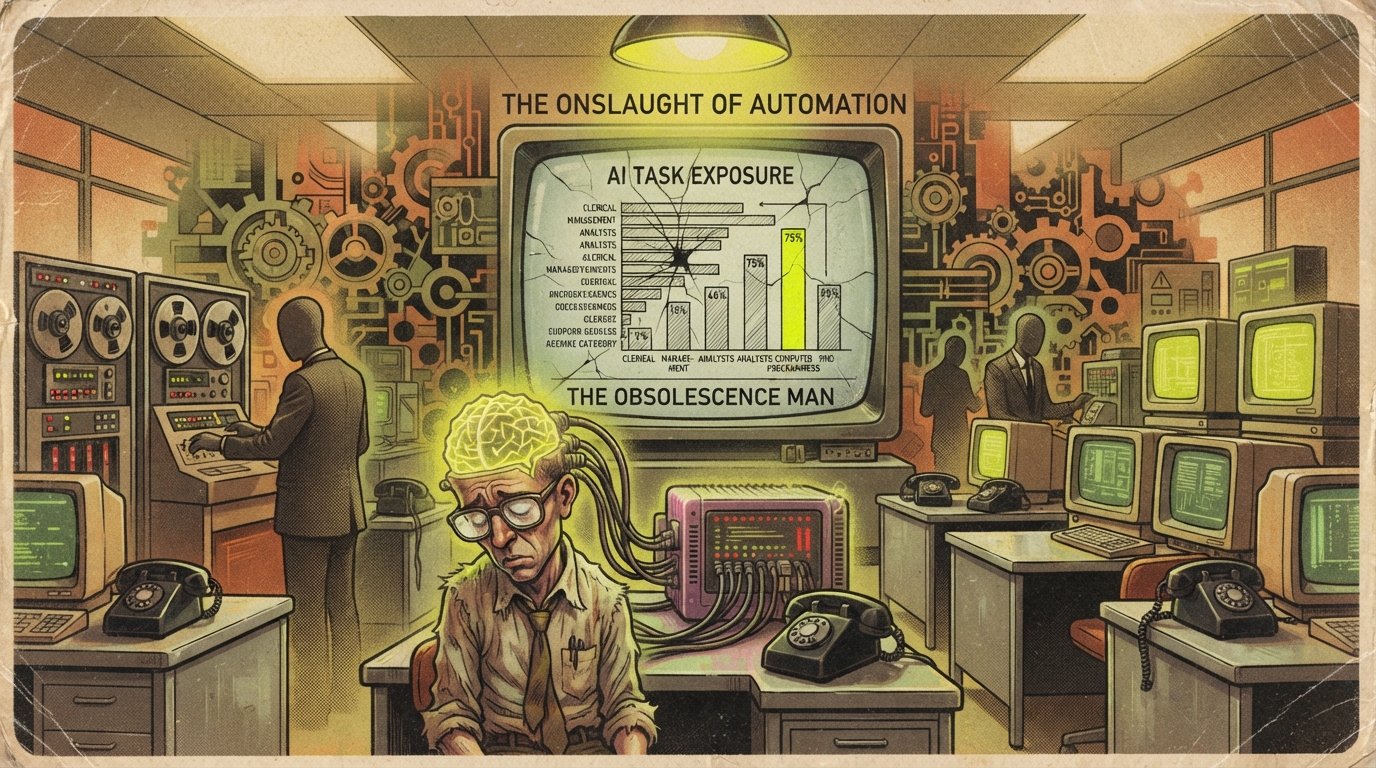
Erik Brynjolfsson, who led the study, warned that current trends point to a direction where “existing workers keep their jobs but opportunities shrink for new cohorts entering the labor market”.
The pattern is consistent across multiple data sources:
| Data Source | Finding |
|---|---|
| Stanford Digital Economy Lab (Aug 2026) | 19% employment gap for ages 22–25 in AI-exposed occupations |
| Revelio Labs | Entry-level postings down 35%+ since January 2023; 40%+ in the most AI-exposed roles |
| SignalFire | Hiring of candidates with less than one year of experience fell nearly 50% between 2019 and 2024 |
| GMAC Corporate Recruiters Survey (2026) | One-third of employers say they are replacing entry-level jobs with AI |
| Gartner CHRO Survey (July 2026) | 22% of CHROs report that at least one business leader has stopped hiring for entry-level roles due to AI automation |
| Adzuna | Vacancies for graduate jobs, apprenticeships, internships, and junior roles dropped 32% since ChatGPT’s launch |
What “Disappearing” Actually Looks Like
Entry-level jobs are not vanishing from the economy. They are being “seniorised” — transformed into roles that demand skills traditionally associated with experienced workers.
PwC’s 2026 AI Jobs Barometer analyzed 2.4 million entry-level job postings in the United States. The key finding: entry-level roles most exposed to AI are now seven times more likely to require traditionally senior-level skills such as leadership, judgment, creativity, and face-to-face interaction.
The result is a bifurcated market:
“Seniorised” entry-level roles — jobs that combine AI fluency with human-intensive skills — grew 35% since 2019.
Traditional entry-level roles — jobs based on routine, codified tasks — shrank 10% over the same period.
This is not the disappearance of entry-level work. It is the disappearance of entry-level work as it used to be defined.
The Codified vs. Tacit Knowledge Distinction
Stanford’s research draws the most useful line: codified knowledge (formal, documented, standardized — taught through manuals and procedures) vs. tacit knowledge (acquired through practice, mentorship, and repeated exposure to real situations).
Entry-level workers are most vulnerable in jobs that rely heavily on formalized knowledge. Knowledge that can be taught through textbooks and documented procedures is easier for AI to replace. Tacit knowledge built through practical experience is more likely to pair with skilled workers.
The researchers used education requirements in the O*NET database as a proxy and found that the higher the share of formalized knowledge in an occupation, the slower the increase in entry-level employment. In occupations with a higher share of tacit knowledge, employment growth was faster among mid-career and experienced workers.
Which Entry-Level Jobs Are Most Affected?
Entry-level roles in technology, customer service, data processing, and administrative support show the highest displacement pressure. Roles requiring physical presence, empathy, or complex judgment remain more resilient.
Technology and Software Development
Tech roles are the most exposed to AI-driven entry-level displacement. A GMAC survey of 600 recruiters found that 40% of employers in the technology industry say AI is replacing entry-level positions.
Software developer employment for ages 22–25 is down approximately 20% since 2022. Entry-level development opportunities have collapsed by roughly 67% since 2022.
Customer Service and Support
Customer service representatives show approximately 70% task coverage by AI tools. Routine inquiries, order processing, and basic troubleshooting are increasingly handled by AI agents. But Gartner found that only 20% of customer service organizations have actually reduced headcount — most use AI to handle higher volumes with existing staff.
Data Entry, Bookkeeping, and Administrative Roles
These are the most codified roles in the economy, and therefore the most vulnerable. Data entry keyers show 67.1% AI exposure. Bookkeeping, basic research, and administrative support roles are being systematically absorbed by AI tools.
Finance, Legal, and Professional Services
Entry-level finance and legal roles are being reshaped. Mark Cuban warned that roles tied to data entry, bookkeeping, customer support, software development, research, finance, and legal paperwork could see fewer openings.
Roles That Remain Resilient
Entry-level roles requiring physical presence, emotional intelligence, or accountability remain more protected. These include:
Healthcare support roles (nursing assistants, medical technicians)
Skilled trades (electricians, plumbers, mechanics)
Roles requiring complex human judgment and relationship-building
Why Companies Are Cutting Entry-Level Roles
Companies are not eliminating entry-level jobs out of malice. They are responding to three converging pressures: AI capability, cost optimization, and a structural shift in how work is organized.
1. AI Can Now Do the Work
The routine tasks that defined entry-level work — summarizing documents, collating data, basic coding — are precisely the tasks AI handles best. Bloomberg found that AI could replace more than 50% of the tasks performed by market research analysts (53%) and sales representatives (67%), compared to just 9% and 21% for their managerial counterparts.
2. The “Diamond” Organizational Model
Organizations are shifting from a traditional pyramid (many juniors, fewer seniors) to a “diamond” model (fewer juniors, more mid-level and senior talent trained on AI).
Stephen Bennett, agentic AI transformation partner at Artefact, explained: “I can orchestrate a load of agents together to do an entire process from beginning to end, where I only need humans as checkpoints.”
3. Investor Pressure and Signaling
Some companies are announcing AI-driven cuts to impress investors, not because AI has actually replaced the work. Oxford Internet Institute associate professor Carl-Benedikt Frey told the Financial Times he has “not seen any compelling evidence of the narrative that these firms are automating a lot of work”. An FT analysis found that companies citing AI in job cuts underperformed the Nasdaq by almost 10% in the 30 trading days following their announcements.
The Rehiring Wave: Why AI Replacement Is Backfiring
Companies that cut entry-level roles for AI are rehiring at significant rates. The technology did not perform as expected.
IBM’s Reversal
IBM froze back-office hiring in 2023, saying 30% of 26,000 non-customer-facing roles would be automated within five years. By February 2026, IBM announced it would triple entry-level hiring across software development, HR, and other roles widely assumed to be AI-replaceable.
The Scale of Rehiring
Forrester estimates that half of companies that cut jobs for AI will rehire for similar roles.
Careerminds found that one-third of companies rehired 25–50% of cut roles; another 35.6% rehired more than half.
Gartner projects that by 2027, 50% of companies that attributed headcount reductions to AI will rehire staff to perform similar functions under different job titles.
What Rehired Workers Earn
Many rehired workers return to hybrid roles combining AI expertise with human judgment, securing 20–35% higher salaries than before, according to Robert Half data.
Why AI Replacement Fails
AI replacement fails because of four human gaps:
Judgment under uncertainty — AI struggles when the “right answer” depends on context and precedent
Empathy and trust — consumers dislike AI customer service; empathy cannot be automated
Accountability — someone must be legally and ethically responsible for decisions
Tacit knowledge — the kind acquired through experience, not documentation
The Mental Health Toll on Young Workers
The entry-level crisis is not just an economic problem. It is a psychological one.
Psychiatrists at the University of Florida proposed a clinical framework called Artificial Intelligence Replacement Dysfunction (AIRD) in September 2025. It describes the psychological and existential distress experienced by individuals facing job displacement due to AI.
AIRD is not a formal diagnosis, but its symptoms are described with clinical specificity: anxiety, insomnia, demoralization, paranoia, loss of occupational identity, feelings of worthlessness, and hopelessness.
Research by KPMG shows that 52% of workers believe AI will harm their job security. A study found that people working in jobs particularly susceptible to automation are more likely to report feeling stress and other negative emotions.
For young workers, the distress is compounded by a sense of betrayal. They followed the prescribed path — education, internships, entry-level jobs — only to find the first rung of the ladder pulled up behind them.
What Experts Actually Say
The expert consensus is that entry-level work is being transformed, not eliminated — but the transformation is painful and uneven.
Erik Brynjolfsson (Stanford Digital Economy Lab): “The entry-level job effects we’re seeing are not temporary. They are persisting and broadening in scope. Existing workers keep their jobs but opportunities shrink for new cohorts entering the labor market.”
Dario Amodei (CEO, Anthropic): Initially warned AI could wipe out half of all entry-level white-collar jobs within five years. Later revised: “If you automate 90% of the job, then everyone does the 10% of the job.”
Kaelyn Lowmaster (Gartner HR practice): “Organizations that respond by cutting their early career talent pipelines altogether risk creating significant workforce challenges down the road. Instead of eliminating these early career roles, organizations should redefine them.”
Karine Allouche Salanon (Busuu): Warned that the lack of early-career opportunities risks creating “a generation that has never struggled” — and therefore never learned how to judge and decide.
Christopher T. Stanton (Harvard Business School): “Over the next two or three years, 50% to 55% of jobs will be ‘reshaped’ by AI.”
Comparison Table: Entry-Level Job Fears vs. Reality
| Fear | Realistic Near-Term Risk? | Expert View | What You Can Do |
|---|---|---|---|
| Entry-level jobs are disappearing entirely | Moderate — hiring is down, not eliminated | Stanford: 19% employment gap; PwC: “seniorised” roles grew 35% | Build AI fluency and human-intensive skills early |
| I can’t get any entry-level job | High in AI-exposed fields | Revelio: postings down 40%+ in most exposed roles | Target roles in less-exposed industries or “seniorised” entry-level positions |
| AI will replace me within a year | Low for most | Gartner: only 20% of customer service orgs reduced headcount | Develop tacit knowledge; focus on judgment and relationships |
| Companies won’t rehire | Low — rehiring is widespread | Forrester: 50% of companies rehire; IBM tripled entry-level hiring | Stay connected to former employers and colleagues |
| My degree is worthless | Partially — codified knowledge is vulnerable | Stanford: tacit knowledge is the protection | Supplement degree with practical experience and AI skills |
| Young workers are permanently disadvantaged | Moderate to high | WEF: 39% of leaders have already replaced entry-level roles with AI | Pursue apprenticeships, rotational programs, and hands-on projects |
| Mental health impact is not serious | High — documented | AIRD framework describes clinical-level distress | Seek support; treat job anxiety as a real stressor |
What Companies and Governments Are Doing
The World Economic Forum Framework
The WEF released a report in July 2026 titled “Artificial Intelligence and the Future of Entry-Level Work: A Framework for Safeguarding and Reinventing Early Career Pathways”. The report urges companies to redesign entry-level roles instead of eliminating them, protect apprenticeships and rotational programs, and make entry-level hiring an explicit component of strategic workforce planning.
IBM’s Reversal
IBM’s decision to triple entry-level hiring is the most significant corporate reversal in the AI displacement narrative. Nickle LaMoreaux, IBM’s chief human resources officer, said the company found that AI “just didn’t work so well” for many roles. IBM is now hiring for software development, HR, and other roles that were assumed to be AI-replaceable.
McKinsey’s Hiring Plans
McKinsey is planning a 12% increase in North American hiring in 2026 and emphasizes that entry-level roles are evolving, not disappearing. The firm is prioritizing systems thinking, critical analysis, and human oversight of AI rather than repetitive execution.
The UK Government’s Response
The UK government launched the AI and the Future of Work Unit and the Early Careers Job Alliance to map how entry-level work is changing. A LinkedIn partnership found that entry-level hiring in the UK is weak but broadly in line with the wider labor market. Certain roles where AI tools have become more capable show weakening entry-level hiring.
The EU AI Act
The EU AI Act classifies employment AI as high-risk, requiring transparency, human oversight, and the right to explanation and review. Employers must inform workers about AI systems used in the workplace. Non-compliance can lead to fines up to €35 million or 7% of global turnover. However, the Act does not specifically address entry-level hiring practices.
Decision Framework: Is Your Entry-Level Job at Risk?
Step 1: Assess the codified vs. tacit balance of your role. Does your work consist mostly of routine, documented tasks? If yes, you are at higher risk.
Step 2: Check AI exposure for your occupation. Computer programmers (74.5%), customer service representatives (70.1%), and data entry keyers (67.1%) are most exposed.
Step 3: Look for “seniorised” entry-level roles. Jobs requiring judgment, leadership, and face-to-face interaction are growing 35% since 2019. Target these.
Step 4: Build AI fluency. AI-exposed entry-level roles are seven times more likely to require senior-level skills. Learn to use AI tools effectively while developing the human skills AI cannot replicate.
Step 5: Consider less-exposed industries. Healthcare, skilled trades, education, and roles requiring physical presence remain more resilient.
Step 6: Monitor, don’t panic. Entry-level hiring is down, but rehiring is widespread. The first job is harder to get. The career is not over.
What Young Workers Can Do Right Now
Become AI-fluent early. The wage premium for AI skills is 62%, up from 57% last year. Jobs requiring AI skills are growing eight times faster than the overall market.
Build a portfolio, not just a resume. Demonstrate real projects, AI-augmented work, and measurable outcomes. Employers increasingly value demonstrated skills over credentials.
Target “seniorised” entry-level roles. These roles combine AI fluency with human-intensive skills like leadership, creativity, and face-to-face interaction. They are growing, not shrinking.
Pursue apprenticeships and rotational programs. These structures protect the learning-by-doing that builds tacit knowledge. The WEF explicitly recommends protecting these pathways.
Develop judgment-building experiences. Seek roles that involve ambiguity, client interaction, and decision-making — not just task execution.
Address the psychological toll directly. If you are experiencing symptoms of AI-related distress — insomnia, intrusive thoughts, loss of motivation — treat it as a real stressor. Talk to someone.
Common Questions
Are entry-level jobs actually disappearing because of AI?
Entry-level hiring is declining sharply in AI-exposed occupations, but jobs are not disappearing entirely. Stanford’s data shows a 19% employment gap for workers ages 22–25 in highly AI-exposed roles. Companies are hiring fewer juniors, not eliminating the roles altogether. The roles themselves are being redefined to require more senior skills.
Which entry-level jobs are most at risk from AI?
Technology roles (40% of employers say AI is replacing entry-level positions), customer service (70% task exposure), data entry (67%), and administrative support are most at risk. Roles requiring physical presence, empathy, or complex judgment are more resilient.
Why are companies cutting entry-level roles if AI can’t fully replace them?
Companies are responding to AI capability, cost pressure, and investor expectations. Some are over-cutting based on optimistic AI assessments. Gartner found that 22% of CHROs report at least one business leader has stopped hiring entry-level roles due to AI automation. Many of these companies are now rehiring.
Do companies rehire workers they replaced with AI?
Yes. Forrester estimates half of companies that cut jobs for AI will rehire for similar roles. IBM tripled entry-level hiring in 2026 after AI failed to replace human judgment in many roles. Careerminds found that one-third of companies rehired 25–50% of cut roles.
What is “seniorisation” of entry-level jobs?
PwC’s research found that entry-level roles most exposed to AI are seven times more likely to require traditionally senior-level skills like leadership, judgment, and creativity. These “seniorised” roles grew 35% since 2019, while traditional entry-level roles shrank 10%.
What is the difference between codified and tacit knowledge?
Codified knowledge is formal, documented, and standardized — taught through manuals and procedures. Tacit knowledge is acquired through practice, mentorship, and real-world experience. AI can replicate codified knowledge. It struggles with tacit knowledge.
Is AI the only reason entry-level hiring is declining?
No. Post-pandemic hiring slowdowns, economic uncertainty, and broader labor market softening are also factors. But Stanford’s research isolates the AI-specific effect, showing a 19% gap that persists even after controlling for other factors.
What should I do if I’m struggling to find an entry-level job?
Target “seniorised” entry-level roles that combine AI fluency with human-intensive skills. Build a portfolio of demonstrated work. Pursue apprenticeships and rotational programs. Consider industries with lower AI exposure like healthcare, skilled trades, or education. Address the psychological toll directly.
Will entry-level jobs come back?
They are coming back, but in different forms. IBM, McKinsey, and other major employers are increasing entry-level hiring. The WEF reports that 67% of global CEOs say AI is increasing entry-level headcount, not reducing it. The jobs will look different — more emphasis on judgment, AI oversight, and human-intensive skills.
What is AI Replacement Dysfunction (AIRD)?
AIRD is a proposed clinical framework describing the psychological distress experienced by workers facing AI-driven displacement. Symptoms include anxiety, insomnia, demoralization, loss of occupational identity, and feelings of worthlessness. It is not yet a formal diagnosis but reflects the real mental health impact of the entry-level crisis.
Key Takeaways
Entry-level jobs are being redefined, not eliminated. Stanford documents a 19% employment gap for workers ages 22–25 in AI-exposed occupations, driven by reduced hiring, not layoffs.
The “seniorisation” of entry-level work is real. PwC found that AI-exposed entry-level roles are seven times more likely to require senior-level skills. These roles grew 35% since 2019.
Technology roles are most exposed. 40% of tech employers say AI is replacing entry-level positions. Software developer employment for ages 22–25 is down 20% since 2022.
Companies are rehiring. IBM tripled entry-level hiring in 2026. Forrester estimates half of companies that cut jobs for AI will rehire for similar roles.
Codified knowledge is vulnerable; tacit knowledge is protection. Entry-level workers in routine, documented roles face the highest displacement risk.
The psychological toll is documented. AIRD describes symptoms including anxiety, insomnia, and loss of occupational identity.
AI skills command a 62% wage premium. Jobs requiring AI skills are growing eight times faster than the overall market.
Government and business responses are emerging. The WEF has published a framework for safeguarding entry-level work. The EU AI Act classifies employment AI as high-risk.
Target “seniorised” roles. Jobs requiring judgment, leadership, and face-to-face interaction are growing while routine roles shrink.
The first job is harder to get. The career is not over. Preparation, AI fluency, and tacit knowledge remain the best protection.
Official & Trusted Resources
Stanford Digital Economy Lab “Canaries in the Coal Mine” (August 2026 update) — ADP payroll analysis of AI employment effects: https://digitaleconomy.stanford.edu
Gartner CHRO Survey on Entry-Level Hiring (July 2026) — 22% of CHROs report stopped entry-level hiring due to AI: https://www.gartner.com
PwC 2026 AI Jobs Barometer — 2.4 million entry-level jobs analyzed; “seniorisation” of entry-level roles: https://www.pwc.com
WEF: Artificial Intelligence and the Future of Entry-Level Work (July 2026) — Framework for safeguarding early career pathways: https://www.weforum.org
GMAC Corporate Recruiters Survey 2026 — One-third of employers replacing entry-level jobs with AI: https://www.gmac.com
Revelio Labs — Entry-level postings down 35%+ since January 2023: https://www.reveliolabs.com
IBM: The Bottom Rung Returns as AI Reshapes Entry-Level Jobs — IBM triples entry-level hiring: https://www.ibm.com
EU AI Act (Regulation 2024/1689) — High-risk classification for employment AI: https://eur-lex.europa.eu