
Why Millions Fear AI Job Loss — And What to Do About It
The most common fear about AI is job displacement — that machines will make human workers obsolete. Surveys show 36% of workers globally worry AI could replace their jobs, and 89% fear AI job loss generally, even if they don’t expect it to happen to them personally. The fear is partially evidence-based: Goldman Sachs estimates up to 300 million jobs could be disrupted globally within a decade, but experts agree that task automation — not wholesale job elimination — is the more likely near-term outcome.
Quick Facts
| Item | Details |
|---|---|
| Most Common Fear | Job displacement and permanent unemployment |
| Who Is Most Affected | Early-career workers, customer service, clerical, and creative roles |
| Is the Fear Evidence-Based? | Partially. 6–7% of workers may be displaced; 22% of jobs will see disruption by 2030 |
| Expert Consensus | Task-level automation is likely; wholesale job elimination is less likely in the near term |
| Related Research | World Economic Forum Future of Jobs 2025; Goldman Sachs AI outlook; Pew Research global surveys |
| Where to Learn More | WEF Future of Jobs Report; Pew Research; NIST AI Risk Management Framework |
| Updated For | September 2026 |
What People Actually Fear About AI
People fear AI for different reasons depending on their circumstances, but the anxieties cluster into recognizable categories. Understanding which fear applies to you is the first step toward addressing it.
The most prevalent fear is economic: losing a job, a career, or financial stability. But fears extend well beyond employment. Pew Research Center surveys across 37 countries found that people also worry about AI’s impact on creativity, relationships, news quality, and personal autonomy. About 50% of Americans are more concerned than excited about AI’s growing role in daily life.

A global survey by Gallup International found that 36% of respondents were worried AI could replace their own jobs, while 46% were not worried. Southeast Asia and South Asia showed the highest concern levels, while advanced economies like Sweden, Denmark, and Estonia showed the lowest.
The fear hierarchy looks roughly like this:
Tier 1 — Immediate personal threat: “Will I lose my job? Can I pay my mortgage? Will my skills still matter in five years?” This is the fear that dominates public discourse and drives most AI anxiety.
Tier 2 — Professional identity threat: “If AI does my work, who am I?” This fear is particularly acute among knowledge workers — journalists, designers, lawyers, analysts — whose identity is tied to cognitive output.
Tier 3 — Systemic threat: “What happens to society if millions are displaced at once? Who regulates this? Who protects workers?” This fear is less personal but increasingly urgent for policymakers and parents.
Tier 4 — Existential threat: “Could superintelligent AI destroy humanity?” This fear attracts significant media attention but remains speculative. Experts disagree sharply on whether it is realistic or distracting.
Is the Job Loss Fear Evidence-Based?
Yes — partially. The fear is not irrational, but it is often oversimplified. The evidence supports concern about task disruption, not immediate mass unemployment.
Goldman Sachs estimates that AI could disrupt up to 300 million jobs globally within the next decade, affecting about 6–7% of workers. In the US alone, AI could automate tasks accounting for one-fourth of all work hours. The investment bank notes that the real inflection point is still coming, especially as AI moves beyond white-collar roles.
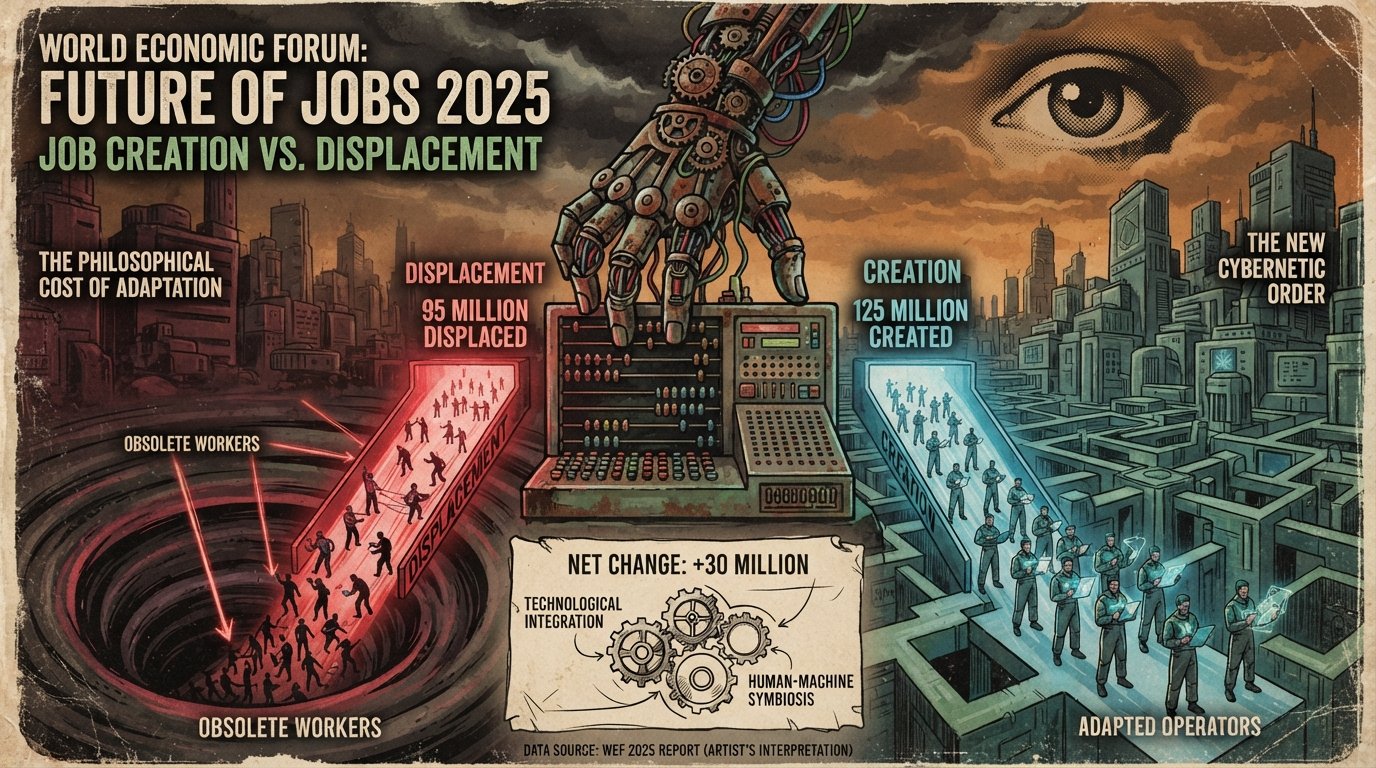
The World Economic Forum’s Future of Jobs Report 2025 projects that 22% of jobs will be disrupted by 2030 — with 170 million new roles created and 92 million displaced, producing a net gain of 78 million jobs. Half of employers plan to reorient their business models around AI, and 40% expect to reduce headcount where automation can replace tasks.
The International Monetary Fund estimates that nearly 40% of jobs globally are exposed to AI, rising to 60% in advanced economies.
The World Economic Forum report also found that almost 39% of current skillsets will be overhauled or outdated between 2025 and 2030.
What this means: The fear of job loss is evidence-based at the task level. Machines are taking over specific functions — writing first drafts, answering customer queries, analyzing data, generating images — far faster than they are eliminating entire occupations. The risk is real but unevenly distributed.
Who Is Actually Most at Risk?
Risk is not evenly distributed. Workers in routine cognitive and administrative roles face the highest near-term exposure, while physical trades and roles requiring complex human interaction remain more protected.
Research points to several high-risk categories:
Most exposed occupations:
Customer service and support roles
Data entry and clerical work
Basic content creation (copywriting, graphic design)
Junior legal and financial analysis
Telemarketing and sales outreach
Entry-level software development tasks
Less exposed occupations:
Skilled trades (electricians, plumbers, HVAC technicians)
Healthcare roles requiring physical care
Roles requiring complex negotiation and empathy
Leadership and strategic decision-making
Creative work requiring genuine originality
Goldman Sachs specifically noted that demand is surging for electrical and HVAC contractors to support AI infrastructure. Construction jobs linked to data center projects have increased by 216,000 since 2022. The US will need an estimated 500,000 additional workers by 2030 to meet rising electricity demand and data center growth.
Pew Research found that 73% of Americans think AI will lead to fewer jobs for cashiers, 67% say factory workers, 59% say journalists, and 48% say software engineers. Lawyers were considered least at risk at 23%.
The early-career problem: One of the most consistent findings across research is that early-career workers are disproportionately affected. Harvard research cited by the IMF found that early-career work experienced employment declines of 6–13% in AI-exposed fields. Companies are automating tasks that were traditionally entry-level training grounds.
Comparison Table: Fear vs. Evidence
| Fear | Realistic Near-Term Risk? | Expert View | What You Can Do |
|---|---|---|---|
| “AI will replace my entire job” | Low to moderate for most occupations | Task automation is more likely than job elimination | Identify which specific tasks are automatable and pivot |
| “AI will make my skills worthless” | Moderate for routine cognitive tasks | 39% of skills will be outdated by 2030 | Invest in AI-augmented skills and human-centric capabilities |
| “No new jobs will be created” | Low | 170 million new jobs projected by 2030 | Monitor emerging roles in AI governance, data, and care work |
| “Only low-skilled workers are at risk” | False | Knowledge workers face significant exposure | Even lawyers and analysts should upskill |
| “AI adoption will happen overnight” | Low | Displacement will unfold over 5–10 years | Use the transition window to prepare |
| “Governments will protect workers” | Uncertain | Regulation is moving slowly and unevenly | Do not rely solely on policy protection |
Task Automation vs. Job Elimination
The critical distinction — and the one most fear-driven coverage misses — is between task automation and job elimination. AI is replacing tasks, not people. Yet.
Goldman Sachs economist Joseph Briggs noted that “you can already see AI’s impact in the tech sector, where employment as a share of the total economy has fallen below its long-term trend,” with displacement appearing in management consulting, customer support, and design. But the overall US labor market has not yet registered “significant AI-led changes.”
This pattern is consistent with historical technology transitions. ATMs did not eliminate bank tellers; they changed what tellers did. E-commerce did not eliminate retail; it shifted retail employment. The question is whether AI will follow the same pattern or break it.
The optimistic case: AI automates tasks, workers redeploy to higher-value activities, new roles emerge, productivity rises, and net employment stabilizes or grows.
The pessimistic case: AI automates tasks faster than workers can retrain, new roles require skills that displaced workers do not have, and the transition period creates lasting unemployment and inequality.
Both cases are plausible. Which one materializes depends heavily on policy choices, corporate behavior, and how quickly workers adapt.
Decision Tree: Is This Fear Realistic for You?
Step 1: Does your job consist mainly of routine, predictable tasks that can be described in a manual?
If YES → Higher risk. Begin planning a transition now.
If NO → Continue to Step 2.
Step 2: Does your job require physical presence, manual dexterity, or complex human interaction?
If YES → Lower near-term risk.
If NO → Continue to Step 3.
Step 3: Does your job involve generating content, analyzing data, or answering predictable questions?
If YES → Moderate to high risk. Prioritize upskilling.
If NO → Continue to Step 4.
Step 4: Does your job require judgment, negotiation, creativity, or leadership in ambiguous situations?
If YES → Lower risk. AI will augment rather than replace you.
If NO → Assess again in 12 months as AI capabilities evolve.
What Experts and Researchers Actually Say
Expert opinion is far from unanimous. The gap between AI experts and the general public is particularly striking.
Pew Research found that 73% of AI experts think AI will have a positive impact on work, compared to just 23% of the general public.
On existential risk, the “godfather of AI” Geoffrey Hinton has estimated a 10–20% chance that AI leads to human extinction within 30 years. But when the University of Melbourne asked five experts whether AI poses an existential risk, three out of five said no.
The Future of Life Institute’s AI Safety Index gave no company a grade above a C+ on safety practices. Anthropic scored highest, followed by OpenAI and Google DeepMind. Critically, no company achieved above a D in existential safety, meaning none demonstrated a credible plan to prevent catastrophic misuse or loss of control.
Stuart Russell, a leading AI researcher at UC Berkeley, has argued that without strict global controls, a superintelligent system could represent an existential risk. Other experts argue that focusing on speculative existential risks distracts from immediate, measurable harms like job displacement, bias, and misinformation.
What Companies Are Doing About It
Major AI companies have published safety frameworks and committed to responsible development, but independent assessments suggest these efforts remain insufficient.
The Future of Life Institute’s 2025 AI Safety Index evaluated eight leading AI companies — OpenAI, Anthropic, Google DeepMind, Meta, xAI, Z.ai, DeepSeek, and Alibaba Cloud — on risk assessment, current harms, and existential safety.
Top performers:
Anthropic: Highest overall score (C+), strongest transparency in risk assessment and safety research investment.
OpenAI: (C) Invested heavily in safety research and red-teaming.
Google DeepMind: (C−) Committed to continued safety and governance innovation.
Bottom tier: xAI, Z.ai, Meta, DeepSeek, and Alibaba Cloud lagged in disclosure, framework completeness, and governance structures like whistleblowing policies.
The Index concluded that existential safety remains “a core structural failure across the industry,” with companies accelerating AGI ambitions without credible plans for preventing catastrophic misuse or loss of control.
In practical terms, companies are:
Publishing model cards and system cards documenting capabilities and limitations
Conducting red-team exercises before deployment
Establishing internal safety teams (though some have seen turnover)
Committing to pre-deployment testing for dangerous capabilities
What they are not doing, according to critics: submitting to independent audits, publishing full risk assessments, or agreeing to binding safety standards.
Regulation and Government Response
Governments are moving, but slowly and unevenly. The EU has the most comprehensive framework; the US is taking a more fragmented approach.
The EU AI Act entered into force in August 2024 and is being implemented progressively through 2028. Key milestones:
February 2025: General provisions and prohibitions applied.
August 2025: Rules for general-purpose AI models applied; governance structures required.
August 2026: The majority of rules come into force; enforcement begins.
December 2026: New prohibitions on AI-generated non-consensual sexual deepfakes and child sexual abuse material.
August 2027: Rules for high-risk AI systems in Annex III apply.
August 2028: Full application for high-risk AI embedded in regulated products.
In the United States, President Trump issued an executive order in December 2025 titled “Ensuring a National Policy Framework for Artificial Intelligence.” The order seeks to establish federal supremacy over state AI regulation, directing the Justice Department to challenge state AI laws seen as “onerous” and instructing the FTC and FCC to issue new regulations on AI disclosure and truthfulness.
The Carnegie Endowment notes that the executive order is vague about which state laws will be targeted, but Colorado’s AI Act is explicitly named. California’s SB-53 and New York’s pending RAISE Act are also expected to be scrutinized. Legal commentators expect the administration will face an uphill battle in court.
The NIST AI Risk Management Framework remains the primary voluntary standard in the US. Released in 2023, it emphasizes four functions — govern, map, measure, and manage — and identifies seven characteristics of trustworthy AI: valid and reliable, safe, secure and resilient, accountable and transparent, explainable and interpretable, privacy-enhanced, and fair with harmful bias managed.
How to Protect Yourself: Practical Steps
Individual action is the most reliable form of protection. Here is what workers can do now.
1. Assess Your Task Exposure
List the specific tasks you perform daily. For each, ask: “Could a well-prompted AI do this 80% as well?” If the answer is yes for most of your tasks, your role is at elevated risk. If your tasks require physical presence, complex judgment, or deep relationships, your risk is lower.
2. Learn to Work With AI, Not Against It
Workers who use AI tools productively are more valuable, not less. Pew Research found that 49% of workers believe they could adapt to AI with proper training, while only 29% believe they could do so on their own. This gap suggests that employer-provided training will be critical.
Free training programs exist:
Adecco Group and Microsoft launched a free global AI learning initiative for jobseekers in October 2025.
Cognizant aims to upskill two million people globally for the AI era by 2030, with over 1,000 AI training and certification programs.
IBM SkillsBuild aims to train 30 million people by 2030, including 2 million specifically in AI by 2026.
3. Develop Human-Centric Skills
The skills least vulnerable to automation are the ones that make us most human:
Complex negotiation and persuasion
Emotional intelligence and empathy
Creative problem-solving in ambiguous situations
Cross-cultural communication
Leadership and team building
Ethical judgment and decision-making
The World Economic Forum found that while AI and big data skills are growing fastest, human skills like creative thinking, resilience, flexibility, and agility remain fundamental.
4. Build a Portfolio Career
Relying on a single employer or job title is increasingly risky. Diversifying income streams — freelancing, consulting, teaching, creating — provides a buffer against displacement in any one area.
5. Stay Informed, Not Panicked
Follow credible sources: the World Economic Forum’s Future of Jobs reports, Pew Research surveys, NIST frameworks, and reputable journalism from Reuters, AP, and MIT Technology Review. Avoid alarmist content that offers no actionable guidance.
Common Questions
1. Will AI really take my job?
For most people, AI will change your job more than it will eliminate it. Task automation is happening faster than job elimination. However, specific roles — particularly routine cognitive and administrative work — face genuine displacement risk. The key is to monitor which of your tasks are automatable and adapt accordingly.
2. Which jobs are safest from AI?
Skilled trades (electricians, plumbers, HVAC technicians), healthcare roles requiring physical care, roles involving complex human interaction, and leadership positions are among the safest. Goldman Sachs noted surging demand for electrical and HVAC contractors to support AI infrastructure.
3. Is AI job loss fear exaggerated?
Partially. The fear of total job elimination is exaggerated in the near term. The fear of task disruption, skill obsolescence, and career instability is evidence-based. The World Economic Forum projects a net gain of 78 million jobs by 2030, but 92 million will be displaced — a painful transition for those affected.
4. What is the single most important thing I can do?
Learn to use AI tools in your current role. Workers who augment their capabilities with AI are more valuable, not less. If your employer does not offer training, seek free programs from Microsoft, IBM, Cognizant, or other providers.
5. Will new jobs replace the ones lost?
Yes, but not necessarily for the same people. The 170 million new jobs projected by 2030 will require different skills — often technical, data-oriented, or care-based. Displaced workers will need retraining and support to access these roles.
6. How long do I have to prepare?
Most estimates suggest a 5–10 year window for significant labor market disruption. Goldman Sachs says the majority of the transition will happen within the next decade. That is enough time to retrain, but not enough to wait and see.
7. Are young people more at risk?
Yes. Early-career workers are disproportionately affected because entry-level tasks are the most automatable. One analysis found employment declines of 6–13% in AI-exposed early-career fields. Students should prioritize skills that complement AI rather than compete with it.
8. What should parents tell their kids about AI and careers?
Encourage curiosity about AI without fear. The most resilient career preparation combines technical literacy with human skills: communication, critical thinking, creativity, and collaboration. Avoid steering children away from entire fields based on AI anxiety alone.
9. Is AI regulation coming?
Yes, but slowly. The EU AI Act is being implemented through 2028. The US is taking a more fragmented approach, with an executive order seeking to limit state regulation and establish federal standards. Workers should not rely solely on regulation for protection.
10. What is the difference between AI safety and AI ethics?
AI safety focuses on preventing systems from causing harm — including catastrophic or existential risks. AI ethics focuses on fairness, transparency, accountability, and bias. Both matter, but they are distinct fields with different research communities and policy implications.
Key Takeaways
The fear of AI job loss is partially evidence-based: 36% of workers globally worry about job replacement, and 6–7% may face displacement within a decade.
Task automation is happening faster than job elimination. Most workers will see their jobs change, not disappear.
Early-career workers, customer service, clerical, and routine cognitive roles face the highest near-term exposure.
The World Economic Forum projects 170 million new jobs and 92 million displaced by 2030 — a net gain, but a painful transition.
Experts disagree on existential risk, but the Future of Life Institute found no AI company has a credible plan to prevent catastrophic misuse.
Regulation is moving slowly. The EU AI Act is the most comprehensive framework; the US is taking a fragmented approach.
The most reliable individual protection is learning to work with AI tools and developing human-centric skills.
Free training programs from Microsoft, IBM, Cognizant, and others are available now.
The transition window is roughly 5–10 years. Waiting is not a strategy.
Official & Trusted Resources
World Economic Forum — Future of Jobs Report 2025: Analysis of job creation, displacement, and skill trends through 2030.
Pew Research Center — Global Views of AI (2026): Survey data from 37 countries on AI attitudes, job fears, and adoption.
Goldman Sachs Research — AI and the Future of Work: Estimates of job disruption and economic impact.
NIST AI Risk Management Framework (AI RMF 1.0): Voluntary US standard for managing AI risks.
EU AI Act — Official Implementation Timeline: Regulatory milestones for the EU’s comprehensive AI law.
Future of Life Institute — AI Safety Index (Winter 2025): Independent assessment of safety practices at eight leading AI companies.
International Monetary Fund — AI and the Future of Employment: Analysis of job exposure and labor market transformation.
MIT Technology Review — AI Coverage: Authoritative journalism on AI developments, risks, and policy.