
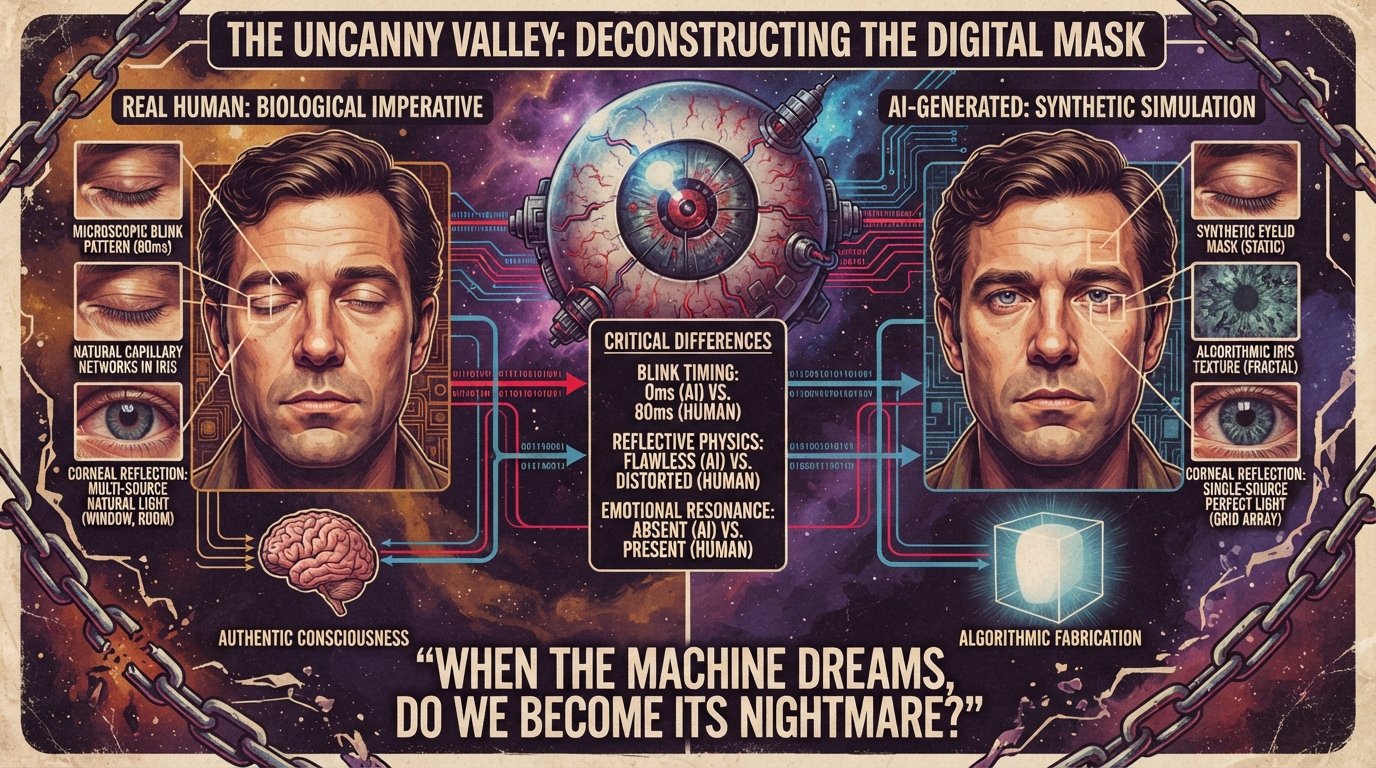
How Can You Tell If a Video Is a Deepfake?
You can spot many deepfakes by watching for unnatural blinking, mismatched lip-sync, distorted hands and ears, inconsistent lighting, and physics errors like objects appearing or disappearing. AI detection tools like NVIDIA’s Synthetic Video Detector and Sensity AI can flag fakes in milliseconds, but compression and adversarial attacks reduce accuracy. No single method is 100% reliable — layer human observation with verification tools and source checks.
Quick Facts
| Item | Details |
|---|---|
| Most Common Fear | A convincing fake video spreads before anyone can verify it, causing harm to reputations, elections, or public safety |
| Who Is Most Affected | Voters, journalists, celebrities, private individuals targeted by non-consensual content, businesses, and anyone who communicates over video |
| Is the Fear Evidence-Based? | Yes — deepfake incidents have been documented in elections, fraud, and disinformation campaigns across multiple countries in 2026 |
| Expert Consensus | Detection is an arms race. No single tool is reliable across all conditions. Compression, adversarial attacks, and novel generation methods degrade detector accuracy. Layered verification — human observation, forensic tools, and source checks — is the practical standard |
| Related Research | IEEE surveys on deepfake detection (2026); NVIDIA Synthetic Video Detector benchmarks; Max Planck Institute facial dynamics research (>95% accuracy); EU AI Act Article 50 transparency rules |
| Where to Learn More | EU AI Act Article 50 guidelines; NIST FATE MORPH 4B (NISTIR 8584); NVIDIA Synthetic Video Detector documentation; Sensity AI and Reality Defender technical reports |
| Updated For | September 2026 |
Why Deepfake Detection Is Getting Harder
Deepfake detection is getting harder because generation technology is improving faster than detection. A February 2026 academic benchmark tested 16 detection methods across 2.6 million images and found an average accuracy of just 21% on Flux Dev, a modern generative model. Detection tools that work well on older datasets fail dramatically on newer generation methods.

Compression is a major challenge. NVIDIA’s Synthetic Video Detector achieves up to 92% accuracy on uncompressed video, but accuracy falls to 87% when videos are compressed by 15% and 82% when compression reaches 50%. Since platforms like YouTube, TikTok, and Instagram routinely compress uploaded videos, real-world accuracy is consistently lower than laboratory results.
Adversarial attacks add another layer of difficulty. Deepfake detectors achieve high accuracy on clean benchmarks but are highly vulnerable to adversarial perturbations, often dropping below 20% area under the curve (AUC) under unseen attacks. Attackers can add nearly imperceptible noise to a fake video to fool detectors.
Visual Red Flags: What to Look For
Eyes and Blinking

AI-generated faces often blink unnaturally. Early models struggled to simulate natural blinking frequency, and some modern models still produce eyes that look unfocused or have inconsistent pupil reflections. Watch for blinking that is too regular, too rare, or mismatched between eyes.
Lip-Sync and Mouth
Lip-sync errors are among the most reliable indicators. The mouth may not fully match the words, or there may be a slight audio-visual delay. Teeth can appear blurred or irregular, and facial expressions may look stiff or disconnected from the speech.
Hands, Ears, and Hair
Hands are a classic weak point for AI generation. Look for fingers that are the wrong number, joints that bend unnaturally, or hands that seem to melt into objects. Ears may blur, shift position, or change shape between frames. Hairlines and jewelry can flicker or detach when the head moves.
Lighting and Shadows
AI video often has inconsistent lighting. Light sources may conflict — for example, a shadow that falls in one direction while the light appears to come from another. Shadows may be too harsh or lack natural gradients. Background objects may have edges that are blurry, warped, or doubled.
Physics and Logic Errors
AI struggles with real-world physics. Watch for objects that appear or disappear, liquids that flow against gravity or inertia, or people who seem to float or slide rather than walk. In one recent example, AI-generated video of a political figure showed limbs that were stiff or warped, with shadows that did not match the light source.
Text and Background Details
Text in the background of AI videos is often garbled, reversed, or unreadable. Logos may be unstable or change between frames. This is because AI models generate text as visual patterns, not as meaningful symbols.
AI Detection Tools: What They Can and Cannot Do
NVIDIA Synthetic Video Detector
NVIDIA’s Synthetic Video Detector, announced at SIGGRAPH 2026, processes 1080p video in as little as 22 milliseconds on RTX systems. It assigns a probability score to each frame indicating whether the footage was AI-generated or manipulated. NVIDIA says the system achieves up to 92% accuracy on uncompressed video, but the company acknowledges it is not a silver bullet and is intended to complement existing editorial verification processes rather than replace them.
Sensity AI
Sensity AI, the world’s first dedicated deepfake detection company, offers a platform that detects digital fingerprints left behind on synthetic media. Its multi-modal detection solution claims 98% accuracy across image, video, and audio modalities. Sensity AI is listed in the NIST Computer Forensics Tools & Techniques Catalog, maintained by the U.S. federal government.
Reality Defender
Reality Defender provides an API-first platform supporting audio, image, video, and document analysis through a single endpoint. It was named a Market Shaper in Gartner’s Emerging Market Quadrant for Deepfake Detection — Startup Vendors as of June 2026. The company has partnered with AU10TIX and 1Kosmos to integrate deepfake detection into identity verification platforms.
Free and Open-Source Tools
Several free tools exist, but their reliability varies. A 2026 study evaluated six publicly accessible tools — including InVID & WeVerify, FotoForensics, Forensically, DecopyAI, FaceOnLive, and Bitmind. The study found that a trained human investigator achieved higher accuracy than every automated classifier, suggesting that human expertise combined with forensic tools outperforms automated detection alone in many cases.
Detection Accuracy Comparison
| Tool | Reported Accuracy | Best Use Case | Limitation |
|---|---|---|---|
| NVIDIA Synthetic Video Detector | 92% (uncompressed), 82% (50% compression) | Real-time newsroom verification | Accuracy drops with compression |
| Sensity AI | 98% (multi-modal) | Enterprise fraud detection | Commercial product; not free |
| Reality Defender | Gartner-recognized | API integration for enterprises | Requires technical integration |
| Max Planck facial dynamics method | >95% average | Research-grade detection | Requires powerful hardware; not real-time |
| Free tools (InVID, FotoForensics, etc.) | Variable; human investigator outperformed classifiers | Journalists, researchers | Not reliable as standalone solutions |
Step-by-Step: How to Check a Suspicious Video
Step 1: Slow Down and Watch Carefully
Play the video at reduced speed or use frame-by-frame analysis. Look for flickering, inconsistent edges, or sudden changes in appearance between frames. AI video often shows “jump” or “shimmer” effects in hair, clothing, or jewelry.
Step 2: Check the Source
Before analyzing the video itself, investigate who posted it. Is the account verified? Does the account have a history of posting similar content? Was the video uploaded during a breaking news event when emotions are high? Disinformation campaigns often exploit moments of crisis or political tension.
Step 3: Cross-Reference with Multiple Sources
A single video is never proof. Search for the same event or claim from multiple independent sources. Established news organizations, official government accounts, and verified journalists are more reliable than anonymous social media posts. If no credible source has reported the event, treat the video as unverified.
Step 4: Run It Through Detection Tools
Upload the video to a detection platform or API. Tools like NVIDIA’s Synthetic Video Detector, Sensity AI, or Reality Defender can provide a probability score. Free tools like InVID & WeVerify can help with reverse image search and metadata analysis. Remember that no tool is 100% accurate — treat the result as one data point, not a verdict.
Step 5: Ask for a Live Challenge
If you are on a video call and suspect the person is a deepfake, ask them to do something AI struggles with. Ask them to wave their hand in front of their face, turn their head quickly, or touch their nose. AI face-swaps often show rendering delays, edge distortion, or mask slippage during rapid movements and occlusion.
Step 6: Verify with Private Information
AI can mimic a person’s appearance and voice, but it cannot know shared secrets. Ask a question only the real person would know — a private memory, an inside joke, or a detail from a past conversation.
Decision Tree: Is This Video Likely a Deepfake?
| Question | If Yes | If No |
|---|---|---|
| Does the video show an event that no credible source has reported? | High suspicion | Continue checking |
| Are there visual artifacts (blinking, lip-sync, hands, lighting)? | High suspicion | Continue checking |
| Was the video posted by an anonymous or unverified account? | High suspicion | Continue checking |
| Does a detection tool flag it as synthetic? | High suspicion | Continue checking |
| Does the person know private information only they would know? | Likely real | Remain cautious |
| Can you verify the event through multiple independent sources? | Likely real | Remain cautious |
What Is Exaggerated vs. Evidence-Based
| Claim | Evidence-Based? | Expert View | What You Should Do |
|---|---|---|---|
| Deepfakes are everywhere and you can’t trust any video | Partially | Deepfakes are growing but not ubiquitous. Most video is still real | Verify before sharing; don’t assume every video is fake |
| AI detection tools can reliably identify any deepfake | No | Detectors fail under compression, adversarial attacks, and novel generation methods | Use tools as one layer; don’t rely solely on them |
| You can always spot a deepfake with your eyes | No | Some visual artifacts remain, but modern deepfakes are increasingly subtle | Combine visual observation with tool-based verification |
| Deepfakes have influenced elections | Yes | Documented incidents in Hungary, Thailand, India, and the U.S. in 2026 | Verify political video through multiple sources |
| EU AI Act labeling will solve deepfake detection | Partially | Labeling helps, but non-compliant content remains | Support enforcement; use platform reporting tools |
| AI can generate a perfect replica of any person | No | AI struggles with physics, occlusion, and consistent identity over long sequences | Use live challenges to test authenticity |
| Watermarking makes detection unnecessary | No | Watermarks can be removed or forged | Combine provenance checks with forensic analysis |
What Experts and Researchers Actually Say
Max Planck Institute for Informatics researchers developed a method that analyzes facial dynamics rather than pixel-level artifacts. Their system uses the FLAME model, which describes facial expressions with 53 mathematical parameters. By comparing a video’s visible facial movements against natural motion patterns learned from over 450 hours of public video, they achieved over 95% average detection accuracy across multiple benchmarks. The method even detected nearly 95% of deepfakes generated by OpenAI’s Sora 2, which previous detectors could not identify.
NVIDIA acknowledges that its detector is not a silver bullet. The company states that human oversight, source verification, and contextual reporting remain essential as generative AI models continue to evolve.
EU regulators have taken the position that transparency is the foundation of trust. As of August 2, 2026, the EU AI Act requires deepfakes to be clearly labeled with visible disclosures and machine-readable marks. Deployers who fail to comply face fines up to €15 million or 3% of global annual turnover.
Sensity AI founder Francesco Cavalli has noted that the line between truth and falsehood is blurring as AI-generated video becomes more realistic. His company’s forensic approach focuses on learning fundamental forensic patterns rather than specific generation artifacts, which helps detection tools remain effective as generation methods change.
What AI Companies Are Doing About It
| Company | Detection Approach | What It Means |
|---|---|---|
| NVIDIA | Synthetic Video Detector (22ms processing; 92% accuracy uncompressed) | Real-time verification for newsrooms and broadcasters |
| Sensity AI | Digital fingerprint detection; 98% multi-modal accuracy | Enterprise-grade forensic analysis |
| Reality Defender | API-first multi-modal detection; Gartner-recognized | Integration into identity verification and fraud prevention |
| SynthID watermarking; content credentials | Embedding provenance data into AI-generated content | |
| Meta | AI-generated content labeling on Facebook and Instagram | Platform-level disclosure |
| TikTok | Mandatory labels for realistic AI-generated content | Platform policy enforcement |
Regulation and Government Response
EU AI Act Article 50
The EU AI Act’s transparency obligations took effect on August 2, 2026. Article 50 requires:
Providers must design AI systems so individuals are informed when interacting with AI and when exposed to AI-generated content. They must apply machine-readable marks to synthetic content.
Deployers must disclose deepfakes with clear and perceivable labels. Deepfakes are defined as AI-generated or manipulated image, audio, or video content that resembles existing persons, objects, places, entities, or events and would falsely appear authentic.
Penalties include fines up to €15 million or 3% of total worldwide annual turnover.
Grace period for marking obligation until December 2026 for generative AI systems placed on the market before August 2, 2026. Deepfakes generated before that date are not subject to mandatory retroactive labeling, though labeling is encouraged.
NIST Guidelines
The National Institute of Standards and Technology (NIST) released NISTIR 8584, a guide for detecting morphing attacks — synthetic images created by fusing different people’s facial photos. The guide is designed to help organizations deploy detection tools and establish operational protocols for handling flagged images. NIST notes that some modern morphing detection algorithms are mature enough for real-world operational use.
U.S. Legislation
The TAKE IT DOWN Act, signed in 2025, criminalizes non-consensual intimate deepfakes and requires platforms to remove them promptly. As of September 2026, no comprehensive federal deepfake detection law exists. State-level laws vary significantly.
How Individuals Can Protect Themselves
For Parents and Educators
Teach students to question video. The “seeing is believing” rule no longer applies. Help children understand that realistic video can be fabricated.
Use live challenges. If a child receives a suspicious video call from someone claiming to be a friend or family member, teach them to ask for a private detail only the real person would know.
Report non-consensual content. If a child is targeted by a deepfake, report it to the platform immediately and contact legal authorities.
For Business Owners
Implement video verification for high-stakes calls. For financial transfers or sensitive communications, use a secondary verification channel (phone call, in-person meeting, or pre-agreed code word).
Train employees on deepfake red flags. Include deepfake awareness in cybersecurity training.
Integrate detection APIs. Platforms like Reality Defender and Sensity AI offer API access for enterprise deployment.
For Everyone
Verify before you share. If a video triggers a strong emotional reaction — anger, fear, urgency — pause. That is exactly what disinformation is designed to do.
Check the source. Anonymous accounts sharing breaking news are less reliable than established news organizations.
Use detection tools. Upload suspicious videos to free tools like InVID & WeVerify or FotoForensics.
Ask for a live challenge. On video calls, ask the person to move their hand in front of their face or turn their head quickly.
Know your rights. In the EU, you have the right to know when content is AI-generated. In the U.S., non-consensual intimate deepfakes are illegal under the TAKE IT DOWN Act.
Latest Developments and Rule Changes (2026)
August 2, 2026: EU AI Act Article 50 transparency rules take effect. Deepfakes must be labeled with visible disclosures and machine-readable marks.
July 2026: NVIDIA announces Synthetic Video Detector at SIGGRAPH 2026, processing 1080p video in 22 milliseconds.
July 2026: Max Planck Institute researchers publish facial dynamics detection method achieving >95% accuracy, including on Sora 2-generated video.
April 2026: Deepfake incidents reported in Hungarian elections and Thai political campaigns.
February 2026: Academic benchmark finds average detection accuracy of just 21% on modern generative models.
2026: Sensity AI listed in NIST Computer Forensics Tools & Techniques Catalog.
Common Questions
1. Can I tell if a video is a deepfake with my eyes?
Sometimes. Visual red flags include unnatural blinking, lip-sync errors, distorted hands, inconsistent lighting, and physics errors. But modern deepfakes are increasingly subtle. Use visual observation as one layer of verification, not your only method.
2. What is the best deepfake detection tool?
No single tool is best for all situations. NVIDIA’s Synthetic Video Detector is fast (22ms) and accurate on uncompressed video (92%). Sensity AI claims 98% multi-modal accuracy. For free options, InVID & WeVerify and FotoForensics are useful starting points. Combine tools with human judgment.
3. Why do detection tools fail on compressed videos?
Compression algorithms remove subtle visual artifacts that detection models rely on. NVIDIA’s detector drops from 92% accuracy on uncompressed video to 82% at 50% compression. Since social media platforms routinely compress uploads, real-world accuracy is lower than lab results.
4. What is the EU AI Act deepfake labeling rule?
As of August 2, 2026, the EU AI Act requires deepfakes to be clearly labeled with visible disclosures and machine-readable marks. Providers and deployers who fail to comply face fines up to €15 million or 3% of global annual turnover.
5. Can I use a live challenge to test if someone is a deepfake?
Yes. Ask the person to wave their hand in front of their face, turn their head quickly, or touch their nose. AI face-swaps often show rendering delays, edge distortion, or mask slippage during rapid movements and occlusion. Also ask a private question only the real person would know.
6. Are deepfakes illegal?
It depends on the jurisdiction. The EU AI Act requires labeling. The U.S. TAKE IT DOWN Act criminalizes non-consensual intimate deepfakes. Some U.S. states have election-specific deepfake laws. As of September 2026, no comprehensive U.S. federal deepfake law exists.
7. How accurate are deepfake detection tools?
Accuracy varies widely. NVIDIA reports 92% on uncompressed video. Sensity AI claims 98% multi-modal accuracy. Max Planck’s facial dynamics method achieves >95%. But a February 2026 benchmark found average accuracy of just 21% on modern generative models. Compression, adversarial attacks, and novel generation methods all reduce accuracy.
8. What should I do if I see a deepfake?
Do not share it. Report it to the platform. If it depicts you or someone you know, contact legal authorities. If it relates to an election or public safety, report it to election officials or relevant authorities. Verify through multiple independent sources before believing or sharing any video.
9. Can deepfakes be detected in real time?
Yes, for some applications. NVIDIA’s detector processes 1080p video in 22 milliseconds on RTX systems, making it fast enough for real-time or near-real-time analysis. Reality Defender offers real-time analysis during live video sessions. However, real-time detection requires integration into the video pipeline and is not available to casual users.
10. Will watermarking solve the deepfake problem?
Watermarking helps but is not a complete solution. Watermarks can be removed, forged, or lost during compression. The EU AI Act requires machine-readable marks, but non-compliant content will still exist. Watermarking is best used as part of a layered verification system that includes forensic analysis and source verification.
Key Takeaways
No single method can reliably detect all deepfakes. Layer human observation, detection tools, and source verification.
Visual red flags include unnatural blinking, lip-sync errors, distorted hands, inconsistent lighting, and physics errors like objects appearing or disappearing.
NVIDIA’s Synthetic Video Detector processes 1080p video in 22 milliseconds but drops from 92% accuracy on uncompressed video to 82% at 50% compression.
A February 2026 benchmark found average detection accuracy of just 21% on modern generative models — the arms race is real.
Max Planck Institute researchers achieved >95% accuracy by analyzing facial dynamics rather than pixel-level artifacts.
The EU AI Act requires deepfake labeling as of August 2, 2026. Fines reach €15 million or 3% of global turnover.
For video calls, ask for a live challenge (wave hand, turn head) and a private detail only the real person would know.
Verify before you share. Deepfakes are designed to trigger emotional sharing. Pause and check the source.
Sensity AI and Reality Defender offer enterprise-grade detection APIs for organizations.
The TAKE IT DOWN Act criminalizes non-consensual intimate deepfakes in the U.S.
Official & Trusted Resources
EU AI Act Article 50 — Transparency Rules — Official European Commission guidelines on deepfake labeling and machine-readable marking. [digital-strategy.ec.europa.eu]
NIST FATE MORPH 4B (NISTIR 8584) — Guide for detecting synthetic morphing attacks. [nist.gov]
NVIDIA Synthetic Video Detector — Real-time AI video verification tool. [nvidia.com]
Sensity AI — Deepfake detection platform; listed in NIST Computer Forensics Catalog. [sensity.ai]
Reality Defender — API-first deepfake detection; Gartner-recognized. [realitydefender.com]
InVID & WeVerify — Free verification toolkit for journalists and researchers. [weverify.eu]
Max Planck Institute for Informatics — Facial dynamics research for deepfake detection. [mpi-inf.mpg.de]
TAKE IT DOWN Act (U.S., 2025) — Criminalizes non-consensual intimate deepfakes. [congress.gov]