
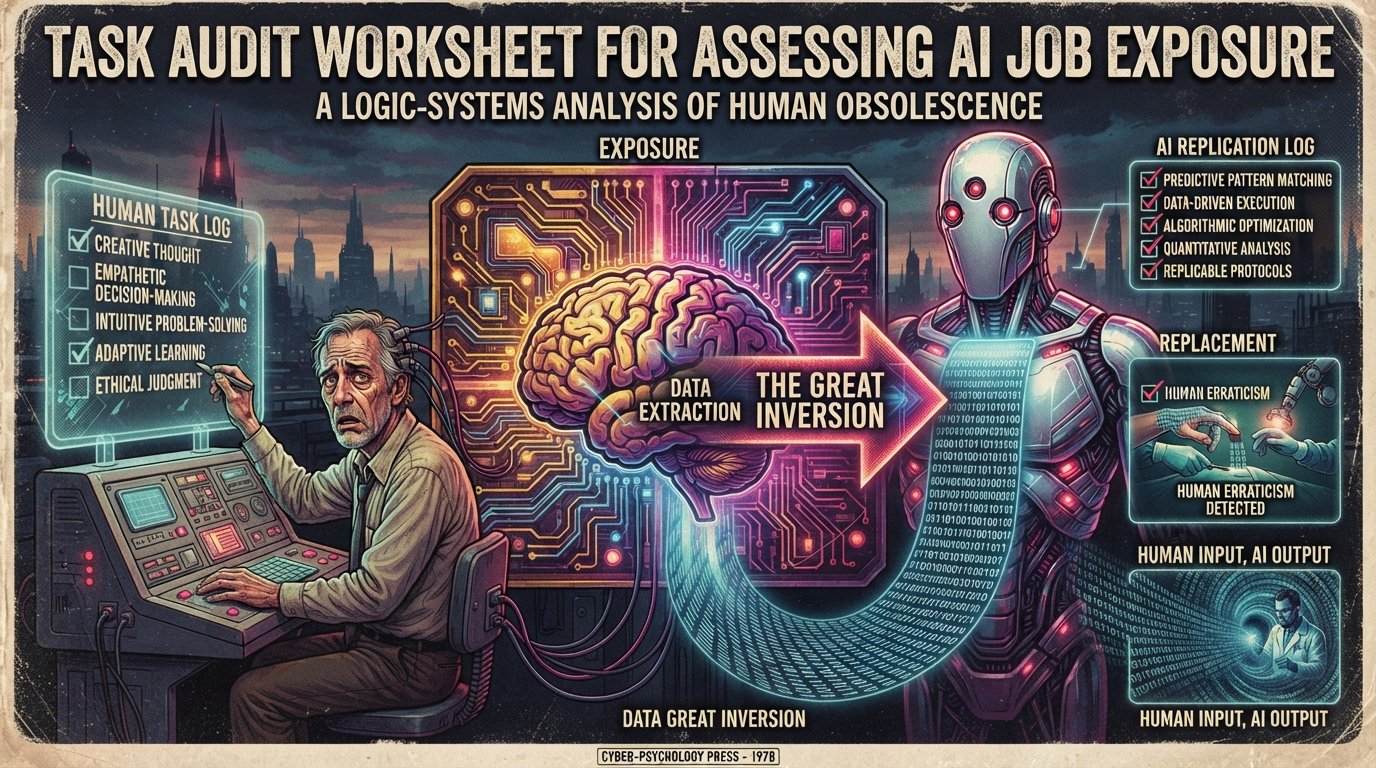
What Should You Do If You Think AI Will Replace Your Role?
If you believe AI will replace your role, do not panic — and do not wait. Start by auditing which of your tasks AI can actually do versus which require human judgment. Then build AI fluency, document your human-intensive contributions, and explore retraining grants. Most jobs are not fully automated; they are being reshaped. The workers who act early adapt faster.
Quick Facts
| Item | Details |
|---|---|
| Most Common Fear | That AI will eliminate your entire role, leaving you without income or career direction |
| Who Is Most Affected | Workers ages 22–25 in AI-exposed fields (19% employment gap), women in administrative roles (86% of most vulnerable group), and workers in routine cognitive roles |
| Is the Fear Evidence-Based? | Partially. AI substitutes tasks, not entire jobs. More than 180,000 corporate job losses have been linked to AI since 2023, but experts find little evidence of mass replacement |
| Expert Consensus | Most jobs will be transformed, not eliminated. The key is adapting your task portfolio toward human-intensive work |
| Related Research | PwC 2026 AI Jobs Barometer, Stanford Digital Economy Lab (August 2026), Atlanta Fed working paper (2026), Challenger Gray & Christmas layoff tracking, Yale Budget Lab analysis |
| Where to Learn More | US Department of Labor AI grants, National Workforce Transition Fund Act of 2026, NIST AI Risk Management Framework, EU AI Act |
| Updated For | September 2026 |
What to Do First: A Direct Answer
If you believe AI will replace your role, the most effective response is a structured assessment and action plan — not a rushed career change.
Here is the sequence that works:
Step 1: Determine whether AI can actually replace your entire job or only parts of it.
Step 2: Identify which of your tasks are most exposed and which are protected.
Step 3: Build AI fluency in your current role, not from scratch.
Step 4: Document and expand your human-intensive contributions.
Step 5: Explore retraining programs, legal protections, and financial safety nets.
Step 6: Set a decision timeline: three months, six months, one year.
The rest of this article walks through each step with evidence, tools, and specific programs you can use.
Step 1: Determine If AI Can Actually Replace Your Entire Job
AI substitutes tasks, not entire jobs. This distinction matters more than any headline about AI layoffs.
McKinsey senior partner Alexis Krivkovich has said that while AI is technically capable of automating 57% of work-related activities, that percentage is spread across “pieces and parts” of various jobs and responsibilities across an organization. “It’s very few jobs that are actually entirely automated away by the current AI and robotics technology that’s out there,” she said.
A National Bureau of Economic Research working paper found that eight in 10 senior business executives say AI has had no impact at all on either their organizations’ employment or productivity. MIT IDE researchers have argued that automation should be understood as a spectrum — no automation, partial automation, or full automation — rather than a binary switch, and that tasks with many subtasks and high complexity favor only limited automation.
How to Audit Your Own Role
Make a list of the ten most important things you do at work. For each task, assign a category:
Fully automatable today: Routine data entry, basic document drafting, standard calculations, scheduling.
Partially automatable: Research summaries, first-draft writing, code generation, image editing.
AI-assisted but human-led: Strategic planning, client relationship management, complex problem-solving.
Human-only: Ethical judgment, physical care, emotional support, novel creative direction, trust-building.
Count how many of your ten tasks fall into the first two categories. If most do, your role is genuinely exposed. If most fall into the last two, your role is more resilient than you may fear.
Comparison Table: Task Types and AI Exposure
| Task Category | AI Capability Today | Risk Level | What to Do |
|---|---|---|---|
| Routine data processing | High — AI handles well | High | Automate it yourself and move to higher-value work |
| Standard writing and editing | Medium-High — AI drafts, human refines | Medium | Learn to direct AI tools; focus on judgment and voice |
| Code generation | Medium — AI writes functions, humans design systems | Medium | Shift toward architecture, review, and debugging |
| Complex negotiation | Low — AI lacks emotional intelligence | Low | Double down; these skills are appreciating |
| Physical care and skilled trades | Very Low — robotics lags far behind | Very Low | Safe near-term; growing demand |
Step 2: Identify Which Tasks Are Most Exposed
AI is most effective at reproducing codified knowledge — formal, standardized, documented information. It is less effective at replicating tacit knowledge — the practical wisdom acquired through mentorship, repetition, and real-world experience.
Stanford Digital Economy Lab research found that employment among workers ages 22–25 in highly AI-exposed occupations stands about 19% below where it would be if it had kept pace with similarly aged workers in less-exposed occupations. The adjustment is happening primarily through reduced hiring, not increased layoffs.
PwC’s 2026 AI Jobs Barometer, based on more than one billion job ads, found that AI is creating a “two-track” labor market. “Professionalised” roles — where AI amplifies expert judgment — are seeing twice the job growth and 42% faster salary growth than “democratised” roles, where AI makes the work itself easier for non-experts.
Decision Tree: How Exposed Is Your Role?
Does your work involve mostly routine, rule-based tasks?
→ Yes: Higher risk. Start building judgment-based skills immediately.
→ No: Continue to the next question.
Can AI produce 70%+ of your deliverables without human correction?
→ Yes: High risk. Your output is largely codified.
→ No: Continue.
Does your role require you to make decisions with incomplete information?
→ Yes: Lower risk. AI struggles with ambiguity.
→ No: Moderate risk. Seek stretch assignments that build judgment.
Do you work directly with people in ways that require trust, empathy, or physical presence?
→ Yes: Lower risk. These are structural moats.
→ No: Assess whether you can add a human-facing component to your role.
Step 3: Build AI Fluency in Your Current Role
Workers with AI skills earn a 62% wage premium over peers in identical roles without those skills, according to PwC’s 2026 analysis. That premium rose from 57% the year before and has more than doubled from 25% two years earlier. Jobs requiring specific AI skills are growing almost eight times faster than the total job market — 69% growth compared with 9%.
The 90-Day AI Fluency Plan
Months 1: Apply AI to your current work. Choose one small, repetitive task. Learn to use an AI tool to handle it. Document the time saved and the quality difference.
Months 2–3: Build and document real projects. Use free or low-cost AI tools to create a portfolio piece in your field — a data analysis, a written report, a workflow improvement.
Months 3–6: Position yourself for AI-adjacent responsibilities. Volunteer to lead AI adoption in your team. Train colleagues. Become the person who knows where AI works and where it fails.
This is not about becoming a machine learning engineer. It is about becoming the person on your team who can direct AI effectively and evaluate its output critically.
Step 4: Document and Expand Your Human-Intensive Contributions
PwC found that entry-level roles most exposed to AI are now seven times more likely to require traditionally senior skills such as leadership, strategic decision-making, and team building. Openings for these “seniorised” entry-level roles grew 35% since 2019, while other entry-level roles declined 10%.
The skills that are appreciating in value are:
Judgment: Weighing trade-offs when data is ambiguous.
Leadership: Motivating and coordinating people toward a goal.
Creativity: Generating novel approaches AI cannot derive from training data.
Relationship management: Building trust, negotiating, navigating human dynamics.
Ethical reasoning: Recognizing when an AI recommendation is technically correct but morally wrong.
What to Document
Keep a running record of moments when your human judgment changed an outcome. Examples:
“AI recommended X, but I recognized Y based on context it missed.”
“I resolved a client concern that an automated response would have escalated.”
“I designed a workflow that combined AI output with human review to catch errors.”
This documentation serves two purposes: it builds your case for promotion or retention, and it clarifies for you which parts of your role are genuinely AI-proof.
Step 5: Explore Retraining Programs and Financial Safety Nets
If your role is genuinely at high risk, do not wait for a layoff to start exploring options. Several programs now exist specifically for AI-related workforce transitions.
Government Programs (United States)
US Department of Labor AI Grants: The DOL launched $50 million in national grants to retrain dislocated workers into AI-enabled careers, with a 36-month performance period.
EDA AI Upskill Accelerator Pilot: The Economic Development Administration made available approximately $25 million in funding to upskill American workers in using AI.
National Workforce Transition Fund Act of 2026: Proposed legislation to establish a National Workforce Transition Board to support training and education activities for workers affected by AI adoption.
AI Ready Ohio: Launched in November 2025, this program provides statewide online training tracks and has reached thousands of workers in Cincinnati, Columbus, and other regions.
Government Programs (International)
EU Union of Skills: The European Commission supports skills development and reskilling through the Union of Skills initiative and the European Globalisation Adjustment Fund for Displaced Workers.
UK AI Skills Boost: Launched in June 2025 with an initial goal of 7 million training opportunities, expanded in January 2026 to 10 million by 2030, offering free training in practical AI skills.
Canada: A CAD 50 million federal contribution program funds sectoral organizations to deliver skills training for workers in industries potentially disrupted by AI.
How to Access These Programs
Visit your state or national labor department website.
Search for “AI workforce training” or “dislocated worker grants.”
Contact your local workforce development board.
Ask your employer about tuition reimbursement or training partnerships.
Step 6: Know Your Legal Rights
If your employer cites AI as a reason for layoffs, you have certain protections depending on your jurisdiction.
United States: The US currently relies on voluntary frameworks. Executive Order 14409 (June 2026) explicitly avoids mandatory licensing or pre-clearance requirements for AI model development. There is no federal law requiring employers to retrain workers displaced by AI.
European Union: The EU AI Act classifies AI systems used in employment decisions — recruitment, selection, promotion, termination, and performance monitoring — as high-risk. Companies must check regularly for safety risks and bias and keep detailed technical records. However, implementation of these obligations has been delayed to December 2027.
What this means for you: In the US, your protection comes primarily from your own preparation and from unemployment insurance if you are laid off. In the EU, you have stronger procedural rights regarding how AI is used in employment decisions. Regardless of where you live, document your contributions and keep your resume current.
The “AI Washing” Problem
OpenAI CEO Sam Altman has said companies are “AI washing” their layoffs — blaming AI for cuts driven by other business factors. Apollo Global Management’s chief economist wrote that he sees “zero evidence of job losses because of AI,” citing ADP employment data.
A Yale Budget Lab analysis found no significant differences in the rate of occupational change or length of unemployment for individuals in AI-exposed jobs from ChatGPT’s release through March 2026. A survey of 600 HR leaders who made AI-driven layoffs found that only 8.4% said the restructuring had delivered as promised and that they would do the same again.
This matters because it means: your layoff may not be about AI at all. And if it is not, your skills may be more transferable than the announcement suggests.
Step 7: Set a Decision Timeline
Uncertainty is stressful. A timeline converts anxiety into action.
Next 30 days:
Complete your task audit (Step 1).
Choose one AI tool to learn.
Update your resume with measurable achievements.
Next 90 days:
Apply AI to at least one work task weekly.
Document three instances where your judgment changed an outcome.
Research one retraining program or course.
Next 6 months:
Have a conversation with your manager about your role’s trajectory.
Build or strengthen one professional relationship outside your immediate team.
Assess whether your role is becoming more or less exposed.
Next 12 months:
Reassess. If your risk has increased, activate your transition plan.
If your risk has decreased, consider deepening your expertise or mentoring others.
Comparison Table: What People Fear vs. What to Do
| Fear | Realistic Near-Term Risk | What the Evidence Shows | What You Should Do |
|---|---|---|---|
| My whole job will disappear | Low for most roles | AI automates tasks, not entire jobs; only 6% of US jobs projected automated by 2030 | Audit your tasks; most roles will transform, not vanish |
| I will be laid off and not rehired | Moderate | 55% of leaders regret AI layoffs; half will be reversed | Keep skills current; monitor rehiring trends in your industry |
| My skills will become worthless | Low to Moderate | Human judgment, creativity, and leadership are appreciating | Build AI fluency and human-intensive skills simultaneously |
| I cannot afford to retrain | Real concern | Government grants and employer programs exist | Explore DOL, EDA, and state-level programs; ask about tuition reimbursement |
| AI will replace entry-level roles entirely | Moderate to High | Entry-level hiring has declined; roles are “seniorising” | Seek mentorship; ask for stretch assignments; build judgment early |
Common Questions
How do I know if my job is actually at risk from AI?
Audit your tasks, not your job title. If most of your work involves routine, codified tasks that AI can replicate, your risk is higher. If your work requires judgment, relationships, or physical presence, your risk is lower. McKinsey estimates AI can automate 57% of work activities, but those activities are spread across many different jobs.
Should I quit my job and retrain before I am laid off?
Not necessarily. Most jobs are being reshaped, not eliminated. Retraining while employed is safer than quitting. If you do decide to transition, explore government grants and employer tuition programs first. The evidence suggests adaptation within your current field is often more effective than starting over.
What are the most AI-resistant skills I can learn?
Judgment, leadership, creativity, relationship management, and ethical reasoning. PwC found that AI-exposed entry-level roles are seven times more likely to require these skills. They are the hardest for AI to replicate because they depend on context, experience, and human connection.
Is there financial help if I lose my job to AI?
Yes. The US Department of Labor has $50 million in grants for dislocated workers. The EDA offers $25 million through its AI Upskill Accelerator. Many states have programs like AI Ready Ohio. The proposed National Workforce Transition Fund Act would create additional support. Contact your state labor department for local options.
How long do I have before AI replaces my role?
The Atlanta Fed found little evidence of near-term aggregate employment declines, suggesting a gradual transition. But entry-level hiring is already affected. The honest answer is: no one knows precisely. The best strategy is to prepare now rather than wait for certainty.
What if my company says AI is replacing me but I think it is really cost-cutting?
You may be right. Sam Altman and economists have acknowledged “AI washing” — companies blaming AI for layoffs driven by other factors. A Yale Budget Lab analysis found no significant unemployment duration differences for AI-exposed jobs. If you are laid off, your skills may be more transferable than the announcement implies.
Should I tell my employer I am worried about AI replacing my role?
Yes, framed constructively. Say: “I want to make sure I am building the skills this team will need in two years. Can we talk about where my role is heading?” This positions you as proactive rather than anxious. It also gives you information you need to plan.
What is the single most important thing I can do this week?
List your ten most important work tasks. For each, write whether AI can do it today, assist with it, or cannot touch it. This simple audit will tell you more about your actual risk than any headline.
Are AI companies doing anything to help displaced workers?
Major AI labs publish safety research and some support workforce initiatives, but their primary focus is capability development. The World Economic Forum’s Reskilling Revolution aims to reach 1 billion people with better skills access. More than 25 technology companies have pledged to support 120 million workers with AI access and training.
What if I am already unemployed because of AI?
Focus on three things: apply for unemployment insurance immediately, contact your state workforce development board about dislocated worker grants, and begin documenting your transferable skills. The average AI-attributed layoff is being reversed at a higher rate than previous layoff cycles — your experience may be more valuable than the current market suggests.
Key Takeaways
AI replaces tasks, not entire jobs. Most roles will be transformed, not eliminated.
Audit your ten most important tasks to understand your actual exposure.
Workers with AI skills earn a 62% wage premium; AI job postings are growing eight times faster than the overall market.
The labor market is splitting into “professionalised” roles (AI amplifies expertise) and “democratised” roles (AI simplifies work). Aim for the first track.
Entry-level roles are “seniorising” — seven times more likely to require leadership and judgment.
Government retraining programs exist: DOL $50M grants, EDA $25M AI Upskill Accelerator, state programs like AI Ready Ohio.
“AI washing” is real: many AI-attributed layoffs are reversed or driven by other factors. Your skills may be more transferable than announcements suggest.
The best time to prepare is before you are forced to. Set a 30-90-180-365 day timeline and start now.
Official & Trusted Resources
US Department of Labor: AI-enabled career grants and dislocated worker programs
US Economic Development Administration: AI Upskill Accelerator Pilot Program
National Workforce Transition Fund Act of 2026 (S. 5055): Proposed federal transition support
PwC: 2026 AI Jobs Barometer (analysis of 1 billion+ job ads)
Stanford Digital Economy Lab: Research on AI and entry-level employment
Atlanta Federal Reserve: Working Paper 2026-4 on AI, productivity, and workforce
Challenger, Gray & Christmas: Monthly layoff tracking data
Yale Budget Lab: Analysis of AI exposure and unemployment duration
NIST: AI Risk Management Framework (AI RMF 1.0)
EU AI Act: Regulation (EU) 2024/1689
World Economic Forum: Reskilling Revolution Initiative
MIT IDE: Economics of Human and AI Collaboration (arXiv working paper)