

Can AI Really Replace Human Jobs? The Honest Answer
AI is replacing specific tasks and some entry-level jobs, not entire occupations wholesale. Goldman Sachs estimates AI could displace 6–7% of U.S. workers over a decade, while the IMF reports 40% of global jobs are exposed—exposure meaning tasks can be automated, not that jobs will disappear. The honest answer: AI replaces tasks within jobs, and the impact falls hardest on entry-level workers.
Quick Facts
| Item | Details |
|---|---|
| Most Common Fear | That AI will eliminate entire career paths, especially entry-level white-collar roles |
| Who Is Most Affected | Workers aged 22–25 in AI-exposed occupations; computer programmers, customer service representatives, data entry keyers, financial analysts |
| Is the Fear Evidence-Based? | Partially. Task automation is documented and accelerating; wholesale job elimination is slower and more uneven than headlines suggest |
| Expert Consensus | AI will cause meaningful disruption but is unlikely to trigger a “job apocalypse”; new roles will emerge; entry-level workers face the greatest near-term challenge |
| Related Research | Stanford Digital Economy Lab (Aug 2026); Goldman Sachs (2026); IMF (2026); Challenger, Gray & Christmas (June 2026); WEF Future of Jobs (2025–2026) |
| Where to Learn More | Stanford Digital Economy Lab; Goldman Sachs Research; IMF; Challenger, Gray & Christmas; WEF; Anthropic Economic Index |
| Updated For | September 2026 |
What Is Actually Happening Right Now?
AI is automating tasks and reshaping hiring patterns, not eliminating entire occupations. The most rigorous evidence comes from Stanford University’s Digital Economy Lab, which found that employment for workers ages 22 to 25 in the most AI-exposed occupations is now 19% below their peers in less-exposed fields—up from 13% a year earlier. The researchers analyzed anonymized ADP payroll data and used Anthropic’s Economic Index to measure how occupations actually use AI.
Challenger, Gray & Christmas reported that U.S. employers attributed 87,714 job cuts to AI through mid-2026, surpassing the 54,836 in all of 2025. AI was cited as the top reason for layoffs for three consecutive months.
But Challenger’s Andy Challenger offered a measured view: “AI isn’t yet the jobpocalypse some predicted. Like spreadsheets and email before it, the technology will ultimately make workers more productive, but our data shows companies are already acting on it, citing AI for more cuts than any other reason.”
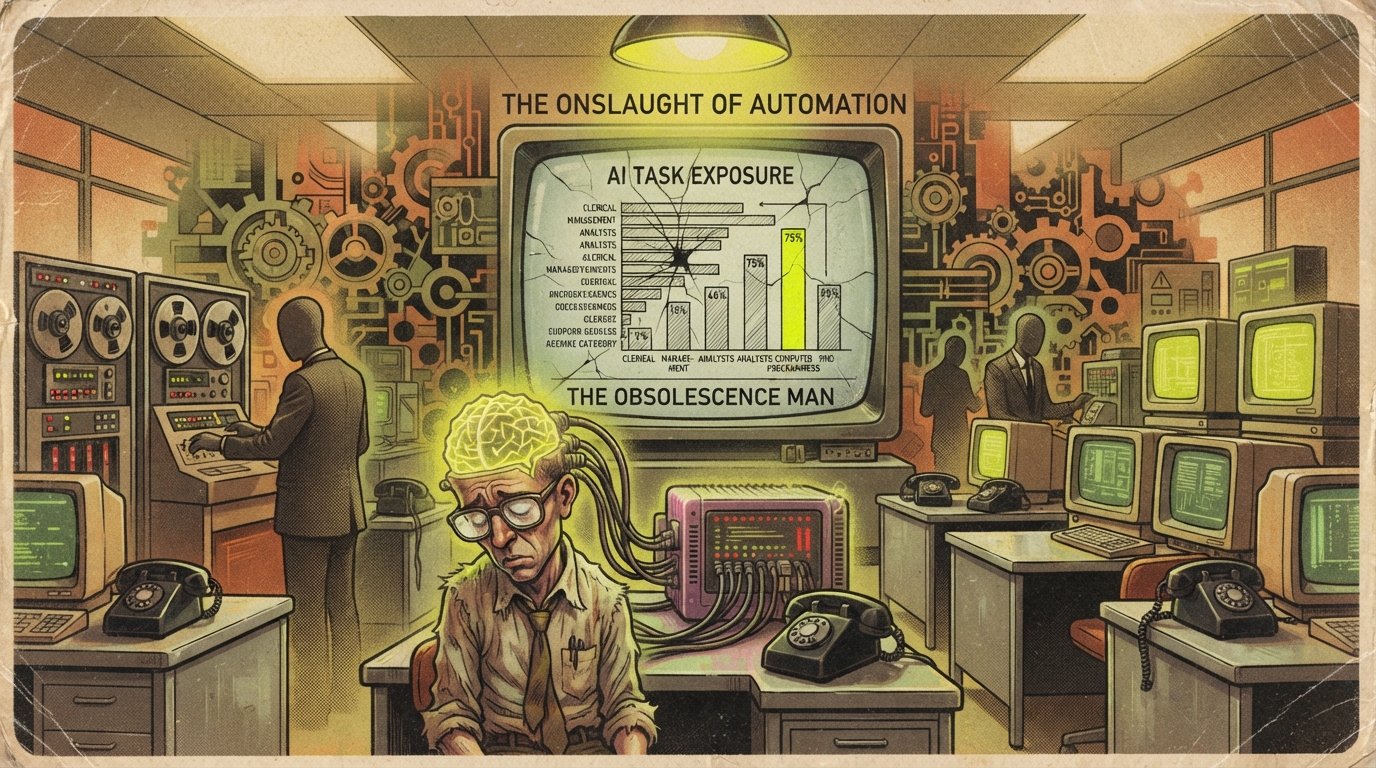
OpenAI CEO Sam Altman said companies were “AI washing” their layoffs—blaming AI for decisions driven by other business factors. Apollo Global Management’s chief economist Torsten Sløk wrote that he sees “zero evidence of job losses because of AI,” citing the ADP National Employment Report.
What the Data Shows: Task Automation vs. Job Elimination
AI is replacing tasks, not whole jobs. A job consists of many tasks. AI may take some, but humans still need to take responsibility, learn on the job, and adapt. Indeed’s data shows that AI-exposed occupations saw advertised pay grow 46% since 2021, while the entry-level share of postings in those occupations fell from 29% to 10%.
The Numbers
| Metric | Finding | Source |
|---|---|---|
| U.S. job cuts attributed to AI (2026) | 87,714 | Challenger, Gray & Christmas |
| Entry-level employment decline (ages 22–25) | 19% below trend | Stanford Digital Economy Lab |
| Senior hiring at AI-adopting companies | +6.7% over five years | Stanford/King’s College London |
| Junior hiring at AI-adopting companies | -3% over five years | Stanford/King’s College London |
| Call center employment (U.S.) | 39% below trend | Goldman Sachs |
| AI-attributed share of total 2026 layoffs | 22% | Challenger, Gray & Christmas |
Sources: Stanford Digital Economy Lab (Aug 2026); Challenger, Gray & Christmas (June 2026); Goldman Sachs (2026)
The Stanford and King’s College London study analyzed 1.25 billion job postings and 154 million employment records across 41 countries. It found that AI is “labour-saving for junior workers and labour-expanding for seniors in exposed occupations.”
The “Seniorization” Effect
Companies adopting AI are not eliminating jobs—they are restructuring them. Employment in computer-related and mathematical occupations increased by 0.8 percentage points at AI-adopting companies, but growth was concentrated among senior employees rather than junior talent.
A PwC analysis of 2.4 million entry-level roles found that AI-exposed entry-level jobs requiring judgment and leadership grew 35% since 2019, while other entry-level roles declined 10%. The entry-level is not disappearing. It is being transformed into something more demanding.
Which Jobs Are Most at Risk?
The jobs most at risk are those dominated by repetitive digital tasks. Anthropic’s 2026 labor market report introduced “Observed Exposure”—measuring how frequently AI is actually used to automate tasks in real professional settings.
High-Risk Occupations
| Occupation | Observed Exposure | What AI Does |
|---|---|---|
| Computer Programmers | ~75% task coverage | Code generation, debugging, documentation |
| Customer Service Representatives | ~67% task coverage | Scripted responses, ticket triage, chat support |
| Data Entry Keyers | ~67% task coverage | Reading documents, entering data |
| Financial Analysts | High exposure | Data analysis, report generation |
| Medical Record Specialists | High exposure | Coding, categorization, record management |
| Market Research Analysts | High exposure | Data synthesis, trend identification |
Source: Anthropic Economic Index (2026)
Low-Risk Occupations
Anthropic’s research found that 30% of jobs have almost zero risk of AI elimination. These roles share common denominators: physical work, in-person service, and real-world manipulation.
| Occupation | Why It’s Protected |
|---|---|
| Cooks | Physical dexterity, real-time sensory judgment |
| Motorcycle Mechanics | Hands-on repair, diagnostic intuition |
| Lifeguards | Real-time physical intervention, emergency response |
| Bartenders | Social interaction, physical service |
| Dishwashers | Physical labor, in-person work |
| Dressing Room Attendants | Personal service, physical presence |
What Do Experts Actually Predict?
Expert predictions span an extraordinary range. Goldman Sachs takes a measured view: AI could displace around 6–7% of U.S. workers over roughly a decade. The IMF estimates that 40% of global jobs are exposed to AI, rising to 60% in advanced economies—but exposure can also bring productivity gains, meaning some affected jobs could become more productive rather than simply disappear.
The World Economic Forum projects that 170 million new jobs will be created and 92 million displaced by 2030—a net gain of 78 million, but a churn of 262 million roles.
The Range of Expert Opinion
| Expert / Institution | Prediction | Timeframe |
|---|---|---|
| Goldman Sachs | ~6–7% of U.S. workers displaced | 10 years |
| IMF | 40% of global jobs exposed; 60% in advanced economies | Current |
| World Economic Forum | 170M new jobs, 92M displaced (net +78M) | By 2030 |
| Stanford Digital Economy Lab | Entry-level employment 19% below trend | Current |
| Dario Amodei (Anthropic CEO) | Up to 50% of entry-level white-collar jobs disrupted | 1–5 years |
| Yann LeCun (Meta) | Idea AI will erase 20% of jobs is “ridiculously stupid” | Ongoing |
| Daron Acemoglu (MIT) | AI will replace more jobs than it creates short-term; losses won’t be catastrophic | 5–10 years |
The Optimist View
Yann LeCun, former Meta AI chief and Turing Award winner, called predictions of mass white-collar unemployment “extremely destructive.” He said the idea that AI could erase as many as 20 percent of jobs is “ridiculously stupid,” reasoning that it will take at least 15 years for AI technologies to reach their full productive potential.
The Alarmist View
Anthropic CEO Dario Amodei warned in 2025 that AI could wipe out half of all entry-level white-collar jobs and push unemployment as high as 20% within five years. He has since revisited that prediction, citing the Jevons Paradox—the idea that increased efficiency can increase demand.
The Balanced View
Goldman Sachs economists concluded that AI will cause “meaningful labour displacement” but expect “labour market headwinds will be temporary,” with new industries and occupations absorbing workers over time. Yale’s Budget Lab found no clear economy-wide connection between AI adoption and employment or unemployment in its June 2026 analysis, though it noted that the biggest effects may still lie ahead.
What Is Exaggerated vs. Evidence-Based
| Fear | Realistic Near-Term Risk? | Expert View | What You Can Do |
|---|---|---|---|
| “AI will replace all jobs within 5 years” | Low | Goldman Sachs: fears of mass unemployment are exaggerated; new roles will emerge | Focus on adaptation, not panic |
| “AI will replace entire occupations” | Moderate | Anthropic: AI automates tasks, not entire professions | Identify which of your tasks are automatable |
| “Entry-level jobs will disappear entirely” | High | Stanford: entry-level employment 19% below trend in AI-exposed roles | Build senior-level skills early |
| “All white-collar jobs are doomed” | Moderate | Goldman Sachs: white-collar sectors hit hardest, but senior roles remain stable | Develop judgment, leadership, client-facing skills |
| “AI will create more jobs than it destroys” | Uncertain | WEF: net gain projected, but churn of 262 million roles | Prepare for transitions |
| “Physical jobs are completely safe” | Low-Moderate | Anthropic: 30% of jobs have near-zero exposure, mostly physical | Recognize long-term automation trends |
What Companies Are Doing About It
Companies are deploying reskilling, redeployment, and AI training programs—though efforts vary widely. Verizon announced a $70 million investment in “Verizon AI Skills for America,” offering free AI training from IBM, Google, Microsoft, Anthropic, Coursera, and OpenAI through an online portal, with community partners including Goodwill Industries International and the Local Initiatives Support Corporation providing additional training and career support.
| Company | Action Taken |
|---|---|
| Verizon | $70 million investment in free AI training for job seekers, displaced workers, and small businesses |
| JPMorgan Chase | CEO Jamie Dimon confirmed “huge redeployment plans” for displaced workers |
| Microsoft | Partnered with Anthropic as anchor partners in a nonprofit reskilling organization |
| Workday | Developing “job architecture for the next decade” based on AI impact research |
| McKinsey | Employing 25,000 AI agents alongside 40,000 humans |
A 2026 survey found that 62% of employers provided on-the-job AI training, 56% updated role profiles with AI skills, and 55% hired for AI-specific roles. However, only 33% reported redesigning career paths and mobility strategies.
New Roles Being Created
AI is creating entirely new categories of work. Emerging roles include:
AI engineers and machine learning specialists
Prompt engineers and AI interaction designers
AI safety specialists and bias auditors
Data center field technicians
LLM application engineers
AI ethics officers
These specialized roles command an average 56% wage premium.
Regulation and Government Response
Regulation is emerging but remains fragmented. The EU AI Act, which enters into force in August 2026, focuses primarily on AI safety and transparency rather than direct job protections. The European Commission adopted a Communication on a Quality Jobs Roadmap, announcing a proposal for a Quality Jobs Act by the end of 2026.
In the U.S., NIST is integrating AI skills and roles into its workforce framework, adding a new skill competency area for artificial intelligence security. The Workforce for AI Trust Act would authorize NIST to support education and workforce development activities.
How to Protect Yourself
The most effective protection is building skills AI cannot easily replicate while learning to use AI tools yourself.
Step 1: Assess Your Task Exposure
| Question | If Yes | If No |
|---|---|---|
| Does your job primarily involve repetitive digital tasks? | High risk—start planning transition | Continue to Step 2 |
| Is your work language-heavy (writing, analysis, communication)? | Moderate-high risk—build complementary skills | Continue to Step 3 |
| Does your role require physical presence or real-time human interaction? | Lower risk—but stay informed | Continue to Step 4 |
| Does your role require judgment, leadership, or complex decision-making? | Lower risk—double down on these skills | Assess specific tasks |
Step 2: Build AI Literacy
Use AI tools extensively. This teaches you what AI can and cannot do, and what you, as a human, are uniquely better at. Indeed’s data shows AI-exposed occupations saw advertised pay grow 46% since 2021—the wage premium for AI skills is real.
Step 3: Develop Human Skills AI Cannot Replicate
The World Economic Forum’s Future of Jobs Report puts analytical thinking at the top of the core-skills list, with seven in ten employers calling it essential. Skills that remain difficult for AI:
Judgment — deciding what matters
Contextualization — understanding why something matters
Responsibility — taking ownership of outcomes
Innovation — creating in the face of the unexpected
Empathy — understanding others’ needs
Negotiation — achieving outcomes through human interaction
Step 4: Shift from “Typist” to “Architect”
AI can write code, emails, and reports. Own the “why,” not just the “how.” Professionals should shift from executing tasks to owning outcomes.
Common Questions
1. Will AI actually replace human jobs?
AI is replacing specific tasks and some entry-level jobs, not entire occupations. Goldman Sachs estimates 6–7% of U.S. workers could be displaced over a decade. The WEF projects a net gain of 78 million jobs by 2030, though with significant churn.
2. How many jobs has AI replaced in 2026?
U.S. employers attributed 87,714 job cuts to AI through mid-2026, up from 54,836 in all of 2025. However, not all AI-attributed layoffs are actually caused by AI. OpenAI CEO Sam Altman said companies were “AI washing” their layoffs.
3. Are entry-level jobs disappearing because of AI?
Entry-level hiring has declined 6–13% in AI-exposed occupations. Employment for workers aged 22–25 is 19% below trend. However, AI-exposed entry-level roles that require senior-level skills grew 35% since 2019.
4. What jobs are safest from AI?
Physical, hands-on jobs requiring real-time human interaction are safest. Anthropic found 30% of jobs have near-zero AI exposure—including cooks, mechanics, lifeguards, bartenders, and tradespeople.
5. Is the fear of AI job loss exaggerated?
Partially. Task automation is real and accelerating. But predictions of mass unemployment are not supported by current data. Goldman Sachs and the IMF both report that economy-wide displacement remains moderate.
6. Why are entry-level jobs hit hardest?
Entry-level roles involve structured, documented tasks that AI can learn from textbooks and procedures. Tacit knowledge—built through experience and mentoring—is harder for AI to replace. Stanford research shows employment for workers aged 22–25 in AI-exposed roles is 19% below trend.
7. Will AI create new jobs?
Yes. New roles are emerging in AI engineering, AI safety, prompt engineering, data center operations, and AI ethics. These roles command a 56% wage premium. AI-related job postings surged 70.5% in 2025 relative to 2024.
8. What is “AI washing” in layoffs?
AI washing is when companies attribute layoffs to AI when other factors are at play. OpenAI CEO Sam Altman said companies were doing this in 2026. Apollo’s chief economist said he sees “zero evidence of job losses because of AI.”
9. Which industries are most affected by AI layoffs?
Tech, customer service, call centers, software publishing, management consulting, and advertising services are most affected. Goldman Sachs reports call center employment is 39% below trend in the U.S.
10. How can I protect my job from AI?
Build AI literacy, develop human skills (judgment, empathy, leadership), shift from task execution to outcome ownership, and stay adaptable. Continuous learning is the new job security.
Key Takeaways
AI replaces tasks, not entire jobs—at least for now. Computer programmers have 75% task coverage, but the role itself is evolving rather than disappearing.
Entry-level workers are hit hardest. Employment for ages 22–25 in AI-exposed roles is 19% below trend; entry-level software hiring dropped 20%.
White-collar knowledge work is most exposed. Programmers, customer service reps, data entry keyers, financial analysts, and market researchers face the highest risk.
Physical, hands-on jobs are safest. Anthropic found 30% of jobs have near-zero AI exposure—cooks, mechanics, lifeguards, bartenders, and tradespeople.
Goldman Sachs estimates 6–7% of U.S. workers could be displaced over 10 years. The IMF reports 40% of global jobs are exposed, but exposure does not equal elimination.
The WEF projects net job gains by 2030—170 million created, 92 million displaced—but with massive churn of 262 million roles.
“AI washing” complicates the picture. Not all AI-attributed layoffs are actually caused by AI, according to experts and company leaders.
Companies are investing in reskilling. Verizon committed $70 million; Microsoft and Anthropic are anchor partners in a reskilling nonprofit.
AI literacy and human skills are your best protection. Judgment, empathy, leadership, and creativity remain difficult for AI to replicate.
The transition is real, uneven, and faster than previous shifts. Adaptability is the new job security.
Official & Trusted Resources
Research and Data
Stanford Digital Economy Lab: “Canaries in the Coal Mine?” (Aug 2026) — digitaleconomy.stanford.edu
Goldman Sachs Research: AI and Labor Markets (2026) — goldmansachs.com
IMF: Annual Report 2026 — imf.org
Challenger, Gray & Christmas: Job Cuts Report — challengergray.com
World Economic Forum: Future of Jobs Report 2025–2026 — weforum.org
Anthropic: Economic Index — anthropic.com
Government and Regulatory
NIST: AI Risk Management Framework — nist.gov
EU AI Act — eur-lex.europa.eu
Federal Trade Commission: AI and Consumer Protection — ftc.gov
Workforce Development
Verizon AI Skills for America — verizon.com
Indeed Hiring Lab Labor Market Outlook Survey Q3 2026 — indeed.com